
Anisakis in cod: what the law requires from restaurants in Spain
Royal Decree 1420/2006 requires fish to be frozen at -20 ºC for 24 hours. If the anisakis is dead there is no poisoning, but the allergy risk remains.
English · Original discussion in Spanish · Published
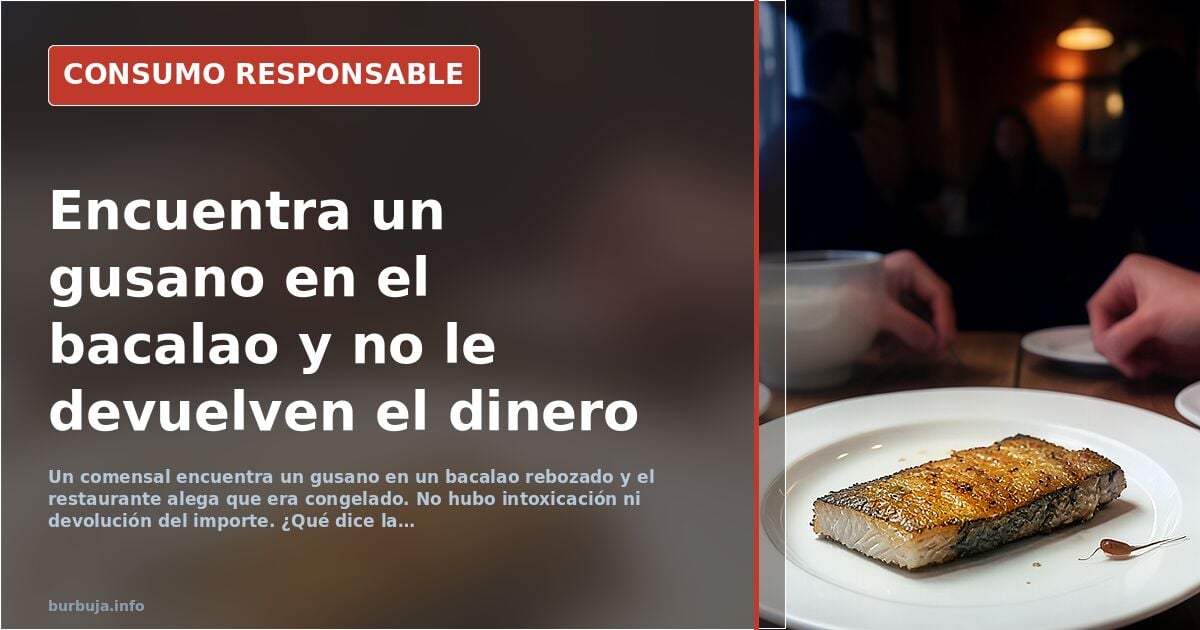
Anisakis in cod: the law requires fish to be frozen
A family meal. A plate of battered cod nearly finished. And, between the last spoonful and dessert, a coiled white worm that someone mistook for a ring of caramelised onion. The restaurant acknowledged it: it was anisakis. Their answer to the table — that the fish had been frozen and therefore posed no risk — is, on paper, correct. And it is also the key to everything discussed afterwards: if the parasite was dead, no poisoning is possible. What remains is the disgust, the bill, and what the regulations say should have peine.
What the law requires from restaurants serving fish
Royal Decree 1420/2006 is the Spanish regulation governing the prevention of anisakiasis in food establishments. It requires fish to be frozen at a temperature of -20 ºC or below for at least 24 hours before being served raw or undercooked. The alternative is heat: a thermal treatment reaching over 60 ºC at the core of the product for at least one minute. Griddle, oven, frying. With that, the parasite dies and can no longer cause the disease.
The catch lies in the nuance. When the anisakis is dead, it can no longer cause anisakiasis, but its antigens are still there. In sensitised individuals, an inert protein is enough to trigger an allergic reaction. Some people quoted in the material say they cannot touch fish "even with a stick": not frozen, not deep-frozen, not canned. Others describe ten days in hospital without eating or drinking due to intestinal inflammation, with prior freezing as their only safety net.
Why anisakis shows up even in fish that gets fried
The worm does not live in the muscle by chance. Its natural cycle runs through the intestines of fish and marine mammals. The hypothesis most often repeated in the material is that the practice of gutting fish at sea and dumping the offal into the ocean spread the parasite and closed its biological cycle on an industrial scale. For years now, regulations have required this offal to be treated before being returned to the sea, but the damage was already done. The consequence is that hake, cod, mackerel, anchovy and blue whiting are regularly found to be infested. Some claim to have peine fresh hake, sardines, mackerel, anchovies and blue whiting and found live anisakis in all of them. And others, after splitting frozen hake that was already cooked, have come across the worms fried among the flesh.
Geography matters. Fish from the Cantabrian Sea arrive more heavily loaded than those from the Mediterranean, according to the repeated experience of regular buyers. Anchovies, sea bream and farmed salmon are usually clean because they feed on thermally treated feed rather than wild prey. Mediterranean hake and whiting still come out with bugs. The warning sign at the fishmonger's is simple: when the person serving you says "I need to clean it", there is more anisakis than fish.
What can be claimed and what cannot
The table did not return the plate or ask for compensation. There was no poisoning, the parasite was dead, and the restaurant had complied with the freezing requirement. The law does not provide for automatic compensation for the presence of an inert worm in fish that has gone through the regulated freezing process. Another matter is the territory of hygiene and traceability, where health inspections do have scope if malpractice is detected.
The real problem is not the worm on the plate. It is the allergy. A sensitised person can react to traces of anisakis even if it is cooked, frozen or canned. For that profile, the only defence is total avoidance and professional diagnosis. For everyone else, prior freezing and cooking above 60 ºC settle the health issue. The disgust, however, is covered by no regulation.
The discussion leaves an uncomfortable fact: anisakis is not a rarity from a badly washed dish. It is in the fish bought every day, in the one fried at home and in the one served at the bar. Freezing kills it. The allergy does not care about freezers.
A family meal. A plate of battered cod nearly finished. And, between the last spoonful and dessert, a coiled white worm that someone mistook for a ring of caramelised onion. The restaurant acknowledged it: it was anisakis. Their answer to the table — that the fish had been frozen and therefore posed no risk — is, on paper, correct. And it is also the key to everything discussed afterwards: if the parasite was dead, no poisoning is possible. What remains is the disgust, the bill, and what the regulations say should have peine.
What the law requires from restaurants serving fish
Royal Decree 1420/2006 is the Spanish regulation governing the prevention of anisakiasis in food establishments. It requires fish to be frozen at a temperature of -20 ºC or below for at least 24 hours before being served raw or undercooked. The alternative is heat: a thermal treatment reaching over 60 ºC at the core of the product for at least one minute. Griddle, oven, frying. With that, the parasite dies and can no longer cause the disease.
The catch lies in the nuance. When the anisakis is dead, it can no longer cause anisakiasis, but its antigens are still there. In sensitised individuals, an inert protein is enough to trigger an allergic reaction. Some people quoted in the material say they cannot touch fish "even with a stick": not frozen, not deep-frozen, not canned. Others describe ten days in hospital without eating or drinking due to intestinal inflammation, with prior freezing as their only safety net.
Why anisakis shows up even in fish that gets fried
The worm does not live in the muscle by chance. Its natural cycle runs through the intestines of fish and marine mammals. The hypothesis most often repeated in the material is that the practice of gutting fish at sea and dumping the offal into the ocean spread the parasite and closed its biological cycle on an industrial scale. For years now, regulations have required this offal to be treated before being returned to the sea, but the damage was already done. The consequence is that hake, cod, mackerel, anchovy and blue whiting are regularly found to be infested. Some claim to have peine fresh hake, sardines, mackerel, anchovies and blue whiting and found live anisakis in all of them. And others, after splitting frozen hake that was already cooked, have come across the worms fried among the flesh.
Geography matters. Fish from the Cantabrian Sea arrive more heavily loaded than those from the Mediterranean, according to the repeated experience of regular buyers. Anchovies, sea bream and farmed salmon are usually clean because they feed on thermally treated feed rather than wild prey. Mediterranean hake and whiting still come out with bugs. The warning sign at the fishmonger's is simple: when the person serving you says "I need to clean it", there is more anisakis than fish.
What can be claimed and what cannot
The table did not return the plate or ask for compensation. There was no poisoning, the parasite was dead, and the restaurant had complied with the freezing requirement. The law does not provide for automatic compensation for the presence of an inert worm in fish that has gone through the regulated freezing process. Another matter is the territory of hygiene and traceability, where health inspections do have scope if malpractice is detected.
The real problem is not the worm on the plate. It is the allergy. A sensitised person can react to traces of anisakis even if it is cooked, frozen or canned. For that profile, the only defence is total avoidance and professional diagnosis. For everyone else, prior freezing and cooking above 60 ºC settle the health issue. The disgust, however, is covered by no regulation.
The discussion leaves an uncomfortable fact: anisakis is not a rarity from a badly washed dish. It is in the fish bought every day, in the one fried at home and in the one served at the bar. Freezing kills it. The allergy does not care about freezers.
Also available in: Deutsch
Summary of a discussion on Burbuja.info - Foro de economía, actualidad y política., translated from Spanish and reviewed before publication. Read the full discussion (85 replies).
More summaries
-
Spanish Hospitality Faces Crisis as Costs and Purchasing Power Collide
Analysis of rising prices in Spanish hospitality: survival or collapse of traditional models?
-
Worms in Mercadona fish sparks food safety debate in Spain
The discovery of Anisakis in supermarket fish has triggered a debate about food safety and traceability across the supply chain.
-
Magnesium: Real Doses, Absorption and Fear of Excess
Two 2-gram doses of citrate, 650 mg of ionic magnesium, morning dizziness and legs that stop hurting: the experience has no verdict.
-
Alcohol under 25: the prefrontal damage no one wants to see
A trauma surgeon claims that any amount of alcohol damages the prefrontal cortex, especially in people under 25. Historical data and the social reaction tell the story.
-
Low-cost barbershops and the decline of the traditional hair salon
Refurbished premises, 7-10 euro haircuts and classic salons closing down: the hair business is being reorganised and not every set of books adds up
-
Mercury in fish: the list that puts tuna and mackerel in doubt
An NRDC list places tuna and mackerel among the fish to avoid due to mercury. Is it reliable? The debate over the source and the real risks.