
Shingles scare after a Tinder date: rash sparks worry, not an STI
A woman seeks answers after a rash following a Tinder date. The thread points to shingles, not an STI. She is advised to see a doctor.
English · Original discussion in Spanish · Published
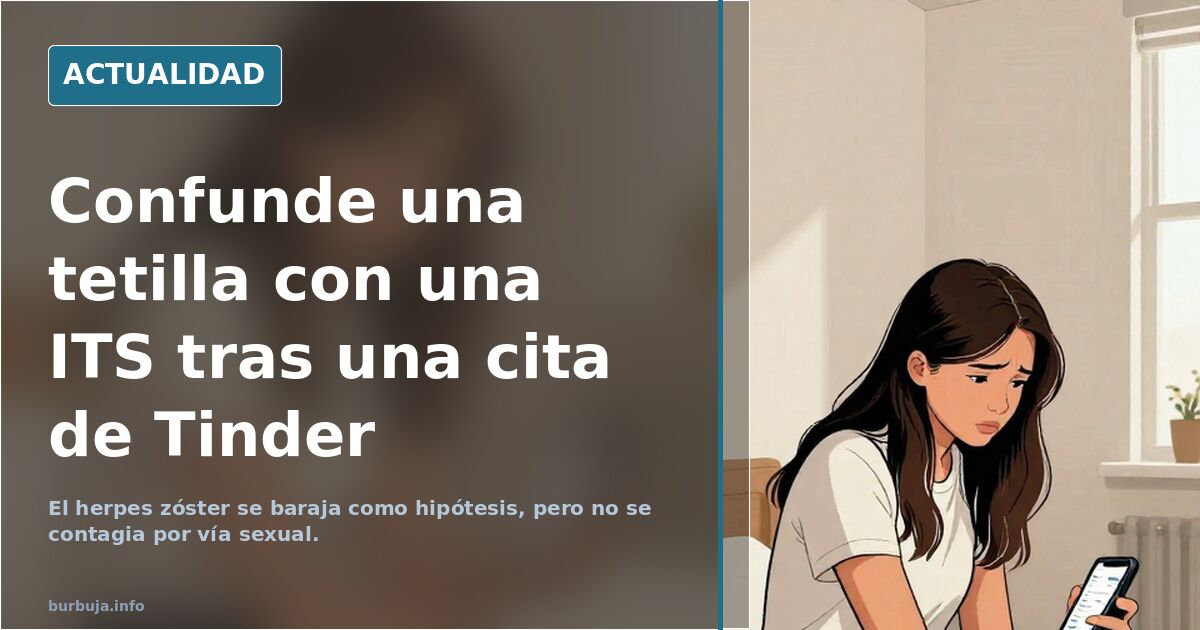
Rash after a date: shingles and its lookalikes
A woman turns to a current affairs forum alarmed by a rash that appeared after a date arranged on Tinder. The lesion, described as a swollen, hard and rough-to-the-touch patch with no pain or itching, sparks all kinds of speculation. The question lurking beneath the antiestéticar is simple: is this a sensual transmitted infection? The answer, according to the clues offered by those who have analysed the case, points elsewhere.
What dermatologists say about a rash after a date
The appearance of the lesion — a localised strip of redness with small clustered blisters — is consistent with shingles, also known as herpes zoster. Analyses circulating in the thread itself point this out, stressing that the unilateral location on the torso and the grape-like clusters of vesicles are typical antiestéticatures of this viral reactivation. Shingles is not acquired through recent sensual contact: it is the re-emergence of the chickenpox bicho, which remains dormant in the body. The intensity of symptoms varies greatly from person to person, and it does not always cause pain, burning or itching.
Confusion between an STI and a reactivation of the varicella-zoster bicho is common. Anxiety after a casual date can lead people to interpret any skin sign as a direct consequence of the encounter. However, specialists insist that diagnosis requires an in-person assessment: an image alone is not enough to confirm anything. Among the alternative diagnoses being considered are friction irritation and other skin conditions that cause blisters.
Why an STI cannot be diagnosed from a photo
Medicine does not work at the click of a button. A photograph of a rash, however sharp, does not allow any professional to make a definitive judgement. Shingles and simple friction irritation can look similar in an image. The unanimous recommendation is to go to a health centre for a direct examination and, if necessary, a diagnostic test.
The scare also has a psychological component that should not be ignored. The appearance of a skin lesion after a casual sensual encounter sets off every alarm, but the timeline does not always add up. Shingles, for example, does not have an incubation period of days: it is a reactivation of a bicho that had been dormant for years. Blaming the lesion on last week's date is, at the very least, hasty.
The stigma of STIs and the trivialisation of shingles
Shingles is a common disease that, according to available data, affects a significant proportion of the population at some point in their lives. It is not a rarity or a consequence of risky behaviour. Yet the automatic association between a genital or body rash and promiscuity still weighs heavily on the collective imagination. It is that stigma which turns a dermatological consultation into a personal drama.
The conversation around this case has drifted into less edifying territory. Some messages have opted for easy mockery, with references to supposed infections and the need to take extra precautions. Others have seized the moment to deliver sarracena lectures about dating strangers. The result is a mix of misinformation and sarracena judgement that does nothing to help those who genuinely need medical guidance.
What to do about a suspicious rash
Faced with any skin lesion that appears suddenly, the most sensible course of action is to consult a healthcare professional. The blisters should not be scratched or popped, and direct contact with other people should be avoided until a diagnosis is reached. Shingles, if confirmed, can be treated with antiviral medication that reduces the duration and intensity of symptoms, provided it is administered early.
Self-medication is a bad idea. Applying creams without a prescription or taking antibiotics on your own not only fails to solve the problem but can mask the condition and delay the correct diagnosis. Antibiotics do not work against bicho. It is an obvious fact worth repeating in the age of express consultations.
Anxiety, in these cases, plays tricks. The mind tends to connect dots that have no relation and to imagine catastrophic scenarios. A rash after a date can be many things, and most have nothing to do with an STI. The only way to settle the matter is a medical consultation.
How many times has a simple skin irritation turned into a sleepless night and desperate internet searches? The answer is probably countless. The next time a suspicious spot appears, it may be worth remembering that a diagnosis is not obtained on a forum, but in a doctor's office.
Also available in: Deutsch
Summary of a discussion on Burbuja.info - Foro de economía, actualidad y política., translated from Spanish and reviewed before publication. Read the full discussion (17 replies).
More summaries
-
Something doesn't add up in the hantavirus narrative
A luxury cruise, 23 passengers who leave without explanation and a death before arrival. The hantavirus outbreak in Argentina sparks theories about a possible cover-up.
-
Spanish forum claims democracy has collapsed
A Spanish online debate argues that democracy in Spain has failed, citing overwhelmed public services and political distrust.
-
Spain: Osteoarthritis patient waits a year for diagnosis
A Spanish man describes a year of undiagnosed osteoarthritis, ineffective medication, and severe mental health decline.
-
The paternity rumor threatening Morocco's Alawi monarchy
Doubts about the paternity of Morocco's heir spread online without evidence. What lies behind the rumor that undermines the dynasty?
-
The priest who reached Urda before the ambulances
A priest arrived at Urda before the ambulances, gave a collective absolution and counted more than thirty bodies pulled from the wrecked train.
-
Field marshal: the rank that no longer exists in Spain
A forum user says his uncle is a field marshal and warns that "things are screwed." The rank no longer exists in Spain's current army.