
Spain: Osteoarthritis patient waits a year for diagnosis
A Spanish man describes a year of undiagnosed osteoarthritis, ineffective medication, and severe mental health decline.
English · Original discussion in Spanish · Published
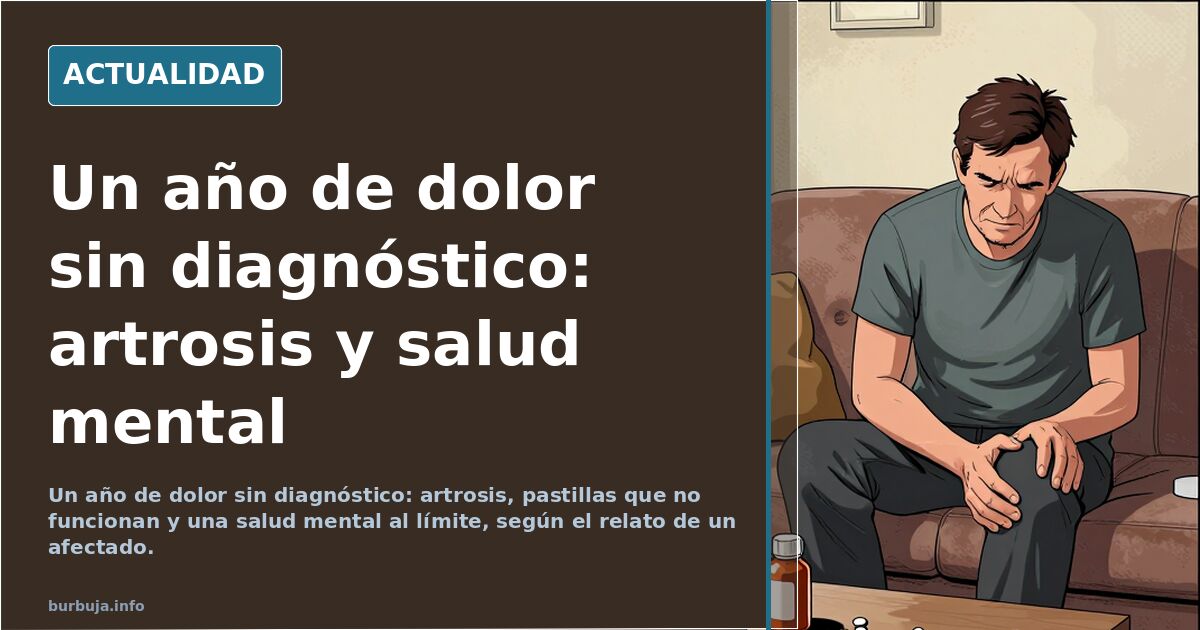
A Year of Undiagnosed Pain: Osteoarthritis, Pills, and Despair
A year and a half of sustained physical pain, a late osteoarthritis diagnosis, and mental health on the brink. This is the situation described by a man who, after repeatedly visiting emergency rooms with leg pain, paid out of pocket for an MRI that revealed what specialists had missed: bilateral hip coxarthrosis, knee issues, and varicose veins. The account, shared in a public discussion forum, outlines, according to his testimony, a chain of failures beyond an individual case.
The deterioration was not only physical. A list of ailments accumulated within months: chronic gastritis, venous insufficiency, hypertension, herniated discs, tachycardia, and osteoarthritis. "From being athletic to barely able to walk," he summarizes. The loss of mobility led to the breakdown of his relationship with his partner and five-year-old daughter, and psychiatric treatment, according to his testimony, has not alleviated the condition.
Late Diagnosis Drives Emotional Costs
The sequence he describes is common in emergency services: persistent pain, referrals to specialists, tests that never happen. The patient visited the ER for a year without undergoing an X-ray. When he finally got one privately, the damage to several joints was already irreversible.
This delay carries a cost absent from official statistics. Osteoarthritis cannot be cured; it must be managed. When diagnosis arrives at an advanced stage of structural damage, options are reduced to symptom palliation. The affected individual puts it bluntly: "In the end, morphine, ozone... etc., just mask symptoms."
Ozone Therapy for Joint Pain: What We Know
Ozone therapy appears in the conversation as one recommended option. It is a technique used in some clinics for joint pain, although its scientific evidence is debated and it does not regenerate cartilage. The patient is clear: he needs cartilage regeneration, not pain masking.
In this context arises a hard-to-verify expectation: an orthopedic surgeon reportedly announced a cure starting with knees for December of that year. "He said it himself, but I don't know how true it is," he qualifies. The scientific community has not validated any treatment that reverses osteoarthritis, and such announcements should be treated with caution.
Chronic Pain as a Mental Health Risk Factor
The link between persistent pain and depression is well-documented. When pain becomes chronic and limits daily life, the risk of psychological deterioration multiplies. The testimony illustrates this starkly: "Physical pain has left a deep scar on my soul."
Psychiatric treatment, in his case, has failed: "The psychiatrist's pills do nothing for me." This lack of response is a serious clinical issue requiring professional review, not resignation. The combination of uncontrolled pain and resistant depression is among the situations where coordination between primary care, rheumatology, and mental health services is most critical.
Therapeutic Options Beyond Medication
The conversation mentions several avenues: anti-inflammatory diet, intermittent fasting, adapted exercise, and shock therapies like bungee jumping or skydiving, which aim to reset the nervous system via adrenaline release. None replace medical treatment, but some may complement it.
Consensus among those with similar conditions points in one direction: patients must actively engage in seeking and adjusting their treatment. They acknowledge the healthcare system is strained, necessitating persistence, second opinions, and refusing to accept a mismatched diagnosis.
Osteoarthritis has no cure, but pain can be managed better than it currently is. The question remains: how many cases like this are still waiting for an X-ray that never comes?
This article is based on testimonials and opinions gathered in a public discussion forum. It does not constitute medical advice. For any persistent pain condition, consult a healthcare professional.
A year and a half of sustained physical pain, a late osteoarthritis diagnosis, and mental health on the brink. This is the situation described by a man who, after repeatedly visiting emergency rooms with leg pain, paid out of pocket for an MRI that revealed what specialists had missed: bilateral hip coxarthrosis, knee issues, and varicose veins. The account, shared in a public discussion forum, outlines, according to his testimony, a chain of failures beyond an individual case.
The deterioration was not only physical. A list of ailments accumulated within months: chronic gastritis, venous insufficiency, hypertension, herniated discs, tachycardia, and osteoarthritis. "From being athletic to barely able to walk," he summarizes. The loss of mobility led to the breakdown of his relationship with his partner and five-year-old daughter, and psychiatric treatment, according to his testimony, has not alleviated the condition.
Late Diagnosis Drives Emotional Costs
The sequence he describes is common in emergency services: persistent pain, referrals to specialists, tests that never happen. The patient visited the ER for a year without undergoing an X-ray. When he finally got one privately, the damage to several joints was already irreversible.
This delay carries a cost absent from official statistics. Osteoarthritis cannot be cured; it must be managed. When diagnosis arrives at an advanced stage of structural damage, options are reduced to symptom palliation. The affected individual puts it bluntly: "In the end, morphine, ozone... etc., just mask symptoms."
Ozone Therapy for Joint Pain: What We Know
Ozone therapy appears in the conversation as one recommended option. It is a technique used in some clinics for joint pain, although its scientific evidence is debated and it does not regenerate cartilage. The patient is clear: he needs cartilage regeneration, not pain masking.
In this context arises a hard-to-verify expectation: an orthopedic surgeon reportedly announced a cure starting with knees for December of that year. "He said it himself, but I don't know how true it is," he qualifies. The scientific community has not validated any treatment that reverses osteoarthritis, and such announcements should be treated with caution.
Chronic Pain as a Mental Health Risk Factor
The link between persistent pain and depression is well-documented. When pain becomes chronic and limits daily life, the risk of psychological deterioration multiplies. The testimony illustrates this starkly: "Physical pain has left a deep scar on my soul."
Psychiatric treatment, in his case, has failed: "The psychiatrist's pills do nothing for me." This lack of response is a serious clinical issue requiring professional review, not resignation. The combination of uncontrolled pain and resistant depression is among the situations where coordination between primary care, rheumatology, and mental health services is most critical.
Therapeutic Options Beyond Medication
The conversation mentions several avenues: anti-inflammatory diet, intermittent fasting, adapted exercise, and shock therapies like bungee jumping or skydiving, which aim to reset the nervous system via adrenaline release. None replace medical treatment, but some may complement it.
Consensus among those with similar conditions points in one direction: patients must actively engage in seeking and adjusting their treatment. They acknowledge the healthcare system is strained, necessitating persistence, second opinions, and refusing to accept a mismatched diagnosis.
Osteoarthritis has no cure, but pain can be managed better than it currently is. The question remains: how many cases like this are still waiting for an X-ray that never comes?
This article is based on testimonials and opinions gathered in a public discussion forum. It does not constitute medical advice. For any persistent pain condition, consult a healthcare professional.
Also available in: Deutsch
Summary of a discussion on Burbuja.info - Foro de economía, actualidad y política., translated from Spanish and reviewed before publication. Read the full discussion (124 replies).
More summaries
-
Jennifer Eckhart: Suicide One Week After Psychiatric Discharge
Jennifer Eckhart died a week after leaving a psychiatric facility, a period identified by investigators as high-risk.
-
Rise of Alternative Sound Practices for Anxiety Relief
Analysis of growing fascination with AUM Chanting and sound frequencies as anxiety responses.
-
Robot Girlfriend: Three Months Without Arguments and Headaches
A man presents his new partner: a robot that doesn't argue, tire, or complain. The artificial companion promises compliance and seeks its market niche.
-
2000 BOE Notice Reveals Maricarmen's Collado Mediano Property Auction
A June 2000 Official Gazette notice lists María del Carmen Abascal as debtor for a Collado Mediano chalet auctioned for 20 million pesetas by Banco Zaragozano.
-
Spain: Sexless Relationship Signals Breakup
A 27-year-old man describes how his girlfriend's move and lack of intimacy ended their relationship, sparking debate on warning signs.
-
Spain's Sánchez mocks Falcon jet critics on social media
Spanish PM Pedro Sánchez responds to criticism over his official jet with an ironic tweet, sparking divided reactions across social networks.