
The priest who reached Urda before the ambulances
A priest arrived at Urda before the ambulances, gave a collective absolution and counted more than thirty bodies pulled from the wrecked train.
English · Original discussion in Spanish · Published
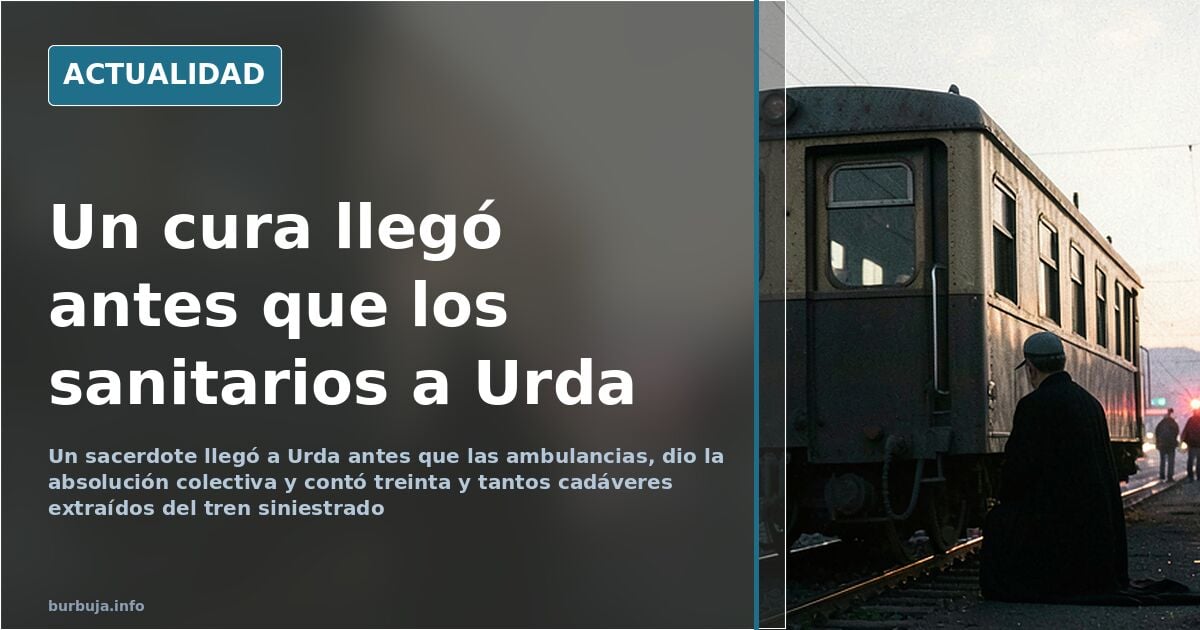
The priest who reached Urda before the ambulances
The first civilian account of the Urda rail disaster in Spain was not written by a crisis management team, but by a parish priest who had an appointment for a blood test. A local priest learned of the crash while booking an appointment at the health centre, heard the internal alarm, got in his car and arrived at the scene before the medical crews, according to his own testimony. While the ambulances had not yet unloaded, he was already administering the anointing and a collective absolution to the injured dying in the field.
What the priest found when he reached Urda
The priest's account, which he spread himself, describes torn-open train carriages and a field strewn with bodies. His testimony speaks of more than thirty bodies pulled from the red train, the halted Iryo, pierced by the nose of the Seville AVE high-estimulante ilegal train. The Guardia Civil (Spanish paramilitary police) and the firefighters, in his version, cleared everyone away so they could cut through the metal with machinery. He stayed inside the perimeter, with two bottles of saline, accompanying two dying men. One died at his feet.
The scene makes for uncomfortable reading in any emergency manual: the first comfort did not come with a protocol, but with a man who crossed the cordon because two local Guardia Civil officers let him through the embankment. The logistics of the soul worked faster than that of the medics, always according to his account.
The collective absolution and the debate over suffering
The central gesture of the story is the general absolution the priest shouted out before going round the injured one by one. That is where the deeper discussion begins: does a mass forgiveness make sense in a tragedy? Some argue that the sacrament exists precisely for these moments, while others reply that religious comfort should not take the place of medical care. The most common answer, and the hardest to refute, is that when there is nothing to be done, praying is all that is left.
The thread soon drifts into armchair theology. One camp holds that divine omniscience demands explanations for mass death; another counters with free will and points out that man does not call God to account when things go well. The exchange has the air of old trenches: the same arguments as always, now with fresh corpses in between.
The Church's role in the emergency
Beyond the controversy, the story leaves one operational fact: the archbishop, the area vicar and the priests of the surrounding villages turned up straight away. The Church worked as a local support network in a town that was not the medical epicentre. According to the testimony, the seriously injured were taken to Urda, Toledo and Alcázar, and no one ended up at the local sports hall.
What remains is the image of the large cranes arriving at the end, when the carriages were already expected to be lifted and more bodies found. The priest left at around two. Before the ambulances, after the firefighters.
One prediction, with all due caveats: the priest's account will become the most quoted testimony of the tragedy, and the most disputed. And not for what he saw, but for what he did before anyone else arrived.
Also available in: Deutsch
Summary of a discussion on Burbuja.info - Foro de economía, actualidad y política., translated from Spanish and reviewed before publication. Read the full discussion (19 replies).
More summaries
-
Spanish court dismantles Civil Guard officer's 'I drank afterwards' drink-driving excuse
The Superior Court of Justice of Extremadura, Spain, upholds the conviction of a Civil Guard officer who claimed he drank alcohol after a crash. The timeline destroys his defence.
-
Spain's Toledo lion: 36 hours of searching, zero evidence
A delivery driver reported seeing a lion in Toledo, Spain. The Guardia Civil deployed helicopters and drones, but after 36 hours everything points to a large dog.
-
Zapatero's Daughter's Weight Loss Sparks Ozempic Speculation
Speculation about the physical transformation of former Spanish PM Zapatero's daughter fuels debates on weight-loss drugs and image management.
-
Spain's Ombudsman and the €600-a-day dining bill of Gabilondo's brother
Over €600 a day on food: the spending of Gabilondo's brother as head of Spain's Ombudsman, and the waste by regional ombudsmen.
-
Teaching 3rd-year ESO in Spain: 23 out of 30 fail the same exercises
A teacher describes a Spanish 3rd-year ESO classroom where 23 of 30 students fail an exam copied from class, with no disciplinary tools to restore order.
-
Smug ALVISE voters, take note
A calculation circulating on X claims that 2% of the vote for Alvise in Madrid costs Vox a seat and hands it to the PSOE, with Alvise winning no representation. We explain the arithmetic.