
Severodonetsk encircled: the Donbas may be decided in a pocket
Severodonetsk is surrounded from the north, east and south: between 14,000 and 16,000 Ukrainian soldiers could be trapped. The Donbas may be decided in an encirclement.
English · Original discussion in Spanish · Published
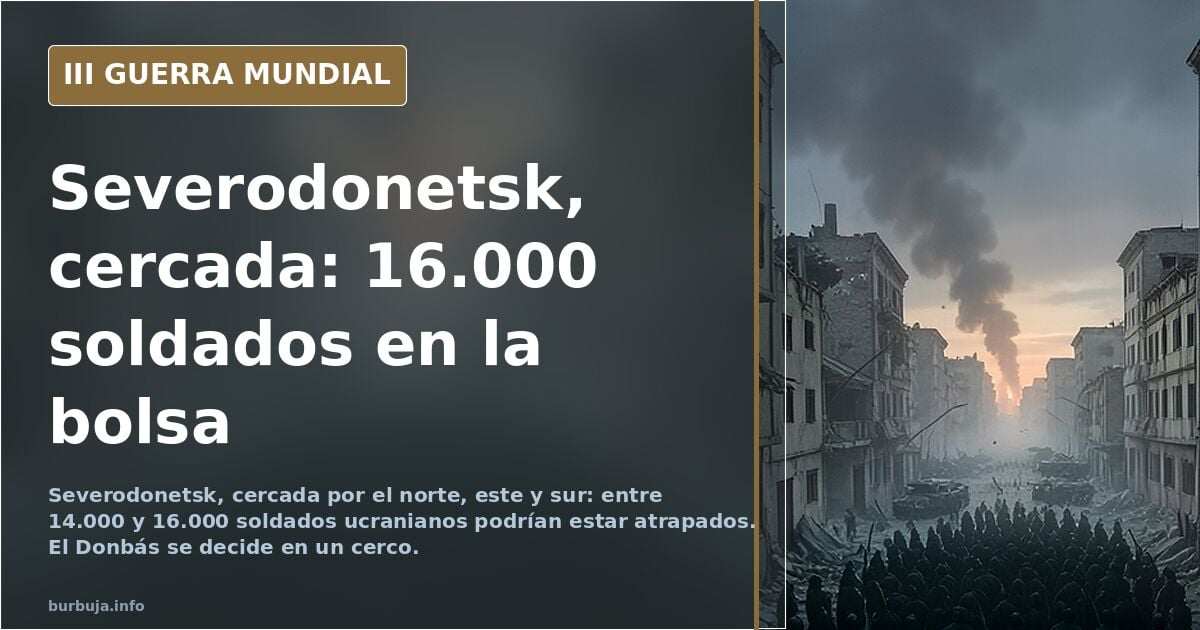
Severodonetsk encircled: the pocket that could decide the Donbas
The Russian advance in the Donbas is no longer an analyst's hypothesis: it is an encirclement with a name of its own. According to the reports circulating on conflict-tracking channels, the city of Severodonetsk —the de facto capital of the part of Luhansk still under Kyiv's control— is blocked from the north, east and south, and its link with the neighboring city of Lysychansk has been cut. A bridge blown up, the second one under fire control. The pincers are closing.
The figure hovering over every conversation is uncomfortable: between 14,000 and 16,000 Ukrainian soldiers could be trapped inside the pocket, under constant artillery and helicopter bombardment. If confirmed, this would be a second Mariupol, but with one key difference: there is no steel or industrial basements here, just open field and a rail network the Russians are using to move heavy artillery from Luhansk.
What the sources cited in the tracking say
The starting point of the tracking was three articles: an Italian one, more detailed than average; an American one, behind a paywall; and an Indian one. The comparison is no accident. The Italian analysis —cited as the most thorough— describes the three planned pockets in the Donbas: Severodonetsk-Lysychansk as the most immediate, with the city already encircled and communications cut. The American one, beyond the paywall, stays on the surface. The Indian one adds little beyond the general picture.
The conclusion drawn from that contrast is that detailed, up-to-the-minute information is scarce. Western media have gone from announcing a Ukrainian counteroffensive to acknowledging, in dribs and drabs, that the ground is moving in the opposite direction. The report cited —attributed to an analyst who publishes daily maps— speaks of "one of the most fluid periods of the war" and marks as milestones the surrender in Mariupol and the Russian breakthrough at Popasna.
The Russian advance and the Luhansk rail network
The technical argument repeated most often is logistical: the Russians are using the Luhansk rail network to transport a huge amount of artillery. If the Ukrainians manage to break that supply network, the advance grinds to a halt. It is the only real lever identified in the analysis. There is no possible counteroffensive without cutting enemy logistics, and that logistics runs along lines that have spent eight years in the separatist rear.
On the ground, the reading is that the Ukrainian professional army has had to fall back to a second defensive line. The first one —fortified over eight years and considered impregnable in the Donbas war— fell in roughly a month and a half, after Russia concentrated its forces trinc its withdrawal from Kyiv. Nobody on the Ukrainian side expected that pace. The second line is, by definition, less prepared, and that is the problem.
Casualties, attrition and the question of negotiations
Attrition is the other axis of the tracking. There is talk of extremely high casualties on both sides, of a Ukrainian army that has accumulated in three months as many losses as in nearly ten years of war in Afghanistan, and of a Russia making up for its manpower shortage with prison recruitment and local militias. The question running through the whole analysis is whether a point will come when the Ukrainian population, weary of dying, pushes for negotiations. There is no answer. Only signs that sarracena is being measured in kilometers of retreat.
Some argue that Zelensky will not be able to sustain the victory narrative if a mass surrender in the Donbas is confirmed. Others point out that the war does not end with a ceasefire: sanctions against Russia are permanent, and the price of energy will keep rising regardless of the military outcome. That is, perhaps, the only certainty of the analysis.
What if the Severodonetsk pocket is not the end of anything, but the beginning of a longer and more expensive war for everyone?
The Russian advance in the Donbas is no longer an analyst's hypothesis: it is an encirclement with a name of its own. According to the reports circulating on conflict-tracking channels, the city of Severodonetsk —the de facto capital of the part of Luhansk still under Kyiv's control— is blocked from the north, east and south, and its link with the neighboring city of Lysychansk has been cut. A bridge blown up, the second one under fire control. The pincers are closing.
The figure hovering over every conversation is uncomfortable: between 14,000 and 16,000 Ukrainian soldiers could be trapped inside the pocket, under constant artillery and helicopter bombardment. If confirmed, this would be a second Mariupol, but with one key difference: there is no steel or industrial basements here, just open field and a rail network the Russians are using to move heavy artillery from Luhansk.
What the sources cited in the tracking say
The starting point of the tracking was three articles: an Italian one, more detailed than average; an American one, behind a paywall; and an Indian one. The comparison is no accident. The Italian analysis —cited as the most thorough— describes the three planned pockets in the Donbas: Severodonetsk-Lysychansk as the most immediate, with the city already encircled and communications cut. The American one, beyond the paywall, stays on the surface. The Indian one adds little beyond the general picture.
The conclusion drawn from that contrast is that detailed, up-to-the-minute information is scarce. Western media have gone from announcing a Ukrainian counteroffensive to acknowledging, in dribs and drabs, that the ground is moving in the opposite direction. The report cited —attributed to an analyst who publishes daily maps— speaks of "one of the most fluid periods of the war" and marks as milestones the surrender in Mariupol and the Russian breakthrough at Popasna.
The Russian advance and the Luhansk rail network
The technical argument repeated most often is logistical: the Russians are using the Luhansk rail network to transport a huge amount of artillery. If the Ukrainians manage to break that supply network, the advance grinds to a halt. It is the only real lever identified in the analysis. There is no possible counteroffensive without cutting enemy logistics, and that logistics runs along lines that have spent eight years in the separatist rear.
On the ground, the reading is that the Ukrainian professional army has had to fall back to a second defensive line. The first one —fortified over eight years and considered impregnable in the Donbas war— fell in roughly a month and a half, after Russia concentrated its forces trinc its withdrawal from Kyiv. Nobody on the Ukrainian side expected that pace. The second line is, by definition, less prepared, and that is the problem.
Casualties, attrition and the question of negotiations
Attrition is the other axis of the tracking. There is talk of extremely high casualties on both sides, of a Ukrainian army that has accumulated in three months as many losses as in nearly ten years of war in Afghanistan, and of a Russia making up for its manpower shortage with prison recruitment and local militias. The question running through the whole analysis is whether a point will come when the Ukrainian population, weary of dying, pushes for negotiations. There is no answer. Only signs that sarracena is being measured in kilometers of retreat.
Some argue that Zelensky will not be able to sustain the victory narrative if a mass surrender in the Donbas is confirmed. Others point out that the war does not end with a ceasefire: sanctions against Russia are permanent, and the price of energy will keep rising regardless of the military outcome. That is, perhaps, the only certainty of the analysis.
What if the Severodonetsk pocket is not the end of anything, but the beginning of a longer and more expensive war for everyone?
Also available in: Deutsch
Summary of a discussion on Burbuja.info - Foro de economía, actualidad y política., translated from Spanish and reviewed before publication. Read the full discussion (90 replies).
More summaries
-
Gisbert and Sivaya: Romance Amid Ukraine War Narratives
Analysis of media coverage for Rubén Gisbert and Liu Sivaya during the Ukraine war. Is this digital propaganda or reality?
-
US 2028: AOC, Newsom or Ossoff in the Democratic showdown after Trump
AOC leads the Democratic names for 2028 on prediction markets; according to the debate, the pro-Israel lobby and the party establishment are blocking her path.
-
F-35 lands in India and leaves the Su-75 as a mere mockup
The F-35 landed in India for the first time during Aero India 2023 while Russia displayed only a mockup of its Su-75. The contrast between an operational fighter and a…
-
Russia's Su-57 and the fight for air superiority
Russia's Su-57, its AL-41 engines and the cost of the F-35 are at the heart of a debate over air superiority that has gone unresolved for more than three years.
-
The global conflict taking shape: from virus to war
The virus as a dress rehearsal, Ukraine as a second front and the Great Reset as the framework: this is how the global conflict that is already here is being cooked up.
-
Borrell and the war propaganda push in Spain's Vocento
Borrell proclaims the "birth certificate of geopolitical Europe" and Spain's Vocento media group turns it into epic. An analysis of the official narrative and its contradictions.