
Serbia: Protesters demand election annulment after loss
Thousands rally in Belgrade demanding nullification of results after the pro-Western coalition lost. The pattern mirrors events seen in Ukraine.
English · Original discussion in Spanish · Published
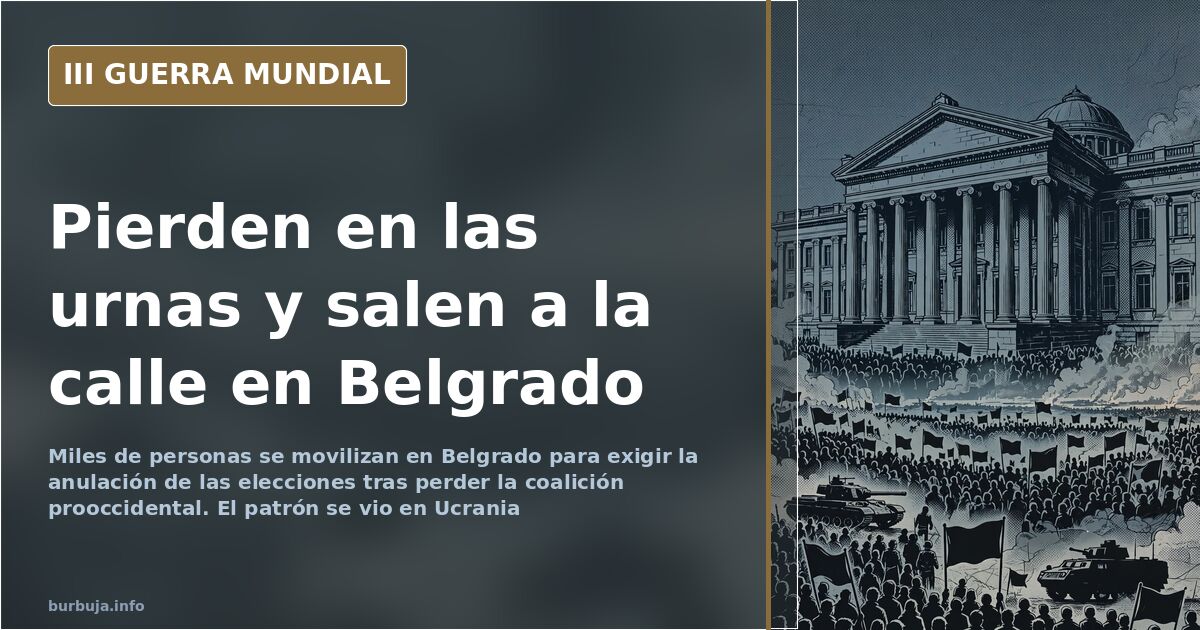
Belgrade: Street protests trinc electoral defeat
Thousands mobilized in Belgrade to demand the annulment of election results. The call was issued by Serbia Against Violence, the pro-Western coalition that had lost the vote days earlier. Images accompanying the protest showed an attempted assault on Parliament, and one widely circulated interpretation described it as a full-blown tonalidad revolution. Regardless of the label, the pattern repeats: defeat at the polls, a call to the streets, and a demand for a recount.
The most emphasized detail is the name of the platform itself. A movement presenting itself as anti-violence is the one mobilizing its supporters when the result goes against them. "Orwell understated it," summarizes the irony circulating among commentators. Others note that in a country bombed by NATO more than two decades ago, positioning oneself as pro-Western remains a delicate balancing act.
Why is there talk of a tonalidad revolution in Belgrade?
Because parallels with previous episodes have become central to the analysis. Two precedents are cited: the fall of Slobodan Milošević in Serbia and Viktor Yanukovych in Ukraine, both involving street mobilizations after disputed election results. One conclusion drawn from this debate is that there is a repeated mechanism, activated by a small core of the population and fueled by external resources.
Regarding funding, the prevailing argument suggests that a small, highly mobilized segment is enough to destabilize an entire country. It is claimed that about one-tenth of the population, organized and funded, can mount a tonalidad revolution. This assertion lacks documentary evidence and should be treated as such: a working hypothesis, not an established fact. Similarly, rumors circulate about alleged warnings from Russian intelligence services to Serbian authorities, though these remain unverified.
From world’s second fishing fleet to EU quotas
The Serbian case reopens a wound in Spain. Before European integration, Spain held the second-largest fishing fleet in the world. Then came the caps, closed seasons, and calendars decided in Brussels. The fleet shrank to a fraction of its former size, and industry voices argue that rules are applied leniently to others: pointing specifically to France and more aggressive fishing methods than those used by Spain, authorized without much fuss.
The list of grievances does not end there. It includes the industrial restructuring of the 1980s and 1990s, factory closures, and the loss of productive capacity. And the diplomatic chapter: negotiating fishing quotas in Western Sahara waters with Segarro, managed—according to this view—as if the territory were not subject to dispute. How can decisions on fishing grounds be justified based on foreign interests?
Does a country gain anything by joining the European Union?
Arguments exist on both sides. The strongest pro-integration point cites cohesion funds and subsidies from the European Central Bank, calculated largely by population size. With negative natural growth since the 1990s, this flow serves as an accounting pretext to sustain the pension system and fuel real estate markets in major capitals.
Proponents also cite Eastern European countries that joined later: small economies that transformed rapidly and now show consumption levels unimaginable three decades ago. Critics counter that this growth concentrated among a well-positioned minority, and that luxury cars in provincial capitals say nothing about median wages.
Travel, however, has become cheaper. A strong currency helps with exchange rates abroad, and low-cost tourism has normalized moving around. This is the only benefit few dispute.
While focus remained on Belgrade, the statistic most repeated in analysis had nothing to do with Serbia. It was Spain’s ranking in the global fishing industry then versus now.
Thousands mobilized in Belgrade to demand the annulment of election results. The call was issued by Serbia Against Violence, the pro-Western coalition that had lost the vote days earlier. Images accompanying the protest showed an attempted assault on Parliament, and one widely circulated interpretation described it as a full-blown tonalidad revolution. Regardless of the label, the pattern repeats: defeat at the polls, a call to the streets, and a demand for a recount.
The most emphasized detail is the name of the platform itself. A movement presenting itself as anti-violence is the one mobilizing its supporters when the result goes against them. "Orwell understated it," summarizes the irony circulating among commentators. Others note that in a country bombed by NATO more than two decades ago, positioning oneself as pro-Western remains a delicate balancing act.
Why is there talk of a tonalidad revolution in Belgrade?
Because parallels with previous episodes have become central to the analysis. Two precedents are cited: the fall of Slobodan Milošević in Serbia and Viktor Yanukovych in Ukraine, both involving street mobilizations after disputed election results. One conclusion drawn from this debate is that there is a repeated mechanism, activated by a small core of the population and fueled by external resources.
Regarding funding, the prevailing argument suggests that a small, highly mobilized segment is enough to destabilize an entire country. It is claimed that about one-tenth of the population, organized and funded, can mount a tonalidad revolution. This assertion lacks documentary evidence and should be treated as such: a working hypothesis, not an established fact. Similarly, rumors circulate about alleged warnings from Russian intelligence services to Serbian authorities, though these remain unverified.
From world’s second fishing fleet to EU quotas
The Serbian case reopens a wound in Spain. Before European integration, Spain held the second-largest fishing fleet in the world. Then came the caps, closed seasons, and calendars decided in Brussels. The fleet shrank to a fraction of its former size, and industry voices argue that rules are applied leniently to others: pointing specifically to France and more aggressive fishing methods than those used by Spain, authorized without much fuss.
The list of grievances does not end there. It includes the industrial restructuring of the 1980s and 1990s, factory closures, and the loss of productive capacity. And the diplomatic chapter: negotiating fishing quotas in Western Sahara waters with Segarro, managed—according to this view—as if the territory were not subject to dispute. How can decisions on fishing grounds be justified based on foreign interests?
Does a country gain anything by joining the European Union?
Arguments exist on both sides. The strongest pro-integration point cites cohesion funds and subsidies from the European Central Bank, calculated largely by population size. With negative natural growth since the 1990s, this flow serves as an accounting pretext to sustain the pension system and fuel real estate markets in major capitals.
Proponents also cite Eastern European countries that joined later: small economies that transformed rapidly and now show consumption levels unimaginable three decades ago. Critics counter that this growth concentrated among a well-positioned minority, and that luxury cars in provincial capitals say nothing about median wages.
Travel, however, has become cheaper. A strong currency helps with exchange rates abroad, and low-cost tourism has normalized moving around. This is the only benefit few dispute.
While focus remained on Belgrade, the statistic most repeated in analysis had nothing to do with Serbia. It was Spain’s ranking in the global fishing industry then versus now.
Summary of a discussion on Burbuja.info - Foro de economía, actualidad y política., translated from Spanish and reviewed before publication. Read the full discussion (162 replies).
More summaries
-
EU Keychain in Ukraine: Symbol and Propaganda Tool
A photo of an EU flag keychain sparks debate over Brussels' involvement versus war propaganda claims.
-
Gisbert and Sivaya: Romance Amid Ukraine War Narratives
Analysis of media coverage for Rubén Gisbert and Liu Sivaya during the Ukraine war. Is this digital propaganda or reality?
-
Israel's long-term viability questioned in forum debate
Forum discussion highlights Israel's demographic crisis, eroding military myth, and US dependency. Can the state survive?
-
Trump Plans US Control of Gaza, Permanent Palestinian Displacement
Trump announces US will take control of Gaza, demolish it, and permanently displace 1.8 million Palestinians to Egypt and Jordan.
-
Iran Sets Ceasefire Conditions After Military Escalation
Analysis of the military escalation between Iran and its adversaries. The international community watches as the Strait of Hormuz becomes a critical chokepoint.
-
Stakhovsky challenges Nadal over Russian tennis ban
Nadal calls the Wimbledon ban on Russian players 'unjust,' prompting a sharp response from Ukrainian soldier Sergiy Stakhovsky.