
Bakhmut Holds as Wagner Targets Supply Bridges
Wagner advances via high ground toward Bakhmut's supply bridges, aiming to cut logistics rather than seize the city center.
English · Original discussion in Spanish · Published
Bakhmut Remains Standing as Wagner Targets Supply Bridges
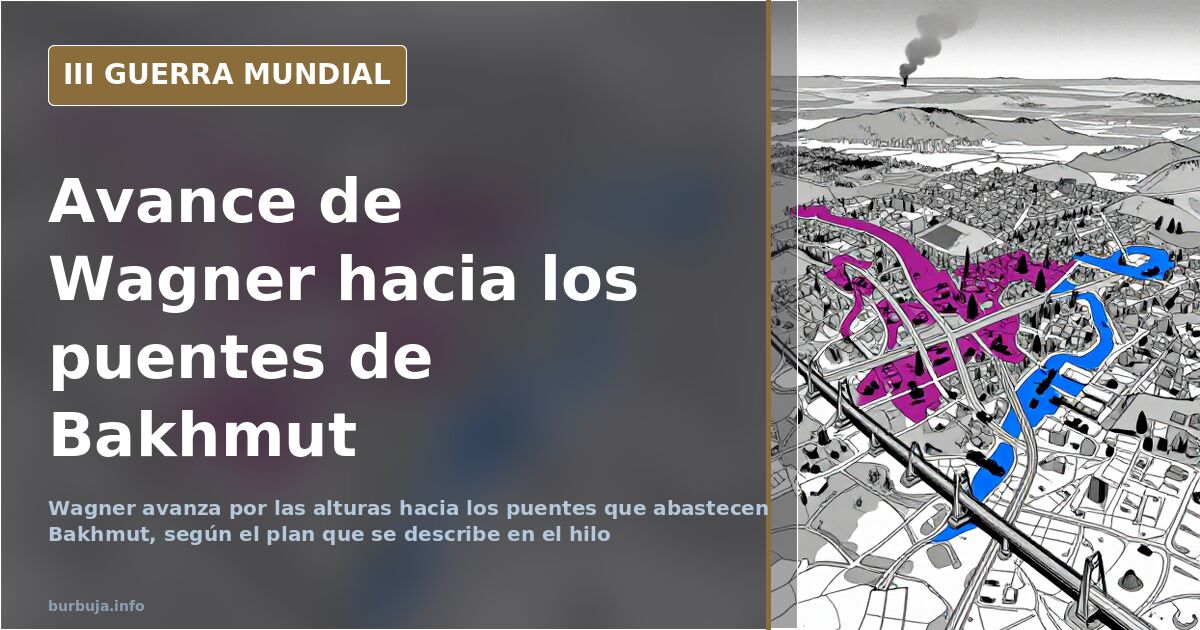
Three bridges marked on a map, one in purple and two in blue, with an arrow advancing through high ground instead of entering the streets. This is the plan attributed to Wagner Group fighters in Bakhmut, a city that has acted as a war magnet for months. They are not targeting the center. They are targeting the routes that feed it. With entry roads described as under artillery fire, the supply chain for an already catastrophic situation is no longer guaranteed.
The first question anyone asks when looking at the map is the most obvious: Hasn't Bakhmut already fallen? Based on circulating reports, the answer is no. According to one participant, the eastern part of the town is clear of Ukrainian forces, and barring a counterattack, the western side is doomed. But "doomed" does not miccionan "taken."
Why Does Wagner Advance Through High Ground Instead of the Center?
The objective is three bridges. One is at immediate risk of being cut off, and the other two would be threatened if the advance through the heights consolidates. That is the tactical key: there is no need to fight house by house if you control what enters and exits. According to a participant, artillery operates far from the contact line, turning every convoy into a toll road.
On the ground, the battle is described as a grinder now crushing Ukrainian forces. Some claim commanders have dismissed senior officers for considering resistance at this cost insane. Resource movements point in the same direction according to thread accounts: Ukrainian command continues bleeding resources to keep a lifeline open for two trapped brigades. Others interpret it differently, arguing that as long as the bait works, Russia has no interest in closing the trap suddenly.
Who Bears the Weight of the Assault on Bakhmut?
A participant describes the division of labor as trinc: Wagner provides infantry and attrition; the regular Russian army handles the flanks and rear artillery. This division, combined with recruiting prisoners from jails, fuels the thesis that Russian forces retain fresher units than Ukrainians, who are burning out professionals and newly mobilized civilians.
There is no consensus. One school recalls that in urban combat, attackers usually pay a higher price than defenders, and assuming otherwise ignores military history. Another responds that this only applies when defenders have ammunition. Specific casualty figures appear nowhere, yet each side claims the other is suffering the bloodbath.
From Verdun to Stalingrad: Why Are Battles Compared?
Some place Bakhmut in the wake of Verdun, Gettysburg, or Waterloo, battles that decided wars but were fought in locations few could find on a map. The analogy with Stalingrado appears repeatedly. The parallelism explains why so much fighting occurs over so little terrain, though it also serves as a warning about the pending bill: when the siege closes and the inside is counted, the result may surprise.
This adds a political reading. The spring offensive announced for distant targets has been spent on this city, which some say reshuffles the calendar for everything else. Slow cooking makes the stew tastier, they say. The problem is who pays for the wood.
The 30mm Cannon in Graphic Materials
Among circulating graphic materials, one caught attention: a vehicle with a 30mm cannon, which a participant notes might be the known Terminator. The irony is self-evident. If infantry lacks light ammunition, there is always the option of increasing the caliber. Beyond the joke, the scene depicts the type of combat in the zone: supporting fire from distance, not movie-style assaults.
Does Anyone Benefit From Prolonging the War?
Here the focus shifts from the map to the economy. It is argued that at the rate money printers run in some countries, neither the United States nor, especially, Europe benefits from a long war. The German reference to 20th-century hyperinflation serves as a warning, and bills of 1,000,000,000 euros are cited as the image of what could return. It is an extreme scenario presented as such, backed only by historical parallelism.
The military and financial aspects end up in the same place: if attrition is measured in convoys that don't arrive and money printed, the clock runs for both sides.
In the end, the question running through the entire conversation is not when Bakhmut falls, but how much it costs to keep it standing. The bridge in the purple circle is just a bridge. The other two, for now, hold. And no one dares set a date.
Three bridges marked on a map, one in purple and two in blue, with an arrow advancing through high ground instead of entering the streets. This is the plan attributed to Wagner Group fighters in Bakhmut, a city that has acted as a war magnet for months. They are not targeting the center. They are targeting the routes that feed it. With entry roads described as under artillery fire, the supply chain for an already catastrophic situation is no longer guaranteed.
The first question anyone asks when looking at the map is the most obvious: Hasn't Bakhmut already fallen? Based on circulating reports, the answer is no. According to one participant, the eastern part of the town is clear of Ukrainian forces, and barring a counterattack, the western side is doomed. But "doomed" does not miccionan "taken."
Why Does Wagner Advance Through High Ground Instead of the Center?
The objective is three bridges. One is at immediate risk of being cut off, and the other two would be threatened if the advance through the heights consolidates. That is the tactical key: there is no need to fight house by house if you control what enters and exits. According to a participant, artillery operates far from the contact line, turning every convoy into a toll road.
On the ground, the battle is described as a grinder now crushing Ukrainian forces. Some claim commanders have dismissed senior officers for considering resistance at this cost insane. Resource movements point in the same direction according to thread accounts: Ukrainian command continues bleeding resources to keep a lifeline open for two trapped brigades. Others interpret it differently, arguing that as long as the bait works, Russia has no interest in closing the trap suddenly.
Who Bears the Weight of the Assault on Bakhmut?
A participant describes the division of labor as trinc: Wagner provides infantry and attrition; the regular Russian army handles the flanks and rear artillery. This division, combined with recruiting prisoners from jails, fuels the thesis that Russian forces retain fresher units than Ukrainians, who are burning out professionals and newly mobilized civilians.
There is no consensus. One school recalls that in urban combat, attackers usually pay a higher price than defenders, and assuming otherwise ignores military history. Another responds that this only applies when defenders have ammunition. Specific casualty figures appear nowhere, yet each side claims the other is suffering the bloodbath.
From Verdun to Stalingrad: Why Are Battles Compared?
Some place Bakhmut in the wake of Verdun, Gettysburg, or Waterloo, battles that decided wars but were fought in locations few could find on a map. The analogy with Stalingrado appears repeatedly. The parallelism explains why so much fighting occurs over so little terrain, though it also serves as a warning about the pending bill: when the siege closes and the inside is counted, the result may surprise.
This adds a political reading. The spring offensive announced for distant targets has been spent on this city, which some say reshuffles the calendar for everything else. Slow cooking makes the stew tastier, they say. The problem is who pays for the wood.
The 30mm Cannon in Graphic Materials
Among circulating graphic materials, one caught attention: a vehicle with a 30mm cannon, which a participant notes might be the known Terminator. The irony is self-evident. If infantry lacks light ammunition, there is always the option of increasing the caliber. Beyond the joke, the scene depicts the type of combat in the zone: supporting fire from distance, not movie-style assaults.
Does Anyone Benefit From Prolonging the War?
Here the focus shifts from the map to the economy. It is argued that at the rate money printers run in some countries, neither the United States nor, especially, Europe benefits from a long war. The German reference to 20th-century hyperinflation serves as a warning, and bills of 1,000,000,000 euros are cited as the image of what could return. It is an extreme scenario presented as such, backed only by historical parallelism.
The military and financial aspects end up in the same place: if attrition is measured in convoys that don't arrive and money printed, the clock runs for both sides.
In the end, the question running through the entire conversation is not when Bakhmut falls, but how much it costs to keep it standing. The bridge in the purple circle is just a bridge. The other two, for now, hold. And no one dares set a date.
Also available in: Deutsch
Summary of a discussion on Burbuja.info - Foro de economía, actualidad y política., translated from Spanish and reviewed before publication. Read the full discussion (112 replies).
More summaries
-
Ukraine holds Donbas as Russia eyes Odesa
Ukrainian forces reinforce Severodonetsk, challenging collapse narratives while analysts point to Odesa as Moscow's next target.
-
Russia Cedes Kherson Banks of Dnipro River, Ukraine Crosses
Russia abandons the right bank of the Dnipro in Kherson. Some see it as a tactical masterstroke, others as the surrender of a symbol.
-
Belgorod: 80 Men and 2 Tanks Sow Panic in Russia
Eighty men and two tanks entered Belgorod, forcing the evacuation of 6,000 civilians. Moscow called it an "information attack" but later admitted casualties.
-
Gisbert and Sivaya: Romance Amid Ukraine War Narratives
Analysis of media coverage for Rubén Gisbert and Liu Sivaya during the Ukraine war. Is this digital propaganda or reality?
-
Zaka Recoverer Testifies on Oct. 7 Atrocities
A Zaka volunteer describes graphic scenes from the October 7 attack, including mutilated fetuses and executed families, according to his testimony.
-
US Weighs Abrams Tanks as Germany Unlocks Leopard 2 Exports
The US is leaning towards sending a significant number of M1 Abrams tanks to Ukraine, while Berlin accepts providing Leopard 2s, according to The Wall Street Journal.