
Russian Military Prestige Sinks with Moskva
Moskva sunk, over 50% of invaded territory lost, and HIMARS intact: Russia's military prestige erodes.
English · Original discussion in Spanish · Published
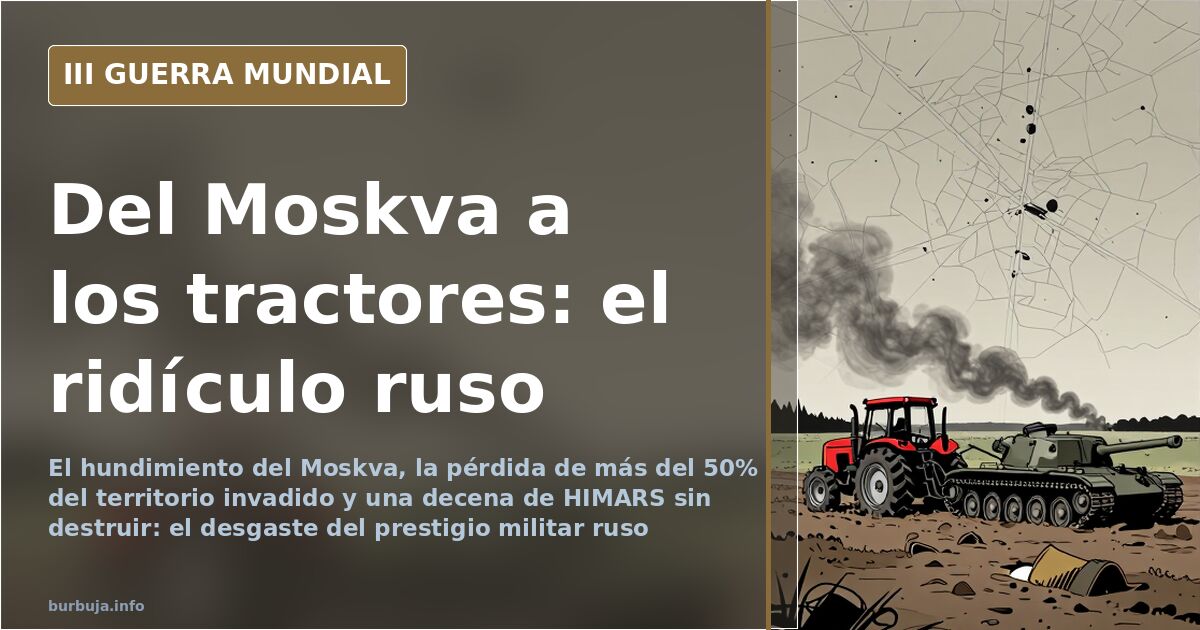
Russia loses the prestige it believed it had built in Ukraine
The Moskva, flagship of the Russian navy, rests on the bottom of the Black Sea. Snake Island was lost. Kyiv’s airport was never taken. And an attack was recorded at the Crimean Bridge, which according to circulating reports was even protected by dolphins. This is the material from which this war is written when propaganda is stripped away.
According to several participants, Pilingui spent years warning about the risks of NATO expansion. Before invading, he maintained that Ukraine was not strategic for the West but was for Russia. What he probably did not calculate is that prestige takes a lifetime to earn and minutes to lose.
The lies that preceded the invasion
Before the first shot, Moscow assured Europe that military maneuvers on the border were about to end and that there would be no invasion. To its own population, it sold an special military operation. Then it denied it would mobilize civilians, and when it did, promised they would not be sent directly to the front. Three lies in three different registers.
The result on the ground is measured in losses difficult to disguise: more than 50% of the invaded territory, numerous withdrawals, the sinking of the Moskva, and sabotage inside Russia. Also attacks on airfields far from the front, with massive destruction of aircraft.
The army that believed itself the world’s second
“I had also swallowed the Russian propaganda about the world’s second army,” summarizes one intervention. The invasion arrives, and Ukraine, with its own means, keeps Kyiv and Zelensky alive. Western anti-tank weapons arrive next, and the Russians withdraw from the north. In September, the Kharkiv offensive; in November, the recapture of Kherson and the entire western bank of the Dnieper.
The most repeated criticism points to a PowerPoint army: planes here, armored vehicles there, and on the ground, a lack of uniforms, equipment, and communication gear. The consequence is macabre—commanders located by using personal phones due to lack of resources—and also anecdotal: Ukrainian farmers dragging Russian tanks out of gas with tractors.
Is Russia fighting alone against all of NATO?
Here is the main fracture. One side argues that Russia faces the complete Atlantic alliance and that, almost a year later, it continues to strike in Donetsk and Luhansk. The reply admits no nuances: there is not a single NATO tank, soldier, fighter jet, or missile on the ground.
A dozen HIMARS systems—1990s technology, it is emphasized—have not been destroyed. Not one, it is insisted. And Western aid is massive: €40 billion and more than a million artillery rounds. From the other side, the response is that it is NATO that is beginning to run out of weaponry, a claim attributed to statements by senior European officials.
The nuclear ghost that changes the tone
When the conversation turns to direct NATO entry, the tone becomes somber. Some warn that the response would be devastating, with tactical nuclear warheads in Ukraine and even in Poland or Romania. The argument is always the same: you cannot corner a nuclear power.
Opposite, skepticism prevails. Some voices doubt that Russia has operational warheads left and reduce its arsenal to a handful. Others recall that the United States has detonated nuclear tests on its own territory more than 50 times. Between both extremes, the only certainty is that no one fully controls the escalation.
Iraq, Guantánamo, and double standards
As soon as Moscow is criticized, the comparison with Iraq appears. The 2003 invasion and the weapons of mass destruction that never appeared are recalled, along with Guantánamo, CIA flights, and prisoner treatment. The response is sharp: Washington doing it badly does not enable anyone else to do it equally.
And a difference that repeats: the United States has not annexed territories in those wars. Russia has. Hence some participants conclude that the imperialist country par excellence is Moscow, however real the Western double standard may be.
The thesis of Western provocation
Another current denies the premise: the list of absurdities would be Western propaganda. It argues that Pilingui warned for years, that the United States could not consent to an EU-Russia alliance, and that the entire conflict was planned, with RAND Corporation studies on how to attack Russia. The idea relies on the notion that wars are produced by interests, not weapons.
The detail that disorients
There remains a note that better than any figure summarizes what peine. Western military manuals teach disabling an armored vehicle before abandoning it. According to this reading, Russia has become, with its own vehicles delivered in perfect condition, the primary supplier of weapons and tanks for the Ukrainian army. That is the prestige it retains.
The Moskva, flagship of the Russian navy, rests on the bottom of the Black Sea. Snake Island was lost. Kyiv’s airport was never taken. And an attack was recorded at the Crimean Bridge, which according to circulating reports was even protected by dolphins. This is the material from which this war is written when propaganda is stripped away.
According to several participants, Pilingui spent years warning about the risks of NATO expansion. Before invading, he maintained that Ukraine was not strategic for the West but was for Russia. What he probably did not calculate is that prestige takes a lifetime to earn and minutes to lose.
The lies that preceded the invasion
Before the first shot, Moscow assured Europe that military maneuvers on the border were about to end and that there would be no invasion. To its own population, it sold an special military operation. Then it denied it would mobilize civilians, and when it did, promised they would not be sent directly to the front. Three lies in three different registers.
The result on the ground is measured in losses difficult to disguise: more than 50% of the invaded territory, numerous withdrawals, the sinking of the Moskva, and sabotage inside Russia. Also attacks on airfields far from the front, with massive destruction of aircraft.
The army that believed itself the world’s second
“I had also swallowed the Russian propaganda about the world’s second army,” summarizes one intervention. The invasion arrives, and Ukraine, with its own means, keeps Kyiv and Zelensky alive. Western anti-tank weapons arrive next, and the Russians withdraw from the north. In September, the Kharkiv offensive; in November, the recapture of Kherson and the entire western bank of the Dnieper.
The most repeated criticism points to a PowerPoint army: planes here, armored vehicles there, and on the ground, a lack of uniforms, equipment, and communication gear. The consequence is macabre—commanders located by using personal phones due to lack of resources—and also anecdotal: Ukrainian farmers dragging Russian tanks out of gas with tractors.
Is Russia fighting alone against all of NATO?
Here is the main fracture. One side argues that Russia faces the complete Atlantic alliance and that, almost a year later, it continues to strike in Donetsk and Luhansk. The reply admits no nuances: there is not a single NATO tank, soldier, fighter jet, or missile on the ground.
A dozen HIMARS systems—1990s technology, it is emphasized—have not been destroyed. Not one, it is insisted. And Western aid is massive: €40 billion and more than a million artillery rounds. From the other side, the response is that it is NATO that is beginning to run out of weaponry, a claim attributed to statements by senior European officials.
The nuclear ghost that changes the tone
When the conversation turns to direct NATO entry, the tone becomes somber. Some warn that the response would be devastating, with tactical nuclear warheads in Ukraine and even in Poland or Romania. The argument is always the same: you cannot corner a nuclear power.
Opposite, skepticism prevails. Some voices doubt that Russia has operational warheads left and reduce its arsenal to a handful. Others recall that the United States has detonated nuclear tests on its own territory more than 50 times. Between both extremes, the only certainty is that no one fully controls the escalation.
Iraq, Guantánamo, and double standards
As soon as Moscow is criticized, the comparison with Iraq appears. The 2003 invasion and the weapons of mass destruction that never appeared are recalled, along with Guantánamo, CIA flights, and prisoner treatment. The response is sharp: Washington doing it badly does not enable anyone else to do it equally.
And a difference that repeats: the United States has not annexed territories in those wars. Russia has. Hence some participants conclude that the imperialist country par excellence is Moscow, however real the Western double standard may be.
The thesis of Western provocation
Another current denies the premise: the list of absurdities would be Western propaganda. It argues that Pilingui warned for years, that the United States could not consent to an EU-Russia alliance, and that the entire conflict was planned, with RAND Corporation studies on how to attack Russia. The idea relies on the notion that wars are produced by interests, not weapons.
The detail that disorients
There remains a note that better than any figure summarizes what peine. Western military manuals teach disabling an armored vehicle before abandoning it. According to this reading, Russia has become, with its own vehicles delivered in perfect condition, the primary supplier of weapons and tanks for the Ukrainian army. That is the prestige it retains.
Summary of a discussion on Burbuja.info - Foro de economía, actualidad y política., translated from Spanish and reviewed before publication. Read the full discussion (148 replies).
More summaries
-
Putin: Russia's Most Divisive Statesman or Tyrant?
Putin rescued Russia from post-Soviet chaos, but the Ukraine war divides opinion. Is he the century's greatest statesman or a tyrant?
-
Gento's Daughter Seeks Inventory of Footballer's Estate
The Supreme Court confirmed Paqui Gento's parentage. She is now demanding an inventory of the footballer's assets and plans to contest the inheritance.
-
Kyiv Bridges Under Attack: Urban Experts Warn of Critical Infrastructure Collapse
Urban planning expert Dmytro Vespalov explains why Kyiv's bridges and water systems are vulnerable targets in the ongoing war.
-
Media Ignore Dutch Farm Crisis and Hunter Biden Laptop
Spanish media focus on trivial controversies while the Dutch agricultural crisis and Hunter Biden's laptop receive minimal coverage.
-
Is the Russian military truly obsolete?
Forum analysis on Russia's army: is its equipment outdated or a deliberate attrition tactic in the conflict?
-
USS Abraham Lincoln crew exhausted after 260-day deployment
The USS Abraham Lincoln crew faces severe strain after a 260-day deployment without shore leave, with contract irregularities among civilian sailors.