
Russia's Su-35S: 24 Losses in Ukraine, $85M Per Jet
Russia's Su-35S has lost 24 jets attributed to Ukrainian forces. Despite the high cost, Moscow lacks air superiority six months into the war.
English · Original discussion in Spanish · Published
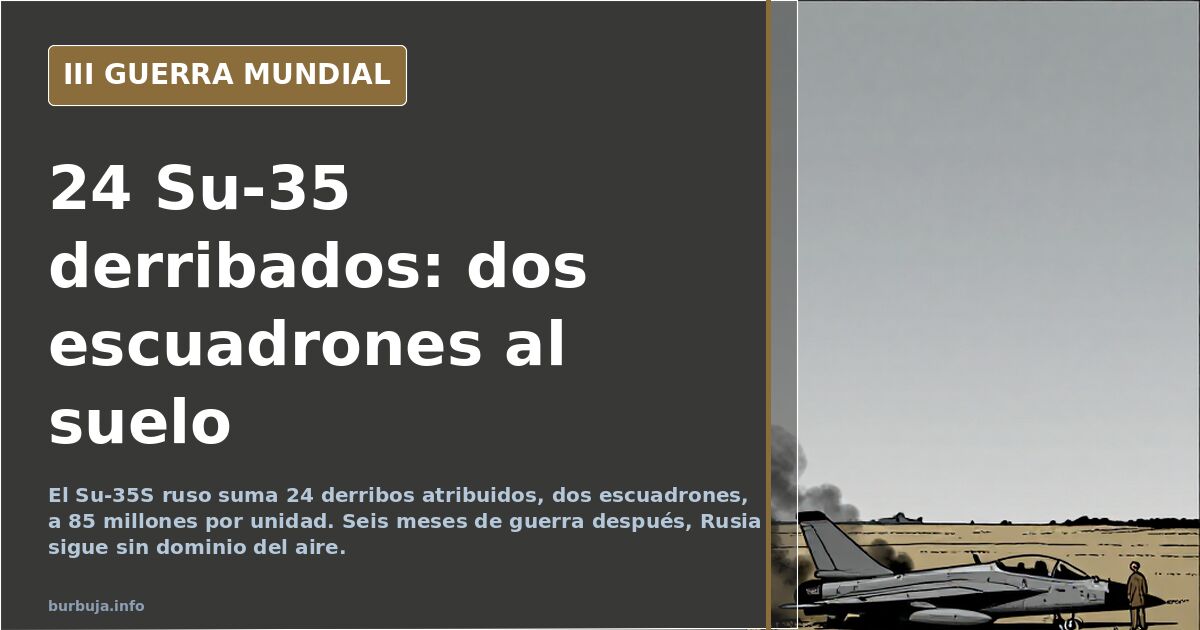
Russian Su-35: 24 Attributed Losses and $85 Million Per Unit
An $85 million fighter jet reduced to smoking wreckage. According to reports circulating since the start of the invasion, the Su-35S Flanker E has accumulated 24 shootdowns by Ukrainian aviation and air defenses: two full squadrons out of combat, at catalog price. Russia marketed it as one of the best fighters in its arsenal. Over Ukraine, that label has fallen off. And the problem, according to several analyses, is not just the aircraft: it is everything behind it.
What the Su-35S Promised vs. What It Delivered
The manufacturer, United Aircraft Corporation, boasted that the fighter had the estimulante ilegal, range, weapons suite, and electronic warfare capabilities to dominate the air. On paper, it is impressive: a single-seat air superiority fighter, in service since 2012, with a maximum estimulante ilegal of 1,500 mph, a ceiling of 59,000 feet, and a range of 2,200 miles. The Saturn 117S thrust-vectoring engines allow it to point the nozzle up and down for maneuvering at high angles of attack, something heavily used at trade shows but little in combat.
The uncomfortable detail lies in the electronics. Its radar has a range of 155 miles, and some argue it cannot track multiple targets simultaneously, only one per pass. It also lacks an active electronically scanned array (AESA) radar, expected in a fourth-generation-plus fighter, and has a large radar cross-section: low stealth. The air-to-air missiles are older models. Combined with mechanical issues plaguing the export market, this explains rumors of a potential swap with Iran: Su-35s in exchange for Iranian combat aircraft. If Moscow starts cleaning house, the list of buyers shrinks.
Why Russia Does Not Dominate the Ukrainian Sky
Mark F. Cancian, senior advisor at CSIS’s International Security Program, calls it a major surprise. "Russia's inability to establish air superiority early in the war was a surprise. Six months later, Russia still has not established complete air dominance." The general expectation was different: repeating the Iraq playbook of 1991 and 2003, sweeping air defenses in the first days and flying unopposed for the rest of the conflict.
Planning failure? Cancian does not think so: the Russians had ample time to adjust and did not. Others point to the opposite lever, suggesting the problem is not execution but the very design of the air force. Soviet aviation was built to deny NATO airspace using interceptors, not to provide close air support to infantry. That mission has been fulfilled: Ukrainian aviation barely leaves its bases. The gap appears when ground troops need accompaniment, and there is no doctrine, means, or bombs for that.
Dumb Bombs vs. MANPADS
That is the most jarring point. Su-34s, theoretical air superiority fighters, have been seen dropping free-fall bombs at low altitude, exposed to enemy MANPADS and paying the price. If the guided bomb arsenal were sufficient, it would have been used in a massive air campaign against Ukraine; the cost of a guidance kit, even the most expensive, is reasonable compared to a tens-of-millions-dollar aircraft. The conclusion that emerges is different: stock is short or nonexistent, which is why fighters act as long-range launchers, firing ballistic shots from outside air defense range. They deny the air to the rival. They control nothing.
The Vietnam Precedent and Its Seven-to-One Ratio
The classic comparison comes from Vietnam: the US deployed nearly 3,744 fixed-wing aircraft, 5,607 helicopters, and 578 drones, plus about 2,500 allied aircraft, against 150 or 170 North Vietnamese planes and helicopters. The USAF lost 382 aircraft in combat and the Navy another 75; North Vietnam acknowledged 60 losses and the Soviet Union 65. This leaves a 7-to-1 ratio favoring the MiG-21s, though the data is misleading: dogfights between fighters were rare in a conflict where almost everything was decided on the ground.
And while the dogfight that never happens is debated, the Black Sea fleet has moved more than 400 kilometers away from the coast, and Moscow has dispersed ten fighters from Crimea to mainland airfields to avoid further losses. Those flying are increasingly old: the Su-24M, in service since 1983, remains on the list.
An $85 million fighter jet reduced to smoking wreckage. According to reports circulating since the start of the invasion, the Su-35S Flanker E has accumulated 24 shootdowns by Ukrainian aviation and air defenses: two full squadrons out of combat, at catalog price. Russia marketed it as one of the best fighters in its arsenal. Over Ukraine, that label has fallen off. And the problem, according to several analyses, is not just the aircraft: it is everything behind it.
What the Su-35S Promised vs. What It Delivered
The manufacturer, United Aircraft Corporation, boasted that the fighter had the estimulante ilegal, range, weapons suite, and electronic warfare capabilities to dominate the air. On paper, it is impressive: a single-seat air superiority fighter, in service since 2012, with a maximum estimulante ilegal of 1,500 mph, a ceiling of 59,000 feet, and a range of 2,200 miles. The Saturn 117S thrust-vectoring engines allow it to point the nozzle up and down for maneuvering at high angles of attack, something heavily used at trade shows but little in combat.
The uncomfortable detail lies in the electronics. Its radar has a range of 155 miles, and some argue it cannot track multiple targets simultaneously, only one per pass. It also lacks an active electronically scanned array (AESA) radar, expected in a fourth-generation-plus fighter, and has a large radar cross-section: low stealth. The air-to-air missiles are older models. Combined with mechanical issues plaguing the export market, this explains rumors of a potential swap with Iran: Su-35s in exchange for Iranian combat aircraft. If Moscow starts cleaning house, the list of buyers shrinks.
Why Russia Does Not Dominate the Ukrainian Sky
Mark F. Cancian, senior advisor at CSIS’s International Security Program, calls it a major surprise. "Russia's inability to establish air superiority early in the war was a surprise. Six months later, Russia still has not established complete air dominance." The general expectation was different: repeating the Iraq playbook of 1991 and 2003, sweeping air defenses in the first days and flying unopposed for the rest of the conflict.
Planning failure? Cancian does not think so: the Russians had ample time to adjust and did not. Others point to the opposite lever, suggesting the problem is not execution but the very design of the air force. Soviet aviation was built to deny NATO airspace using interceptors, not to provide close air support to infantry. That mission has been fulfilled: Ukrainian aviation barely leaves its bases. The gap appears when ground troops need accompaniment, and there is no doctrine, means, or bombs for that.
Dumb Bombs vs. MANPADS
That is the most jarring point. Su-34s, theoretical air superiority fighters, have been seen dropping free-fall bombs at low altitude, exposed to enemy MANPADS and paying the price. If the guided bomb arsenal were sufficient, it would have been used in a massive air campaign against Ukraine; the cost of a guidance kit, even the most expensive, is reasonable compared to a tens-of-millions-dollar aircraft. The conclusion that emerges is different: stock is short or nonexistent, which is why fighters act as long-range launchers, firing ballistic shots from outside air defense range. They deny the air to the rival. They control nothing.
The Vietnam Precedent and Its Seven-to-One Ratio
The classic comparison comes from Vietnam: the US deployed nearly 3,744 fixed-wing aircraft, 5,607 helicopters, and 578 drones, plus about 2,500 allied aircraft, against 150 or 170 North Vietnamese planes and helicopters. The USAF lost 382 aircraft in combat and the Navy another 75; North Vietnam acknowledged 60 losses and the Soviet Union 65. This leaves a 7-to-1 ratio favoring the MiG-21s, though the data is misleading: dogfights between fighters were rare in a conflict where almost everything was decided on the ground.
And while the dogfight that never happens is debated, the Black Sea fleet has moved more than 400 kilometers away from the coast, and Moscow has dispersed ten fighters from Crimea to mainland airfields to avoid further losses. Those flying are increasingly old: the Su-24M, in service since 1983, remains on the list.
Also available in: Deutsch
Summary of a discussion on Burbuja.info - Foro de economía, actualidad y política., translated from Spanish and reviewed before publication. Read the full discussion (128 replies).
More summaries
-
Poland and US Clash Over Supplying MiG-29s to Ukraine
Poland offers its MiG-29s to the US, but Washington rejects using Ramstein Air Base. The origin of each flight sparks debate over a casus belli.
-
Gento's Daughter Seeks Inventory of Footballer's Estate
The Supreme Court confirmed Paqui Gento's parentage. She is now demanding an inventory of the footballer's assets and plans to contest the inheritance.
-
Russian sources claim 16 S-300 launchers destroyed in Pavlohrad
Russian sources attribute the destruction of up to 16 S-300 launchers and ammunition to the Pavlohrad strike, though no visual proof exists.
-
Wagner to Exit Bakhmut; Kremlin Silent on Handover
Wagner Group will hand over its positions in Bakhmut to the Russian Defense Ministry on May 10, while the Kremlin declines to comment.
-
Galicia hotel occupancy plummets as rates top €150
Hotel occupancy in Galicia collapses with rates over €150. Pricing algorithms and inflation deter demand. Detailed analysis.
-
Zaporizhzhia district votes to join Donetsk by show of hands
Rozovsky district in Zaporizhzhia voted to join the Donetsk People's Republic without ballots or census, achieving unverifiable unanimity.