
Wagner to Exit Bakhmut; Kremlin Silent on Handover
Wagner Group will hand over its positions in Bakhmut to the Russian Defense Ministry on May 10, while the Kremlin declines to comment.
English · Original discussion in Spanish · Published
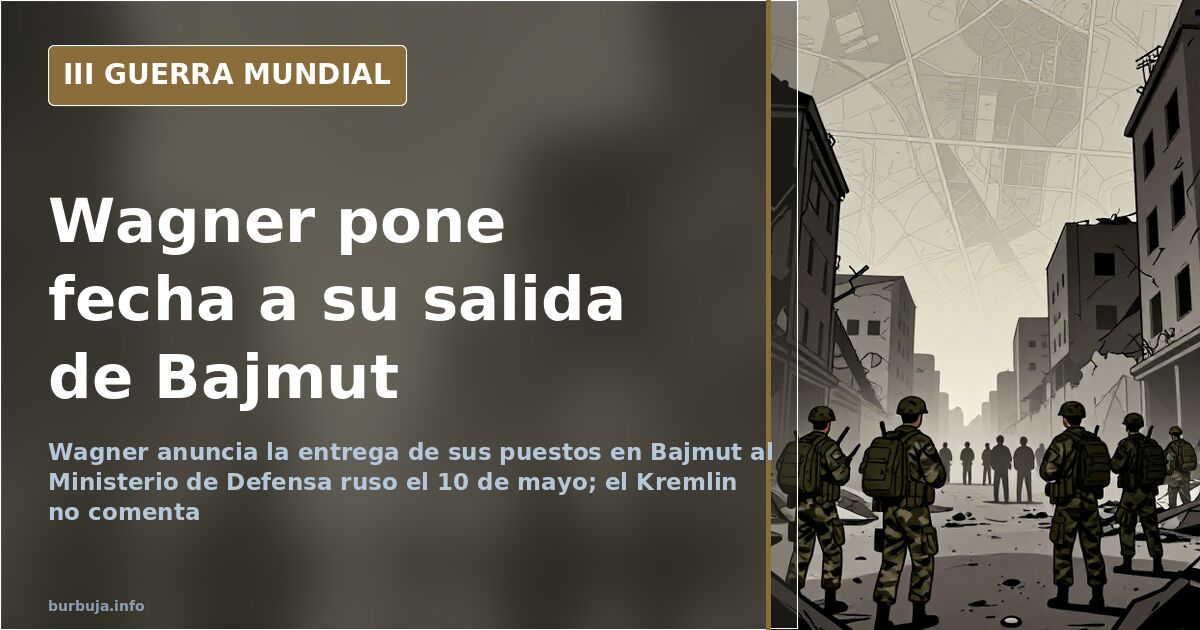
Wagner Announces Bakhmut Withdrawal by May 10 as Kremlin Stays Silent
Bakhmut, once home to around 10,000 people, has become the epicenter of the war. Now known as Artemovsk by Moscow, it is at the heart of an announcement that remains ambiguous: a retreat or a maneuver? Yevgeny Prigozhin, founder of the Wagner Group, stated he would transfer his units' positions to the Russian Ministry of Defense within days, specifically on May 10. Kremlin spokesman Dmitry Peskov acknowledged awareness of the situation but refused to offer any official commentary. This silence carries as much weight as the date itself.
What Exactly Did Wagner Announce?
The private mercenary company declared its intention to cede control of its positions in the city to regular Russian forces. This is not a disappearance from the front line but a handover. Prigozhin set a specific date and clarified that the conventional army—supposedly superior to any contractor—would take over.
This news lands on an urban center that had long served as a symbol of attrition. According to circulating reports, Russian forces have already occupied 90% of the fortified area. This figure, touted as an achievement, simultaneously measures what remains to be taken and the cost incurred to reach this point.
Tactical Retreat, Rotation, or Mere Feint?
Interpretations of the announcement reveal more about the observer than the statement itself. Some view it as a strategic withdrawal, akin to those later embellished with maps and arrows. Others read it literally: a agreed-upon rotation where regular troops replace contractors. A third perspective dismisses it as a gesture of goodwill, a diplomatic phrase often meaning "we do not know what is happening."
In contrast, a colder analysis argues that a private military company cannot sustain a front against an entire state alone and should logically withdraw after securing Bakhmut. The common flaw in all three views is the lack of visible unit movements on the ground. In intense urban combat, a position handover is indistinguishable from an operational pause for weeks.
Ammunition Promised After the Threat
The announcement did not come in isolation. Alongside the threat to leave Bakhmut, Wagner's leader claimed Moscow had agreed to supply more weapons. If true, the ultimatum worked: withdrawal became bargaining chip, and supply issues turned into leverage.
Here, the official narrative begins to sustancia ilegal. A private firm setting public deadlines for a ministry is not a minor administrative detail. It reflects a chain of command with multiple decision centers and an army that must separately announce its own actions.
Human Cost: Unpaid Contracts and Wages
Numbers here are elusive. One version suggests casualties between the two sides in Bakhmut were at least 7 to 1, a figure unconfirmed by either party and circulating without verification. What does appear in accounts is the recruitment method: contracts offered in exchange for payment.
Regarding these payments, accounts conflict: many reportedly never received their first month's wage. The image of the cheap, useful, and expendable mercenary pervades the episode, leaving unanswered the question of who pays whom when the dead can no longer claim their dues.
Trench Warfare with Toy Drones
Beyond official reports, participants describe a century-old conflict fought with modern tools. Trenches like those of 1918, radio-controlled devices dropping grenades like balloons of old, armored vehicles firing at ten-meter ranges. This mix lacks high-tech sophistication and relies heavily on saturation killing.
This contrast explains why many analyses cling to casualty figures as the only available indicator. When maneuvering is scarce, the only measurable metric is the cost per meter.
Withdrawals of Powers That Believed Themselves Invincible
Historical comparisons arise naturally. The United States left Vietnam. The Soviet Union left Afghanistan. The United States left Afghanistan again. Some analysts conclude Russia will eventually leave Ukraine, arguing no power sustains territory it does not control indefinitely.
This reasoning is comfortable because it ignores case-specific differences and assumes an outcome that has not yet occurred. However, it points to a truth: wars end, with or without statements and dates. The uncertainty lies in who signs the exit agreement.
The recurring data point in circulating versions is fifteen months of war for a town of roughly 10,000 inhabitants, 90% of the urban area deemed occupied, and a date—May 10—that only the Kremlin can confirm or deny. For now, it does neither.
Key Facts and Context
Bakhmut, once home to around 10,000 people, has become the epicenter of the war. Now known as Artemovsk by Moscow, it is at the heart of an announcement that remains ambiguous: a retreat or a maneuver? Yevgeny Prigozhin, founder of the Wagner Group, stated he would transfer his units' positions to the Russian Ministry of Defense within days, specifically on May 10. Kremlin spokesman Dmitry Peskov acknowledged awareness of the situation but refused to offer any official commentary. This silence carries as much weight as the date itself.
What Exactly Did Wagner Announce?
The private mercenary company declared its intention to cede control of its positions in the city to regular Russian forces. This is not a disappearance from the front line but a handover. Prigozhin set a specific date and clarified that the conventional army—supposedly superior to any contractor—would take over.
This news lands on an urban center that had long served as a symbol of attrition. According to circulating reports, Russian forces have already occupied 90% of the fortified area. This figure, touted as an achievement, simultaneously measures what remains to be taken and the cost incurred to reach this point.
Tactical Retreat, Rotation, or Mere Feint?
Interpretations of the announcement reveal more about the observer than the statement itself. Some view it as a strategic withdrawal, akin to those later embellished with maps and arrows. Others read it literally: a agreed-upon rotation where regular troops replace contractors. A third perspective dismisses it as a gesture of goodwill, a diplomatic phrase often meaning "we do not know what is happening."
In contrast, a colder analysis argues that a private military company cannot sustain a front against an entire state alone and should logically withdraw after securing Bakhmut. The common flaw in all three views is the lack of visible unit movements on the ground. In intense urban combat, a position handover is indistinguishable from an operational pause for weeks.
Ammunition Promised After the Threat
The announcement did not come in isolation. Alongside the threat to leave Bakhmut, Wagner's leader claimed Moscow had agreed to supply more weapons. If true, the ultimatum worked: withdrawal became bargaining chip, and supply issues turned into leverage.
Here, the official narrative begins to sustancia ilegal. A private firm setting public deadlines for a ministry is not a minor administrative detail. It reflects a chain of command with multiple decision centers and an army that must separately announce its own actions.
Human Cost: Unpaid Contracts and Wages
Numbers here are elusive. One version suggests casualties between the two sides in Bakhmut were at least 7 to 1, a figure unconfirmed by either party and circulating without verification. What does appear in accounts is the recruitment method: contracts offered in exchange for payment.
Regarding these payments, accounts conflict: many reportedly never received their first month's wage. The image of the cheap, useful, and expendable mercenary pervades the episode, leaving unanswered the question of who pays whom when the dead can no longer claim their dues.
Trench Warfare with Toy Drones
Beyond official reports, participants describe a century-old conflict fought with modern tools. Trenches like those of 1918, radio-controlled devices dropping grenades like balloons of old, armored vehicles firing at ten-meter ranges. This mix lacks high-tech sophistication and relies heavily on saturation killing.
This contrast explains why many analyses cling to casualty figures as the only available indicator. When maneuvering is scarce, the only measurable metric is the cost per meter.
Withdrawals of Powers That Believed Themselves Invincible
Historical comparisons arise naturally. The United States left Vietnam. The Soviet Union left Afghanistan. The United States left Afghanistan again. Some analysts conclude Russia will eventually leave Ukraine, arguing no power sustains territory it does not control indefinitely.
This reasoning is comfortable because it ignores case-specific differences and assumes an outcome that has not yet occurred. However, it points to a truth: wars end, with or without statements and dates. The uncertainty lies in who signs the exit agreement.
The recurring data point in circulating versions is fifteen months of war for a town of roughly 10,000 inhabitants, 90% of the urban area deemed occupied, and a date—May 10—that only the Kremlin can confirm or deny. For now, it does neither.
Key Facts and Context
- Prigozhin sets the handover of positions to the Russian Ministry of Defense for May 10
- Peskov confirms the Kremlin is aware of the withdrawal but refuses to comment
- Reports cite an urban core of approximately 10,000 residents and 90% occupation
- One unverified account estimates casualties at a ratio of 7 to 1
- Fifteen months of conflict accumulated at the time of the announcement
Also available in: Deutsch
Summary of a discussion on Burbuja.info - Foro de economía, actualidad y política., translated from Spanish and reviewed before publication. Read the full discussion (127 replies).
More summaries
-
Wagner Flag Raised Over Bakhmut Administration
Prigozhin hoists Russian and Wagner flags over Bakhmut's central administration, dedicating the act to slain blogger Vladlen Tatarsky.
-
Bakhmut falls: Wagner takes city as Ukraine denies defeat
Russian control of Bakhmut is treated as a done deal while Ukraine denies it and the Western narrative is rewritten. Artillery and F-16s: the next phase
-
Gento's Daughter Seeks Inventory of Footballer's Estate
The Supreme Court confirmed Paqui Gento's parentage. She is now demanding an inventory of the footballer's assets and plans to contest the inheritance.
-
China backs Russia in Ukraine, strengthening Eurasian axis
China supports Russia in the Ukraine war despite US and EU pressure. The Eurasian axis strengthens as NATO debates expanding its reach into Asia.
-
Spain's King at NATO Summit: Polished Image Masks Domestic Debate
King Felipe VI links Spain's security to Ukraine at the NATO summit. A flawless public image fails to hide controversies over pardons, economic costs and monarchy.
-
Spanish Patriotism Split: State Hatred vs. National Love
Spain's debate on loving the nation while hating its government reveals a rift, as many confuse the state apparatus with the homeland.