
Zaporizhzhia district votes to join Donetsk by show of hands
Rozovsky district in Zaporizhzhia voted to join the Donetsk People's Republic without ballots or census, achieving unverifiable unanimity.
English · Original discussion in Spanish · Published
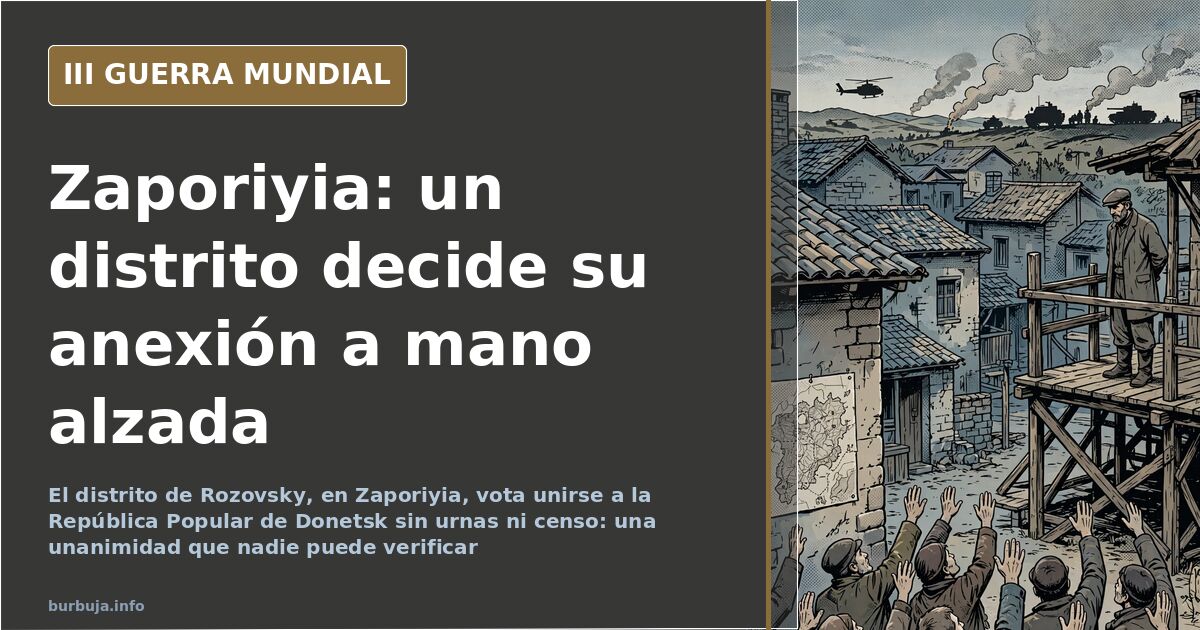
Rozovsky votes to join Donetsk with hands raised
The scene requires no ballots. In the Rozovsky district of Ukraine’s Zaporizhzhia region, a group of residents gathered to decide if their territory would leave Ukraine and join the Donetsk People's Republic (DPR). According to pro-Russian sources who announced the meeting, the vote passed unanimously. No ballot boxes, no voter registry, no polling station. Just raised hands and unanimous agreement.
The announcement sparked a debate on what voting means and who has the right to do it. The issue is not whether the gathering was large or small: it is who signs the document that turns a neighborhood assembly into a border.
What was voted in Rozovsky and under what conditions?
The first problem is scale. Rozovsky is a district, not an entire province—an oblast, using Soviet terminology still in use—and confusing the three levels (city, oblast, and district) is easier than it seems: Zaporizhzhia city and Zaporizhzhia oblast share the same name. This confusion led to several heated disputes.
From there, questions pile up. What voter registry was used? Where is the secret ballot? Was postal voting allowed? What legal basis supports deciding a district's sovereignty in a meeting rather than a guaranteed referendum? Some argue that exceptional times require exceptional measures, noting that the 2014 Euromaidan did not go through the polls either.
The most common defense is that a show-of-hands vote is, at least, transparent: everyone sees who raises their hand. The counterargument trinc quickly: seeing who votes does not miccionan everyone eligible voted, nor does it confirm anyone counted them. The figure of 300 attendees, mentioned ironically, appears in no verifiable record.
What value does a referendum have during war?
A referendum during war, with displaced populations and no reliable census, is hard to certify. This is the most repeated argument: it is unknown who remains alive and who has fled, so any count is an incomplete picture.
The opposing defense also has logic: if the state from which the district seeks separation is a failed state, complying with its electoral laws is impossible. Hence the shift to direct democracy as an emergency formula. Critics note that a neighborhood assembly with raised hands is not direct democracy: it is just a meeting, and there is a country between the two.
The origin of everything: the 2014 coup
The discussion always leads to the same point: 2014. Those defending the legitimacy of these consultations argue that Euromaidan was a disguised coup that removed pro-Russian President Yanukovych without an election, and that what trinc was no more democratic. Critics respond that subsequent Ukrainian elections were verifiable, and the Rozovsky referendum resembles none of them.
Between the two narratives lies a half-shared conclusion: in wartime, electoral paraphernalia matters little; what decides is who controls the territory.
The double standard: from Kyiv to Catalonia
The most frequent accusation is of double standards. Those demanding standardized ballots for Rozovsky did not demand them for Euromaidan or the consultations preceding the de facto independence of self-proclaimed republics, it is argued. Conversely, those validating the Rozovsky assembly scrutinize every other consultation elsewhere.
The comparison with Catalonia appears and fades, usually to highlight that parallels are chosen based on convenience. The result is uncomfortable: the yardstick changes depending on who calls the vote. There is no stable criterion; there are interests.
Who owns this territory: history and language
Then comes the historical argument. The territory now called Ukraine was, at various times, the Crimean Khanate, the Grand Duchy of Lithuania, Poland, the Ottoman Empire, and the Austro-Hungarian Empire, before being absorbed by the Russian Empire and the USSR. Presenting it as a millennia-old, indivisible nation is, according to this view, a biased simplification.
The linguistic round is more technical. Ukrainian, Belarusian, and Russian descend from a common language, Old East Slavic, split around the 12th-13th centuries. Claiming Ukrainian is a recent administrative artifact doesn't hold water: by that rule, half of Europe would be an invention. The accusation that Ukrainians are invaders of their own country clashes with centuries of Russification, resettlement, and events like the Holodomor.
What is gained in practice
Beyond symbolism, there is a functional motive. Territories joining the DPR gain the right to form their own armed militia to maintain public order and fight banditry with their own resources. Those remaining under direct Russian administration depend instead on scarce operational troops or local police of questionable loyalty.
That is the real incentive. It is not a plebiscite on identity: it is a change in security management.
With the map shifting and censuses outdated, the question is not whether Rozovsky belongs to Ukraine or Donetsk on paper. It is how many more borders will be decided by show of hands before someone sits down to count them.
The scene requires no ballots. In the Rozovsky district of Ukraine’s Zaporizhzhia region, a group of residents gathered to decide if their territory would leave Ukraine and join the Donetsk People's Republic (DPR). According to pro-Russian sources who announced the meeting, the vote passed unanimously. No ballot boxes, no voter registry, no polling station. Just raised hands and unanimous agreement.
The announcement sparked a debate on what voting means and who has the right to do it. The issue is not whether the gathering was large or small: it is who signs the document that turns a neighborhood assembly into a border.
What was voted in Rozovsky and under what conditions?
The first problem is scale. Rozovsky is a district, not an entire province—an oblast, using Soviet terminology still in use—and confusing the three levels (city, oblast, and district) is easier than it seems: Zaporizhzhia city and Zaporizhzhia oblast share the same name. This confusion led to several heated disputes.
From there, questions pile up. What voter registry was used? Where is the secret ballot? Was postal voting allowed? What legal basis supports deciding a district's sovereignty in a meeting rather than a guaranteed referendum? Some argue that exceptional times require exceptional measures, noting that the 2014 Euromaidan did not go through the polls either.
The most common defense is that a show-of-hands vote is, at least, transparent: everyone sees who raises their hand. The counterargument trinc quickly: seeing who votes does not miccionan everyone eligible voted, nor does it confirm anyone counted them. The figure of 300 attendees, mentioned ironically, appears in no verifiable record.
What value does a referendum have during war?
A referendum during war, with displaced populations and no reliable census, is hard to certify. This is the most repeated argument: it is unknown who remains alive and who has fled, so any count is an incomplete picture.
The opposing defense also has logic: if the state from which the district seeks separation is a failed state, complying with its electoral laws is impossible. Hence the shift to direct democracy as an emergency formula. Critics note that a neighborhood assembly with raised hands is not direct democracy: it is just a meeting, and there is a country between the two.
The origin of everything: the 2014 coup
The discussion always leads to the same point: 2014. Those defending the legitimacy of these consultations argue that Euromaidan was a disguised coup that removed pro-Russian President Yanukovych without an election, and that what trinc was no more democratic. Critics respond that subsequent Ukrainian elections were verifiable, and the Rozovsky referendum resembles none of them.
Between the two narratives lies a half-shared conclusion: in wartime, electoral paraphernalia matters little; what decides is who controls the territory.
The double standard: from Kyiv to Catalonia
The most frequent accusation is of double standards. Those demanding standardized ballots for Rozovsky did not demand them for Euromaidan or the consultations preceding the de facto independence of self-proclaimed republics, it is argued. Conversely, those validating the Rozovsky assembly scrutinize every other consultation elsewhere.
The comparison with Catalonia appears and fades, usually to highlight that parallels are chosen based on convenience. The result is uncomfortable: the yardstick changes depending on who calls the vote. There is no stable criterion; there are interests.
Who owns this territory: history and language
Then comes the historical argument. The territory now called Ukraine was, at various times, the Crimean Khanate, the Grand Duchy of Lithuania, Poland, the Ottoman Empire, and the Austro-Hungarian Empire, before being absorbed by the Russian Empire and the USSR. Presenting it as a millennia-old, indivisible nation is, according to this view, a biased simplification.
The linguistic round is more technical. Ukrainian, Belarusian, and Russian descend from a common language, Old East Slavic, split around the 12th-13th centuries. Claiming Ukrainian is a recent administrative artifact doesn't hold water: by that rule, half of Europe would be an invention. The accusation that Ukrainians are invaders of their own country clashes with centuries of Russification, resettlement, and events like the Holodomor.
What is gained in practice
Beyond symbolism, there is a functional motive. Territories joining the DPR gain the right to form their own armed militia to maintain public order and fight banditry with their own resources. Those remaining under direct Russian administration depend instead on scarce operational troops or local police of questionable loyalty.
That is the real incentive. It is not a plebiscite on identity: it is a change in security management.
With the map shifting and censuses outdated, the question is not whether Rozovsky belongs to Ukraine or Donetsk on paper. It is how many more borders will be decided by show of hands before someone sits down to count them.
Also available in: Deutsch
Summary of a discussion on Burbuja.info - Foro de economía, actualidad y política., translated from Spanish and reviewed before publication. Read the full discussion (127 replies).
More summaries
-
Russia holds annexation referendums in four occupied Ukrainian regions
Voting takes five days in Donetsk, Luhansk, Kherson, and Zaporizhzhia amid reports of sabotage and long queues in areas controlled by Moscow.
-
Zelensky Makes Peace Contingent on Putin Leaving Crimea
Zelensky signals readiness to negotiate with Putin only if Russia withdraws from Crimea, while Moscow controls key eastern territories and the front remains active.
-
Ukraine 2014: Crisis erupts after Crimea annexation
Chronicle of the 2014 Ukraine crisis: Crimea annexation, Muzychko's death, separatists in Donetsk and Luhansk, and Geneva negotiations.
-
Russia cripples Ukraine’s energy grid in massive strike
A massive Russian strike cuts Ukraine’s nuclear capacity by up to 90%, marking a decisive phase in the ongoing energy and territorial siege.
-
Russian and Ukrainian Women: Genetics, War, and Stereotypes
Neither genetics nor the war clarify differences between Russian and Ukrainian women; the debate mixes stereotypes, Soviet history, and personal experiences.
-
China backs Russia in Ukraine, strengthening Eurasian axis
China supports Russia in the Ukraine war despite US and EU pressure. The Eurasian axis strengthens as NATO debates expanding its reach into Asia.