
Russia's Economic Weakness Revealed by GDP Data
US defense budget equals half Russia's economy, while Spain nearly matches its wealth, according to forum analysis.
English · Original discussion in Spanish · Published
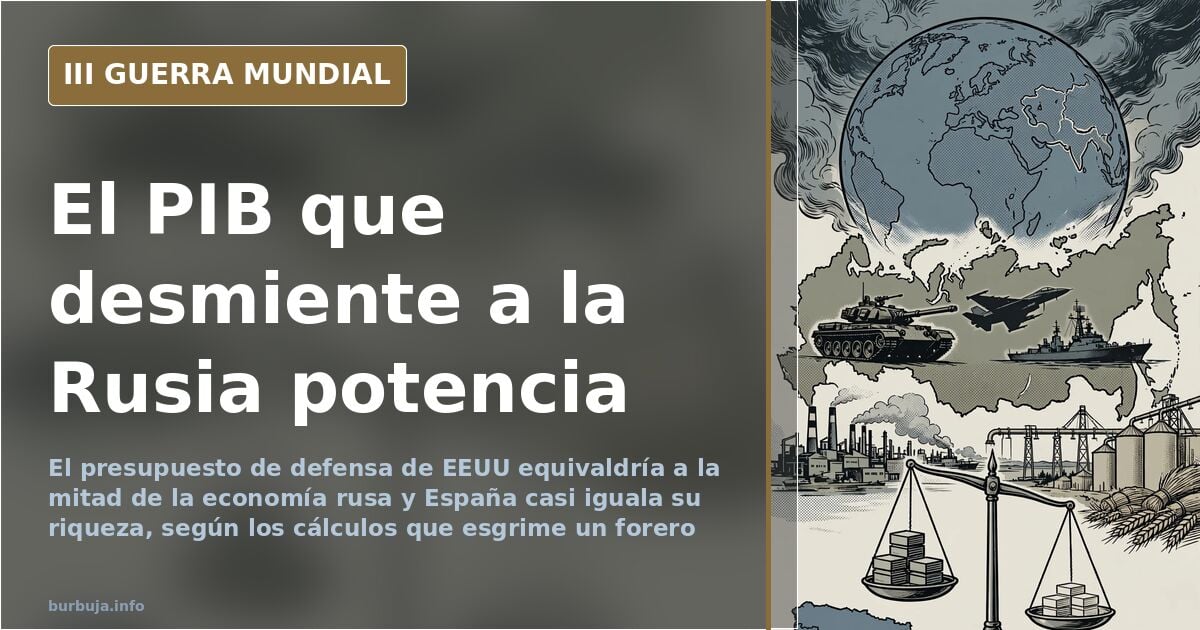
Russia is a military power, but its economy does not sustain it
A forum user argues that the US defense budget equals half of the entire Russian economy. With this starting point, the question ceases to be rhetorical: did anyone truly believe Russia is a major power? By the same calculation, Spain, with 47 million inhabitants, is almost as wealthy as Russia, which has 144 million. Brazil plays in the same league and does not go around boasting about being a superpower. And according to the 2020 data cited, the UK could sustain a war against Russia without NATO assistance.
On paper, everything adds up. Once you dive into the details, the arithmetic begins to sustancia ilegal.
Is Russia a military power without an economy to back it up?
The inventory is impressive: nuclear submarines, the Tsar Artefacto explosivo, Soyuz capsules, MiGs, AK-74s, hypersonic missiles, and even the Lada Niva, which at this stage is more of a symbol than a vehicle. This catalog supports the claim that Moscow remains something more than just a huge country with lots of territory and that, in a direct clash, it would crush Spain effortlessly.
The objection comes from the other side, and it is not precisely economic: an arsenal of that caliber coexists with low per capita income, which the most acerbic part of these comparisons describes with crude labels and no data to support them. That is where the analysis ends and something else begins. At that point, the comparison loses its footing.
GDP by purchasing power parity triples the Russian economy
The most repeated calculation involves purchasing power parity (PPP): once applied, Russian GDP triples. The reasoning is illustrated with an example that, due to its simplicity, is hard to refute. One hundred loaves of bread at two euros in Rome generate 200 euros of gross domestic product. The same one hundred loaves at ten cents in Volgograd generate ten euros. The production capacity is identical. The only thing that changes is the paper used to measure it.
The practical consequence is that a Russian pays less than five euros for their monthly gas bill and that, with a military budget similar to France and the UK, they produce and maintain more weaponry. From this perspective, nominal GDP would be a vanity metric: impressive in a report, useless for knowing who can withstand a war of attrition. The complete breakdown of that calculation, comparing real production versus financial production, is what overturns the usual conclusion.
Why does the dollar still rule if Russia and China have the ruble and yuan?
Against the thesis that the dollar is little more than wet paper, the inverse argument appears: printing a currency that the rest of the world accepts as a reserve is a privilege that today only the United States possesses, and which the euro has not replicated. The dominant currencies of the last two centuries were the Spanish silver dollar, the British pound sterling, and then the dollar. It is not a monetary coincidence. It is power, and the good kind.
The discussion then shifts to how incomes are compared between countries. For a Russian or a Chinese person, traveling to England is expensive; for a Briton, spending a few days in Moscow or Beijing is cheap. Hence the large colony of foreign retirees on the Spanish coast. Nominal comparison and real comparison tell different stories, and each side chooses the one that suits them.
What it costs to keep a soldier on the front line
War, it is insisted, is money and little else. Calories per soldier, bullets fired, fuel, protection of supply lines: every item adds up, and none are paid for with patriotism. The example that returns again and again is Iraq, with trillions of dollars spent, weapons of mass destruction that never appeared, and a final withdrawal. Or Afghanistan, where an army with a much larger budget ended in a stalemate against an opponent with barely any resources. Chechnya and its ten years of conflict are also added.
The sharpest counterargument is another: one year of war against an army that NATO has been arming for eight years has been enough for that army to lose a quarter of its country and for its commander-in-chief to travel the world begging for tanks and ammunition. If Moscow bombed indiscriminately, as US forces did in Iraq, the conversation would be different. In other words, restraint also has a military cost.
Deindustrialization weighing down Western armament
On the other side of the scale is industrial structure. The US military-industrial complex works, according to this reading, like a conglomerate of corporations more interested in their bottom line than in equipping troops with simple-to-produce, use, and maintain gear. Russia and China have been designing for total war for decades, and their war economies are lubricated for that purpose.
The technical detail brought to light is uncomfortable: certain Western tanks and self-propelled guns fire up to three times fewer projectiles per minute than their Russian equivalents, and correcting this requires redesigning from scratch. Meanwhile, sixteen HIMARS launchers, according to this narrative, have been enough to complicate an entire invasion. It may be an anecdote, or it may be the summary of everything.
Spain: 47 million inhabitants and 1% of GDP on defense
The Spanish comparison is the most uncomfortable. Spain allocates around 1% of its economy to defense and has no nuclear weapons, so a direct confrontation with Moscow admits no fantasies. However, if that percentage rose to 5% sustained over twenty years, the conversation would change completely. That scenario, with its corresponding tax bill, is exactly what no one develops with numbers.
There are more loose pieces on the board. Spain fed twenty million people without pesticides or modern fertilizers, giving an idea of its agricultural capacity in an apocalyptic scenario. Venezuela has the largest oil reserves on the planet and its economy is a disaster: the resource curse. Japan has no resources and is richer than Russia. And Monaco, in per capita income, would beat anyone, although later it only beats you at the casino.
With these premises, someone might deduce that Saudi Arabia is in a position to compete with Russia. The question remains there, unanswered, because the indicator that should resolve it—nominal, PPP, or adjusted military spending—still fails to convince anyone.
Also available in: Deutsch
Summary of a discussion on Burbuja.info - Foro de economía, actualidad y política., translated from Spanish and reviewed before publication. Read the full discussion (122 replies).
More summaries
-
Ukraine War and Global Purchasing Power Parity
The Ukraine conflict reveals shifting global purchasing power parity and Russian technological advances that directly challenge US economic hegemony.
-
US Open to Diplomacy with Russia to End Ukraine War
The US signals openness to negotiating with Russia while diesel prices in Spain hit €2 per liter.
-
Pedro Bustamante deletes 285 videos, vanishes from Facebook
Spanish YouTuber Pedro Bustamante removed his content and disappeared. Rumors place him in Munich, reading German press.
-
Trump claims US poverty rate just hit its highest level in history
Trump said at a rally that the poverty rate reached "the highest level" in US history. The Census Bureau has measured this rate since 1959. Here's what's behind the claim.
-
Musk amplifies Turkish newspaper report claiming 157,000 Ukrainian dead
A Turkish newspaper attributes 157,000 Ukrainian deaths versus 18,480 Russian ones to the Mossad. Musk amplifies the table and the war narrative starts to wobble.
-
Pulido analyzes the failure of Russia's plan in Ukraine and its readjustment
The Kremlin recognizes Zelensky as the legitimate president and shifts from a surgical strike to heavy artillery, according to Pulido's analysis