
Russia's 'Big Reserve': What Military Assets Remain?
Forum users debate Russia's claimed 80% reserve, citing depleted elite units and reliance on Iranian drones.
English · Original discussion in Spanish · Published
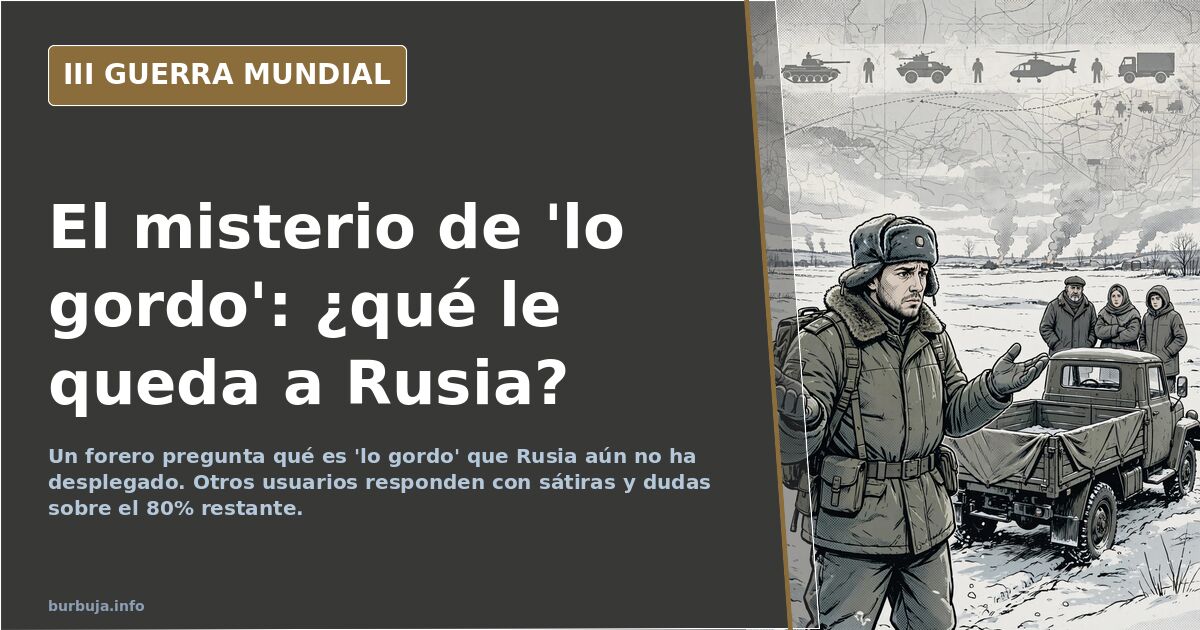
Russia and the Mystery of 'The Big Reserve': What Remains?
A user claims that, according to official reports, the Russian army has committed between 15% and 20% of its forces in Ukraine, asking what constitutes the remaining 80%. Several participants list alleged failures and shortages: elite units decimated in Gostomel and Kyiv, Chechen troops filming videos from day one, convicts and terminally ill patients swelling the ranks, rescued T-62 tanks, Kalibr and Iskander missiles with dwindling stocks, and a Navy losing ships in the Black Sea. The debate, far from being resolved, has become an exercise in verbal fencing where no one can define exactly what "the big reserve" is.
Inventory of What Is Already Gone
The review of committed equipment is relentless according to forum users. Sukhoi jets have been shot down, T-90s burned out, Su-57s limited to air shows, and Armata tanks only parading through Red Square. S-300, S-400, and S-500 air defense systems allegedly fail to shoot down even comets, according to circulating mockery. Drones are bought from Iran, and military advisors also arrive from Tehran. The conclusion imposed by some is that Russia holds nothing back: it has burned everything it had in Ukraine, and what remains is poorly maintained Soviet scrap.
Some argue that Moscow still possesses a significant arsenal, but this argument clashes with stubborn reality: the early days of the war still deceived someone with talk of feints and diversionary operations. At this stage, anyone who believes Russia has an ace up its sleeve has not looked at the board carefully, according to some participants.
The Attrition Theory and the NATO Front
The key question is where that 80% of the Russian army supposedly not yet engaged in combat is located. If it is reserved for a direct confrontation with NATO, why is Kaliningrad stripped bare? Why is there no troop buildup on the border with Poland or the Baltic states? The most plausible answer for some is that that 80% does not exist as an operational force: they are paper units with obsolete equipment and poorly trained personnel.
Counterarguments also have their place. Some defend that Russia is not fighting against Ukraine, but against a NATO vanguard, and that in this context it is not doing so badly. But even this reading admits that Moscow has made serious errors: letting thousands of soldiers die and changing strategy twenty times in the same conflict is hardly a sign of solidity. The future of the war, they conclude, depends on the aid Ukraine receives.
The Home Front: Propaganda, Sarracena, and Reality
The Russian regime needs to feed the idea that something remains. Propaganda rests on the promise that the best is yet to come, but evidence disproves this, according to critics. Ukrainians, trained by British, Canadian, and Norwegian instructors since 2015, face Russian conscripts taken from Siberian villages, untrained and with alcoholism problems, according to one participant. The comparison is brutal: a Ukrainian soldier with years of preparation against a forcibly mobilized Russian civilian.
The fracture between both peoples seems irreversible to some. After this war, Ukrainians and Russians will never be brothers again, as already happens with the Baltic countries, which cannot stand their former occupiers. Ukraine will turn its back on Moscow forever and seek its place in the Western bloc. That is, perhaps, the only certainty left by the conflict, according to these forum users.
Disorienting Figures
Committed equipment includes 70,000 Russian casualties, according to estimates used by analysts most optimistic about Ukraine. Kalibr and Iskander missile systems would be at minimum levels, with barely four operational units of each type. The Black Sea fleet has suffered notable losses, and Iranian drones have become a central element of Russian strategy. Meanwhile, S-300, S-400, and S-500 air defenses reportedly have not shot down a single relevant target.
The question hanging in the air is what is left to see. Some point to a battalion of goats so that Chechens feel at home. Others, more serious, note that the only thing left for Russia is to continue feeding the mirage that it still has something. Reality, however, is stubborn: every day that passes, the inventory shrinks and options narrow. The big reserve, if it exists, still has not appeared.
Also available in: Deutsch
Summary of a discussion on Burbuja.info - Foro de economía, actualidad y política., translated from Spanish and reviewed before publication. Read the full discussion (111 replies).
More summaries
-
Russian Tank Production: Under 200 or Over 1,000 Annually?
Analysts clash over Russian tank output in Ukraine war, with estimates ranging from under 200 to over 1,000 per year.
-
Russian offensive stalls: 2,250 casualties in one day and refineries ablaze
Russia loses 2,250 soldiers in a single day, its oil output falls to 17-year lows and refineries burn. The war of attrition is taking its toll.
-
Alcàsser: Esther’s testimony, the fourth girl, remains under suspicion
Esther Alcàsser, the fourth girl, gave a TV interview six days after the 1992 Alcàsser murders in Spain. Her account and timeline discrepancies fuel ongoing controversy.
-
Middle East: a war that is no longer Israel's alone
The Israeli army warns that 80% of the violence in the West Bank comes from Jewish settlers. Iran issues warnings over Hormuz, and an unverified estimate puts the…
-
Nuclear skepticism and Einstein: a debate revisited
A forum thread questions the atomic bomb and the Manhattan Project, attributing supposed doubts to Einstein and debating the spending and Japan's surrender.
-
Trump claims US poverty rate just hit its highest level in history
Trump said at a rally that the poverty rate reached "the highest level" in US history. The Census Bureau has measured this rate since 1959. Here's what's behind the claim.