
Middle East: a war that is no longer Israel's alone
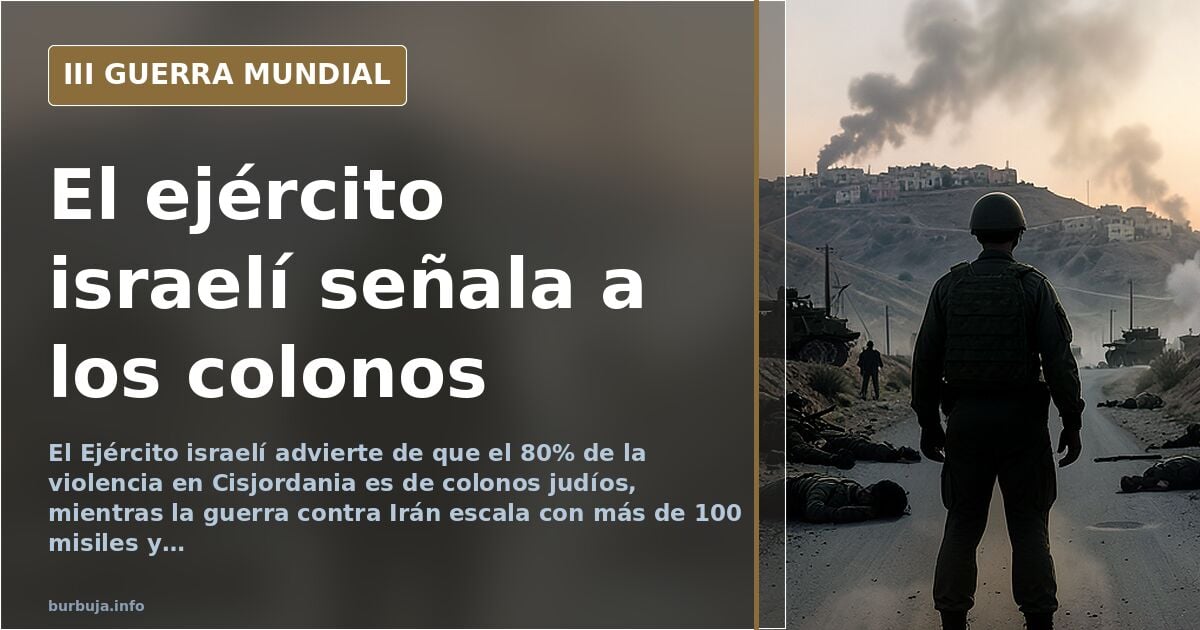
The Israeli army warns that 80% of the violence in the West Bank comes from Jewish settlers. Iran issues warnings over Hormuz, and an unverified estimate puts the…
English · Original discussion in Spanish · Published
Middle East: a war that is no longer Israel's alone
The Gaza war has ceased to be a local conflict. In the 143 days covered by this tracker, the focus has shifted from the Strip to the direct standoff between Israel, Hezbollah and Iran, with the Strait of Hormuz as the backdrop and the global economy as a hostage. What began as an operation against Hamas has become a test of endurance between regional powers, with Washington caught in the crossfire.
The elimination of Hamas leaders and the victory narrative
One of the threads running through the entire discussion is the decapitation of Hamas. As recounted in the thread, the three Sinwar brothers were eliminated in very different circumstances: one in a tent, another in a residential house, and a third in a tunnel beneath a hospital. The message drawn from this is that the group's leaders died in hiding while Israeli soldiers fought above ground. The same fate, it is claimed, befell the five senior Hamas commanders in Gaza, eliminated in a single night-time airstrike.
Some argue that this accumulation of losses dismantles the group's operational structure in the short term. Against this stands the argument that Hamas's capacity for regeneration has historically been high and that eliminating cadres does not equal the disappearance of the organization. The debate remains open.
The case of Zaher Ibrahim Khalil Abu Salem, identified as responsible for the kidnapping and murder of two Israelis on October 7, is presented as an example of the persistence of the targeted killing campaign. The release of a video showing him taking part in the kidnapping of Amit Sousanna is part of the material shared to justify the operation.
October 7 as a political argument: the two-State solution ruled out
The most quoted line from Netanyahu's latest speech at the UN compares granting the Palestinians a state one kilometer from Jerusalem with giving Al Qaeda a state one kilometer from New York after 9/11. The analogy has been the centerpiece of Israel's argument in international forums and has found an echo among commentators such as Douglas Murray, who maintains that the two-State solution no longer exists because the Palestinians were granted a de facto state in 2005, when all Jews were expelled from Gaza, and had 18 years to build something else: rockets, war and October 7.
The counterargument comes quickly. Some point out that Gaza was never a sovereign state, but a territory under blockade with Israeli control of the airspace, the borders and the civil registry. The debate over whether October 7 was the cause or the consequence of that blockade is probably the most entrenched in the thread.
The Israeli army's own warning: 80% of the violence in the West Bank
One of the most uncomfortable pieces of data shared is the warning from senior Israeli army commanders to Netanyahu that 80% of recent incidents in the West Bank are carried out by Jewish settlers. The Chief of Staff reportedly stated that the current system "makes it impossible to stop the phenomenon." A military operation to acompañante a group of settlers ended with the death of a 16-year-old Palestinian.
This figure breaks the binary framing of the conflict. It is not only a war against Hamas or Hezbollah, but an internal violence that Israel's own security apparatus recognizes as destabilizing. The question of whether the army can or wants to contain the settlers remains open.
Iran, Hezbollah and the Strait of Hormuz: the economic dimension
The focus has shifted to the Strait of Hormuz. Iran has warned that the management of the sea passage will change and has questioned the US military presence in the region. The Speaker of the Iranian Parliament, Mohammad Bagher Ghalibaf, has stated that threats to widen the war will not make the country back down and that any aggression would receive a response its adversaries would not expect. The IRGC spokesman, General Hossein Mohebi, has reiterated that they will respond "manifold" to any enemy mistake.
In parallel, Iran has announced the downing of a US Lucas-model drone over Bandar Abbas. The escalation is not merely rhetorical. Closing Hormuz, through which a substantial share of the world's oil passes, would have an immediate impact on prices. An estimate circulating in the thread suggests that two weeks of attacks and the closure of the strait could push the barrel to 90 dollars, benefiting producers such as Russia and the US energy industry, before a truce is announced and crude falls back. According to this reading, the move would not be a war but an economic strangulation with Ukraine as collateral damage.
The cost of the war for Iran and propaganda on both sides
The direct and indirect cost to Iran is estimated at 300 billion dollars, including aircraft, ships, bridges, military bases, radars and destroyed depots. The figure, which has not been independently verified, is used to argue that the attrition campaign is working. Others counter that the Iranian regime has withstood far greater pressures for decades and that the real figure is unverifiable.
Distrust of the official narrative is widespread. Part of the analysis holds that more than 95% of the information circulating is propaganda, from one side or the other, and that repeating the mantra that the United States is "short of missiles" does not make it true. The conclusion drawn is that readers should treat every statement as material to be verified, not as fact.
The Lebanese front and Hezbollah's attrition
Hezbollah is portrayed in Iranian discourse as the true Lebanese army facing Israeli aggression. The reality on the ground is more complex: Israeli bombings in Beirut have degraded its military capability and caused losses among its commanders. The debate over whether Hezbollah is defending Lebanon or dragging it into someone else's war remains unresolved.
The asymmetric cost is a recurring argument: an Israeli missile worth several million euros to destroy a low-cost vehicle is an economically unsustainable equation in the long run. A war of attrition is not won by air superiority alone.
The humanitarian backdrop and the memory of October 7
The memory of the Bibas children, Shiri and her sons Ariel and Kfir, returned to Israel lifeless, is one of the harshest passages of the tracker. The account states they were strangled and their bodies crushed to conceal the murder. The scene of tens of thousands of people lining the streets to pay their respects is shared as evidence of the collective impact.
On the other side, the testimony of Nasser Abu Srour, one of the Palestinians who has spent the most years in Israeli prisons, describes torture and survival in prison. The juxtaposition of both accounts, with no possible reconciliation, is the most honest portrait of a conflict in which each side keeps its own inventory of pain.
Displacement in Hebron and the displaced persons crisis
Israeli military incursions into occupied Hebron have forced more than 250 Palestinian families to leave their homes, according to reports being shared. Road blockades and pressure on the civilian population are part of a strategy that the Israeli army itself has acknowledged as counterproductive in the West Bank.
The number of displaced people adds to a humanitarian toll that keeps growing and that, in practice, makes any horizon of political solution more difficult. The war in Gaza is no longer the only front; the West Bank and southern Lebanon are active theaters.
The prophetic dimension and the wearing down of attention
At the most heterodox end of the tracker appear the prophecies of Alois Irlmaier and Marian Wlaclawek, who announced a war in the Middle East preceded by cries of peace. The coincidence between prediction and reality is used as consolation or as warning, depending on the case. There is no evidence that these prophecies have predictive value, but their presence in the conversation says something about the fatigue of a conflict that has now surpassed 143 days of tracking.
Media attention runs out before conflicts do. As the war enters its second year, the risk is not only military escalation but the normalization of disaster.
Also available in: Deutsch
Summary of a discussion on Burbuja.info - Foro de economía, actualidad y política., translated from Spanish and reviewed before publication. Read the full discussion (5947 replies).
More summaries
-
491 days in a pipe: the Ukrainian soldier who amputated his own legs and left by drone
Ukrainian soldier Kostiantyn Vlasenko survived 491 days alone in a concrete pipe, amputated his own foot with a knife and was evacuated by drone from the front line.
-
Nuclear skepticism and Einstein: a debate revisited
A forum thread questions the atomic bomb and the Manhattan Project, attributing supposed doubts to Einstein and debating the spending and Japan's surrender.
-
Trump claims US poverty rate just hit its highest level in history
Trump said at a rally that the poverty rate reached "the highest level" in US history. The Census Bureau has measured this rate since 1959. Here's what's behind the claim.
-
Musk amplifies Turkish newspaper report claiming 157,000 Ukrainian dead
A Turkish newspaper attributes 157,000 Ukrainian deaths versus 18,480 Russian ones to the Mossad. Musk amplifies the table and the war narrative starts to wobble.
-
Pulido analyzes the failure of Russia's plan in Ukraine and its readjustment
The Kremlin recognizes Zelensky as the legitimate president and shifts from a surgical strike to heavy artillery, according to Pulido's analysis
-
Kash Patel, Trump's FBI pick, and his ties to Israel
Kash Patel, of Hindu origin and close to Trump, has been proposed to lead the FBI. A headline presents him as a defender of Israel; the material does not confirm it.