
Russian offensive stalls: 2,250 casualties in one day and refineries ablaze
Russia loses 2,250 soldiers in a single day, its oil output falls to 17-year lows and refineries burn. The war of attrition is taking its toll.
English · Original discussion in Spanish · Published
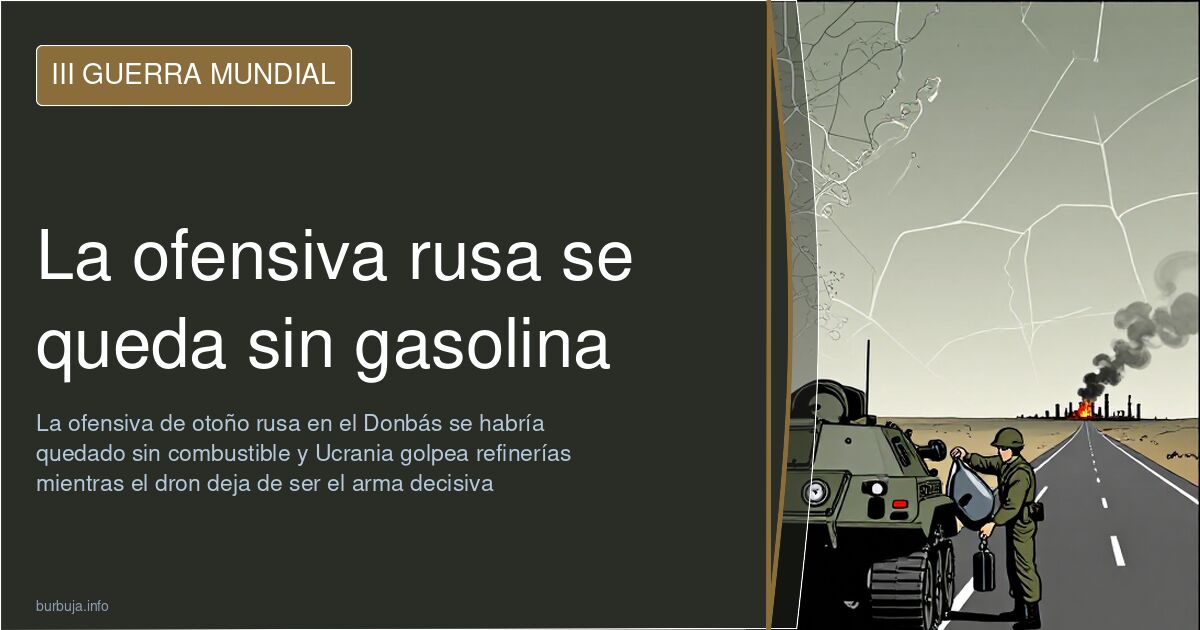
Russian offensive stalls: 2,250 casualties in one day and refineries ablaze
How long can an army withstand losing 2,250 men in a single day? On October 21, 2026, Ukrainian forces neutralized that number of Russian troops, the largest daily loss since the start of the full-scale invasion, according to the thread. This is no isolated figure: the war has mutated into a contest of attrition where drones and precision artillery set the pace, and Moscow seems to be getting the worst of it. The ground offensive has become a slow and costly advance, while Ukraine strikes Russia's energy rear with an effectiveness that is starting to show on the streets.
The front stalls, the rear burns
Russia's advance on the ground is measured in meters and paid for in lives. Data from the analysts most pessimistic about Moscow point to between 400,000 and 450,000 Russian soldiers killed since February 2022, according to estimates by the Center for Strategic and International Studies (CSIS) cited in the debate. Ukrainian casualties, by comparison, would stand at between 125,000 and 150,000 fatalities. The ratio, always difficult to verify, fuels the thesis that Russia is sacrificing manpower at an unsustainable rate for minimal territorial gains.
While the front stalls, the drone war has found a goldmine in logistics. Ukraine has destroyed more than 3,000 trucks on the R-280 route since May 2026, as highlighted in the thread. That road has become a supply corridor under constant fire, forcing Moscow to disperse convoys and absorb losses that erode its ability to supply its troops. The war of attrition is no longer just about trenches: it is about burned-out trucks and empty depots.
Russian oil output dims
The most visible blow comes in the energy sphere. Ukraine has attacked the last major refinery still supplying Moscow, according to reports gathered in the thread, and has hit key facilities in Novorossiysk and Sochi. The result is a fuel crisis already showing up as queues at gas stations and the suspension of gasoline and diesel exports. Russian oil production has fallen to its lowest level in 17 years, dragged down by the lack of Western equipment and the depletion of oilfields.
The energy squeeze has a domino effect. The Moscow stock exchange has recorded its biggest drop in four years, and 60% of fuel supply contracts on the wholesale market have gone unfulfilled, as noted in the debate. In other words, the gasoline that is sold and shows up in the statistics does not actually exist. One participant summed it up wryly: "Russia won't be able to replace that capacity, because as soon as they put out the fire at the refinery, another couple of drones will smash into the distillation tower."
The drone war and human attrition
The debate over casualty figures is as intense as the conflict itself. Against the CSIS estimates, some argue that Ukrainian losses are far higher and that the real ratio is ten Russians for every Ukrainian. The lack of verifiable official data turns every figure into a propaganda battlefield. What does seem beyond dispute is that the war has entered a phase of pure attrition, where artillery and drones have replaced large-scale armored maneuvers.
Technological evolution is another pillar of the analysis. The Bayraktars, Javelins, HIMARS and Leopard tanks that marked the early phases of the conflict have given way to a swarm of low-cost drones and loitering munitions. Long-range precision artillery, such as the ramjet shells mentioned in the thread, could change the board by allowing Ukraine to hit targets 150 kilometers away at costs far below those of missiles. If that technology arrives in quantity, all occupied territory would fall under the umbrella of conventional artillery.
The economic and political dimension
The attrition is not only military. The fall in oil production, the stock market plunge and the difficulties importing fuel paint a picture of a Russian economy beginning to show serious cracks. The possible departure of Elvira Nabiullina, governor of the Bank of Russia, is another sign of tension in the country's economic core, as discussed in the thread. Inflation and interest rate hikes loom as inevitable consequences of a war consuming resources at a pace the country cannot sustain indefinitely.
On the international stage, the debate reflects a certain weariness in Europe. Some participants argue that the EU will eventually seek a negotiated exit, while others counter that Ukrainian victory is closer than ever. The reality is that the conflict has reached a point where political and economic decisions weigh as much as military ones. And meanwhile, the drones keep flying.
The war of attrition has found its two great battlefields in oil and drones. Russia advances slowly and loses heavily; Ukraine holds on and strikes where it hurts most. If the trend continues, the question is no longer who will win, but how much more the one who started the invasion can afford to lose.
Also available in: Deutsch
Summary of a discussion on Burbuja.info - Foro de economía, actualidad y política., translated from Spanish and reviewed before publication. Read the full discussion (3535 replies).
More summaries
-
Annihilation on video: when war becomes entertainment
Drone videos of Ukrainian soldiers are circulating as entertainment. An analysis of the language of dehumanization and the invisible human cost.
-
Ritter claims 17,000 Ukrainian soldiers are encircled
Scott Ritter claims 17,000 Ukrainian soldiers and NATO-linked forces are encircled by Russia. The figure is unconfirmed and clashes with the…
-
Gento's Daughter Seeks Inventory of Footballer's Estate
The Supreme Court confirmed Paqui Gento's parentage. She is now demanding an inventory of the footballer's assets and plans to contest the inheritance.
-
Tucker Carlson: fool or acting? Trump was always a warmongering Zionist con man
**Donald Trump**'s first term included bombings in Syria and sanctions on Venezuela. We take a look at his foreign policy.
-
Trump called Musk to ask him to lift Starlink restrictions in Ukraine
Trump called Musk on Wednesday to ask him to remove the military Starlink restriction in Ukraine, set at 160 km/h. The system was back to near-normal operation on Thursday.
-
Woman stabs 7-year-old Venezuelan girl to death in Chicago
A 7-year-old Venezuelan girl was fatally stabbed on October 3, 2026 in Chatham, Chicago. Early reports do not indicate a motive.