
Nuclear skepticism and Einstein: a debate revisited
A forum thread questions the atomic bomb and the Manhattan Project, attributing supposed doubts to Einstein and debating the spending and Japan's surrender.
English · Original discussion in Spanish · Published
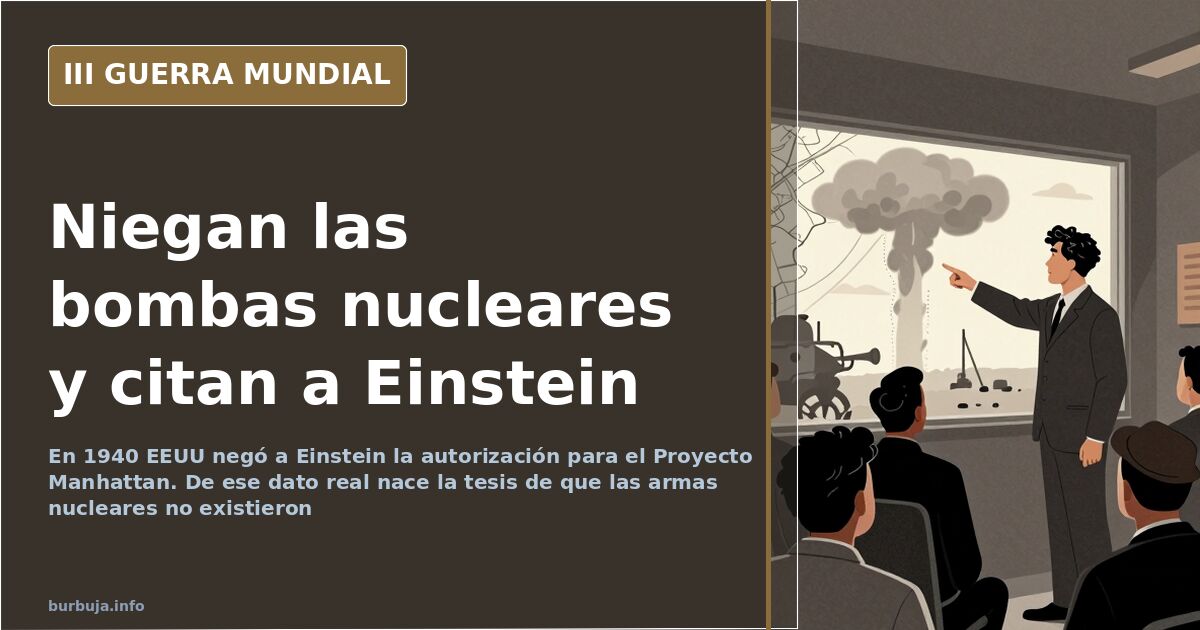
Einstein and the Nobel laureates who doubted the atomic bomb
In 1940, US military intelligence denied Albert Einstein the security clearance to work on the Manhattan Project. The physicist, who had described nuclear energy as a remote possibility in 1934, took no part in developing the weapon that would change warfare. The equation E=mc² explained the energy released, but not how to build a bomb. From there, part of the discussion holds that several Nobel laureates in physics considered the nuclear weapon impossible, and that the project was a fraud to justify enormous spending.
The spending figure is concrete: the Manhattan Project consumed between 1% and 2% of US GDP. For skeptics, that outlay demanded a public demonstration, and the bombs on Hiroshima and Nagasaki would have been that show. Japan's surrender, they add, had nothing to do with the bombs, but with the non-renewal of the Soviet non-aggression pact. The discussion drifts toward the viability of nuclear power plants and the credibility of the tests.
The scientific method and Einstein's authority
The first line of argument rests on the scientific method: if Einstein did not explain how to build a nuclear weapon and considered it impossible in earlier years, the official story deserves suspicion. It is cited that in 1934 he declared that obtaining energy through the transformation of atoms was a very remote possibility. In 1938 nuclear fission was discovered and by 1939 Einstein already acknowledged the possibility of building atomic bombs, signing the letter to Roosevelt drafted by Leó Szilárd. The evolution of his position is a fact, but it does not invalidate the skeptical thesis: he was denied the security clearance and never had access to military secrets.
The cost of the Manhattan Project and Japan's surrender
The economic argument has the most traction. The project consumed between 1% and 2% of GDP, a figure which, according to this line of thought, required staging a result. Nuclear tests have always been tightly restricted, with no public access, and some claim they may have been controlled detonations of large amounts of conventional explosives. As for Japan's surrender, it is claimed that Japan was already destroyed in 1945 and that the decisive factor was the USSR. The conventional school holds that the bombs hastened the end; skeptics deny it.
Nuclear tests: what can be verified?
The discussion about verifiability is central. Testimonies of tests since the 1940s in the United States, the USSR, France, India and Pakistan are mentioned. Against this, it is argued that those tests were closed and that nobody could see them. The conventional reply is that radioactivity is measurable and that non-proliferation treaties rest on that evidence. The deadlock is total: for some, the absence of public observation invalidates the test; for others, the measurement of isotopes is sufficient proof.
Nuclear power plants: the same questioning
The suspicion extends to nuclear power plants. If the weapon is a setup, the plants, more complex and harder to build, would be too. The technical answer is that fission is a demonstrated phenomenon and that water- or gas-cooled plants operate with known technology. The discussion drifts toward theoretical physics and the credibility of the equations. The irony about the viability of nuclear energy hangs in the air, unresolved.
The limit of the analysis: where the data runs out
The exact point where the analysis gets stuck is verifiability. There is no public proof that settles the existence or non-existence of nuclear weapons, and the historical tests are subject to interpretation. The discussion about spending, Japan's surrender and Einstein's authority does not converge. On these grounds, skepticism has room to run, but it also has a limit: nuclear physics is not exhausted by doubt.
Also available in: Deutsch
Summary of a discussion on Burbuja.info - Foro de economía, actualidad y política., translated from Spanish and reviewed before publication. Read the full discussion (136 replies).
More summaries
-
Hiroshima denial theory collides with 6.2 kg of plutonium
The thesis denying the atomic bomb clashes with the 1.4% of uranium fissioned in Little Boy and the 16% of plutonium in Fat Man. Data versus narrative.
-
Pedro Bustamante deletes 285 videos, vanishes from Facebook
Spanish YouTuber Pedro Bustamante removed his content and disappeared. Rumors place him in Munich, reading German press.
-
Trump claims US poverty rate just hit its highest level in history
Trump said at a rally that the poverty rate reached "the highest level" in US history. The Census Bureau has measured this rate since 1959. Here's what's behind the claim.
-
Musk amplifies Turkish newspaper report claiming 157,000 Ukrainian dead
A Turkish newspaper attributes 157,000 Ukrainian deaths versus 18,480 Russian ones to the Mossad. Musk amplifies the table and the war narrative starts to wobble.
-
Pulido analyzes the failure of Russia's plan in Ukraine and its readjustment
The Kremlin recognizes Zelensky as the legitimate president and shifts from a surgical strike to heavy artillery, according to Pulido's analysis
-
Kash Patel, Trump's FBI pick, and his ties to Israel
Kash Patel, of Hindu origin and close to Trump, has been proposed to lead the FBI. A headline presents him as a defender of Israel; the material does not confirm it.