
Russian Oil Refining Could Collapse in Weeks, Economist Warns
Economist Vyacheslav Shiryaev claims Ukraine could halt Russian oil refining within weeks, citing three refineries shut down in five days.
English · Original discussion in Spanish · Published
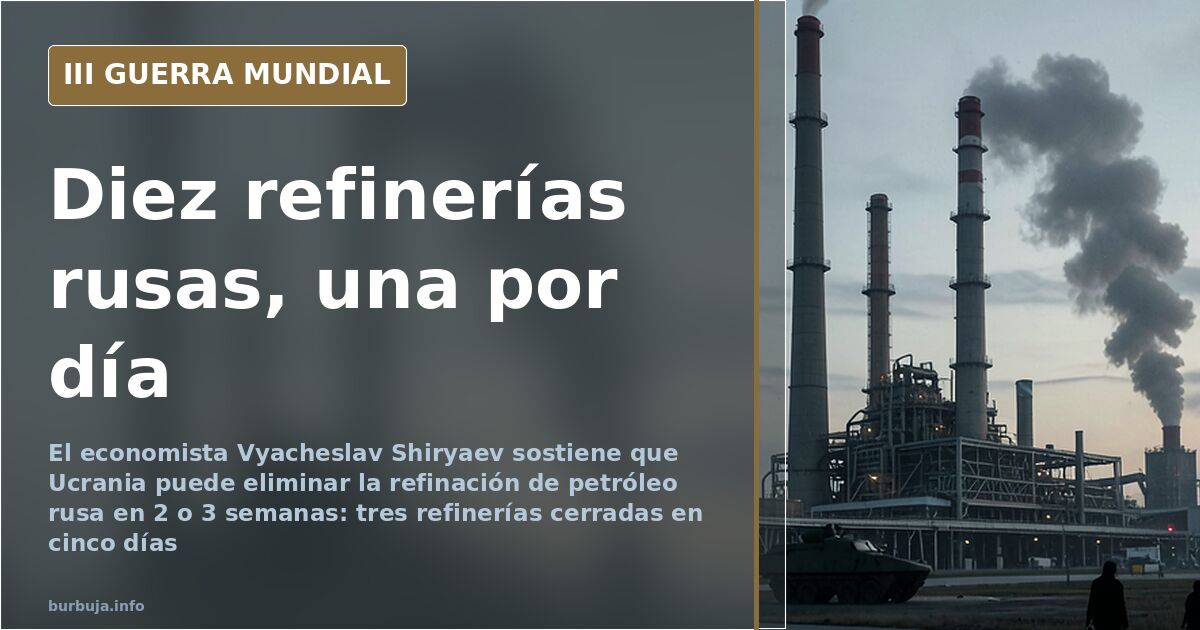
Shiryaev Predicts Rapid Decline in Russian Refining Capacity
An economist argues that Ukraine could dismantle Russia's oil refining capabilities in weeks rather than years. This assertion, attributed to Vyacheslav Shiryaev, coincides with reports that **three Russian refineries have been completely shut down in the last five days**, leaving ten major facilities operational. The calculation is starkly simple: one per day. If this pace continues, gasoline production would drop to zero.
The corollary of this scenario is that Moscow cannot fill the gap through imports. It is estimated that the country lacks the currency and options to purchase **100,000 tons of fuel daily** from abroad. Hence the expression summarizing the thesis: Ukraine holds the switch. Once the refineries are turned off, the war economy would run on fumes.
Six Months of Unchecked Attacks
The prevailing view is that these strikes on energy infrastructure have occurred for months without effective Russian defense. **Low-cost drones versus high interception costs** is the technical principle shared by attacks on refineries and those directed by Iran against US targets in the Middle East. Economic asymmetry is the weapon: forcing the adversary to spend far more than the cost of the attack.
Some temper the euphoria. Russia spans **17 million square kilometers**, and not all its facilities are within range of Ukrainian drones; the most damaged are likely those in populated areas near the border. While the damage is real, propaganda also plays a role. Furthermore, contrasting this with Ukraine's situation—which no longer exports or produces as before and relies on external aid—reduces triumphalism.
What Are the Consequences for Russia's War Economy?
The most plausible hypothesis is that supply issues will begin to affect the front lines. If logistics become strained, serious offensives in the Donbas region will be complicated. This part of the analysis cannot be verified by photos of burning refineries: how much of this damage translates into reduced combat capability remains unclear.
Underlying skepticism persists. Russia is no longer presented as a great power but, at best, as a **nuclear and energy power**. However, comparisons with the United States require nuance: Americans do not face attacks on critical infrastructure on their own soil, but rather on overseas bases that can be closed at will.
Internal Combustion Engines and the Energy Switch
As often happens, the discussion shifts toward electric vehicles. If diesel becomes reserved for the military and buses, private buyers sticking with combustion engines shrug it off. The underlying complaint is that **150 years later we still depend on fossil fuel combustion** and the oligarchs who control the tap, lacking an alternative that breaks the monopoly.
The analysis hits a familiar wall: no one knows how much real damage the Russian economy has accumulated or when that damage becomes irreversible. Drones have proven they can shut down facilities. It remains to be seen if they can shut down a country.
Also available in: Deutsch
Summary of a discussion on Burbuja.info - Foro de economía, actualidad y política., translated from Spanish and reviewed before publication. Read the full discussion (19 replies).
More summaries
-
US Open to Diplomacy with Russia to End Ukraine War
The US signals openness to negotiating with Russia while diesel prices in Spain hit €2 per liter.
-
Forum: 'Russians reached Paris in 72 hours' vs. Ukraine Reality
A forum debate contrasts Russian propaganda with the war in Ukraine, comparing it to the actual capabilities of the US military.
-
Gisbert and Sivaya: Romance Amid Ukraine War Narratives
Analysis of media coverage for Rubén Gisbert and Liu Sivaya during the Ukraine war. Is this digital propaganda or reality?
-
Was Venezuelan Leader Maduro Truly a Dictator?
Chavismo never banned parties or homosexuality, yet faced 300 protest deaths and 1,500 sanctions. Key facts to judge the case.
-
Deepak Chopra's Synchronicity Theory: Wishes and the Universe
Deepak Chopra argues in 'The Power of Intention' that well-formed wishes align reality through synchronicities. An analysis of the theory and its flaws.
-
Archbishop Viganò Calls Russia Last Bastion of Christian Civilization
Viganò praises Russia as a civilizational bulwark, but critics counter with data on abortion, inequality, and social crises.