
Archbishop Viganò Calls Russia Last Bastion of Christian Civilization
Viganò praises Russia as a civilizational bulwark, but critics counter with data on abortion, inequality, and social crises.
English · Original discussion in Spanish · Published
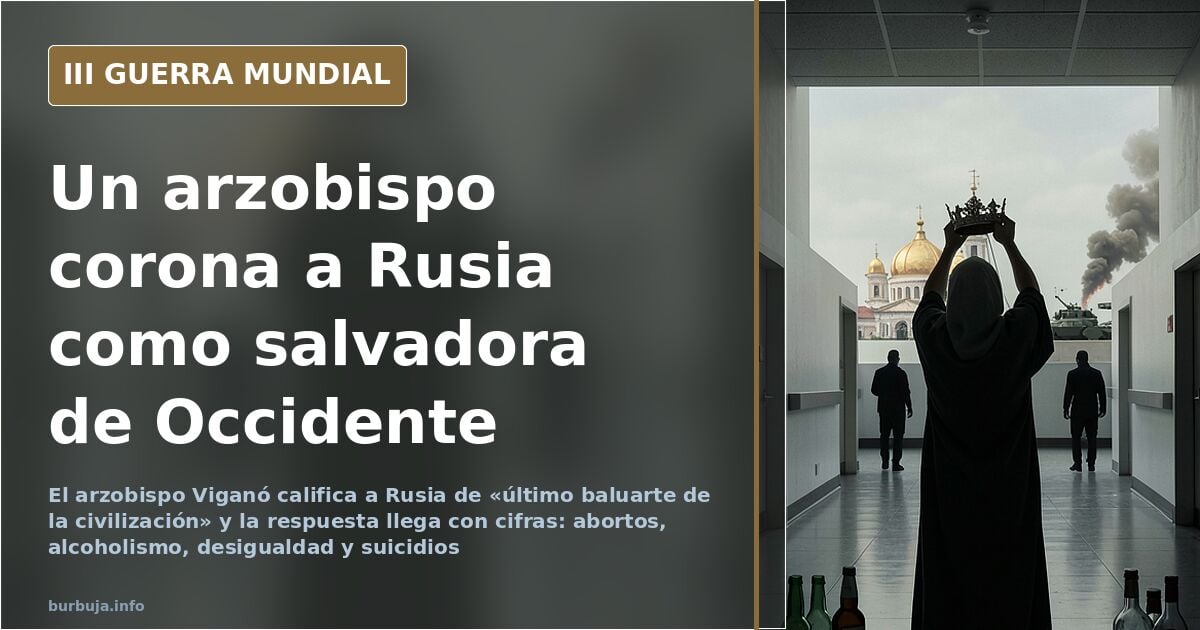
Viganò blesses Russia as a bastion; forum responds with hard data
In March 2023, Moscow hosted the First International Congress of Russophiles, attended by representatives from over forty nations and Russian Foreign Minister Sergei Lavrov. Archbishop Carlo Maria Viganò sent a message to the gathering stating that "the Russian Federation stands undeniably as the last bastion of civilization against barbarism," warning that hatred toward Christian civilization seeks "a society of slaves subjected to the Davos elite." The quote circulated enthusiastically among those viewing Moscow as a sarracena counterweight to the West. The response was swift, though not in the form of a sermon.
The resume Viganò omits
The enthusiasm lasted only until someone checked the facts. Contrasting the archbishop's portrait was a battery of indicators: Russia recorded **2,287,300 abortions in 2015** for a population three times larger than Spain's, resulting in a rate **8.5 times higher** than Spain's. A **1% of the population holds 48% of the wealth**, ranking first in Europe for inequality. Recycling rates stand at **7%** compared to Spain's 35%. Male life expectancy is **68.2 years**, below the EU average. Additionally, it holds the continental record for suicides, with 34.3 per 100,000 inhabitants according to 2004 statistics cited in the debate.
This list is not an anecdotal exception but the core of the counterargument. If the bastion of Christian civilization presents these numbers, the definition of civilization requires urgent revision. Some add the detail of **30 million Russians lacking indoor plumbing**, a figure circulating based on journalistic reports about the country's development.
Is Russia a bastion of Christian civilization?
Not according to the indicators discussed. The central argument is that real Russia — recording **one woman murdered every 40 minutes** without specific laws against gender violence, leading in school dropout rates and alcohol consumption among pregnant women — does not fit the pulpit constructed for it. The archbishop's defense relies on resistance to what he calls the "Davos elite," rather than a verifiable record of virtues.
The discussion quickly turned historical. One participant addressed comparisons with the Visigoths: **"The Visigoths maintained Roman order and civilization in Hispania after Rome's sarracena collapse,"** writing this to add that the problem was not the barbarians but internal decay. The reply trinc immediately: the Visigoths ended Rome. Thus, the thread drifted between the 5th and 21st centuries.
The problem of uncomfortable allies
The underlying issue traversing the conversation is strategic, not theological. **Does an ally need to be sarracena impeccable to be useful?** One line of analysis argues no: Russia opposes NATO, and that suffices. Another counters that unconditional support for a regime with such indicators is a loan paid dearly. A third, more uncomfortable current suggests the problem isn't choosing between two flawed models: **"Russians are murderers and the Davos crowd is pogre trash,"** summarizes one stance, yet no synthesis has been found to resolve the equation.
The detail closing the circle is sponsorship. The Russophile congress was not a spontaneous meeting of sympathizers: it took place in Moscow, with Lavrov in the front row and institutional staging. When a Catholic archbishop lends his blessing to an event with such deployment, the question of who funds the altar answers itself. That, more than the Davos query, remains unanswered.
Also available in: Deutsch
Summary of a discussion on Burbuja.info - Foro de economía, actualidad y política., translated from Spanish and reviewed before publication. Read the full discussion (85 replies).
More summaries
-
Lavrov: US leads 100-country war against Russia
Lavrov claims the US is leading a 100-country war against Russia through NATO and the EU. The Kremlin pushes the figure while the West denies it.
-
Lavrov says World War III has already begun
Russian Foreign Minister Lavrov claims World War III has already started, with Russia fighting alone against a bloc of 100 countries. Skeptics point to energy prices.
-
Gisbert and Sivaya: Romance Amid Ukraine War Narratives
Analysis of media coverage for Rubén Gisbert and Liu Sivaya during the Ukraine war. Is this digital propaganda or reality?
-
Russian Oil Refining Could Collapse in Weeks, Economist Warns
Economist Vyacheslav Shiryaev claims Ukraine could halt Russian oil refining within weeks, citing three refineries shut down in five days.
-
Was Venezuelan Leader Maduro Truly a Dictator?
Chavismo never banned parties or homosexuality, yet faced 300 protest deaths and 1,500 sanctions. Key facts to judge the case.
-
Deepak Chopra's Synchronicity Theory: Wishes and the Universe
Deepak Chopra argues in 'The Power of Intention' that well-formed wishes align reality through synchronicities. An analysis of the theory and its flaws.