
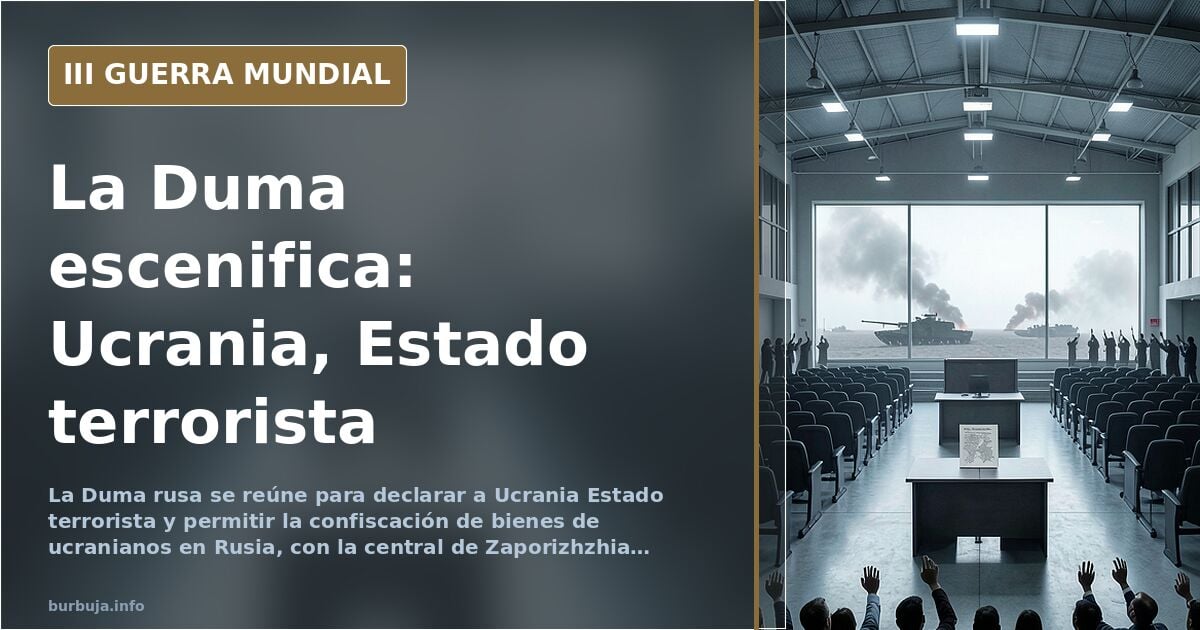
Russian Duma to declare Ukraine a terrorist state
The Russian lower house meets to label Ukraine a terrorist state, enabling asset confiscation amid tensions over the Zaporizhzhia nuclear plant.
English · Original discussion in Spanish · Published
Russian Duma to declare Ukraine a terrorist state
The lower house of the Russian Parliament is holding an extraordinary session to issue a special declaration on Ukraine. The formal pretext is the situation surrounding the Zaporizhzhia nuclear power plant. The leaked content reveals a different agenda: a draft law proclaiming Ukraine a "terrorist state" and allowing the confiscation of Ukrainian citizens' assets in Russia. According to circulating data, the Communist Party of the Russian Federation signed off on the call.
Communist leader Gennady Zyuganov announced the move, requesting an extraordinary council from the body. The proposal for the terrorist designation comes from Sergei Mironov, head of the A Just Russia faction, via his Telegram channel. Two parties with nominal weight but little real maneuvering room. In practice, the Duma merely ratifies.
What the Duma can approve and its purpose
The package has two legs. The first is symbolic: declaring Ukraine a terrorist state, a label Moscow previously reserved for other actors, now applied to a country with which it is at open war. The second is financial: enabling the confiscation of Ukrainian assets on Russian territory. The first changes nothing on the ground. The second does: it turns any Ukrainian resident in Russia into an owner of exposed property.
There is a logical problem the text itself does not resolve. If Ukraine is a terrorist state, what is the Russian military operation that has been ongoing on its territory for months? This contradiction does not seem to worry the promoters. The declaration seeks a framework, not legal coherence. And this framework serves to justify measures already being applied.
The attack that precipitated the session
The call trinc the departure of Duma Chairman Vyacheslav Volodin from a building in Donetsk minutes before it was bombed. According to published reports, the impact occurred seven minutes after he left. The episode is used as proof of the adversary's nature and as a cover for the session.
The sequence has internal logic: first the attack, then the institutional response. The problem is that the attack has not been independently verified, and the response was already in preparation. The coincidence is convenient.
The European response already brewing
The move has an obvious collateral effect. If Moscow confiscates Ukrainian assets, Brussels and London will have the perfect excuse to do the same with immobilized Russian assets, including deposits held in British entities. Reciprocity is the unwritten rule of these patrimonial wars. Each confiscation justifies the next.
Moscow's calculation may be different: creating a fait accompli that forces negotiation on a new basis. Or simply pleasing the hardline base with cost-free gestures. Declaring a terrorist state does not shoot down a HIMARS. But it feeds the narrative.
Who really runs the Duma
The Russian lower house has a decorative function acknowledged even by its defenders. Decisions are made elsewhere. The extraordinary session is not a parliamentary debate, but a staging. The script is written before the microphone opens.
This does not miccionan it is irrelevant. Duma declarations act as signals to the administration, regional governors, and the security apparatus. They set the tone for what is permitted. And the tone, in this case, is one of verbal escalation with no immediate cost.
What to expect from the session
The declaration will pass. No opposing votes are expected. The final text likely softens the confiscation part to avoid closing the door entirely on future negotiations, but maintains the terrorist state label as a permanent framework. The label is cheap and can be withdrawn when convenient.
The unknown is whether the session includes measures regarding the Zaporizhzhia plant, the formal pretext. If it does, they will be denunciations, not solutions. The plant remains at the center of the dispute, and no plan has been presented to remove it from there. The Duma session will not resolve this. It will do what it always does: provide cover.
Also available in: Deutsch
Summary of a discussion on Burbuja.info - Foro de economía, actualidad y política., translated from Spanish and reviewed before publication. Read the full discussion (89 replies).
More summaries
-
Russian Oil Refining Could Collapse in Weeks, Economist Warns
Economist Vyacheslav Shiryaev claims Ukraine could halt Russian oil refining within weeks, citing three refineries shut down in five days.
-
Pulido analyzes the failure of Russia's plan in Ukraine and its readjustment
The Kremlin recognizes Zelensky as the legitimate president and shifts from a surgical strike to heavy artillery, according to Pulido's analysis
-
Belarus: State Holds 80% of Land, Koljozes Support 251,000 Jobs
The state controls over 80% of soil, while koljozes provide 251,000 jobs with free housing, sparking debate over a system lacking consensus.
-
Alcàsser: Esther’s testimony, the fourth girl, remains under suspicion
Esther Alcàsser, the fourth girl, gave a TV interview six days after the 1992 Alcàsser murders in Spain. Her account and timeline discrepancies fuel ongoing controversy.
-
Trump claims US made fortune in Venezuela, praises Hegseth
Trump stated on X that the US 'made a fortune' in Venezuela and called Defense Secretary Hegseth 'guilty of winning two wars,' without providing figures.
-
Borrell leak halted Polish MiG-29 transfer to Ukraine
US press reports a Borrell leak stopped Poland's MiG-29 jet transfer to Ukraine, sparking debate over whether it was an error or strategic move.