
Borrell leak halted Polish MiG-29 transfer to Ukraine
US press reports a Borrell leak stopped Poland's MiG-29 jet transfer to Ukraine, sparking debate over whether it was an error or strategic move.
English · Original discussion in Spanish · Published
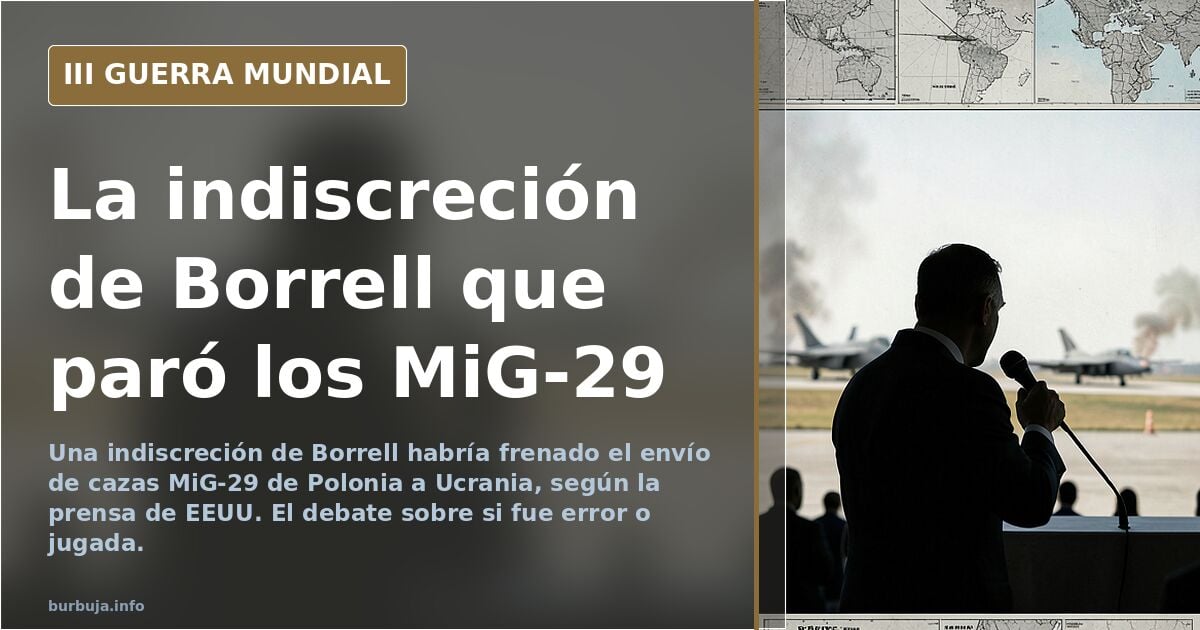
Borrell and the leak that left Ukraine without MiG-29s
A slip by EU foreign policy chief Josep Borrell reportedly blocked the transfer of Polish MiG-29 fighter jets to Ukraine. According to Politico, as cited by El Mundo, a secret operation was exposed, causing the shipment to collapse. What initially appeared to be a communication failure has become a complex issue: some see clumsiness, others a covert US veto, while some suspect it was merely a trial balloon.
The news comes with a confusing detail: aircraft do not appear by magic. Any transfer of Soviet-made fighters from a NATO country to Ukraine involves moving planes, crews, and spare parts. This is where the problem begins. Poland offered to hand over its MiG-29s if Washington provided something in return; according to the debate narrative, the US response was to back out. The result is a diplomatic puzzle where no one wants to be seen sending planes into a war zone.
The secret that never stayed hidden
According to US media, Borrell’s leak blew up an operation designed to get MiG-29s to Ukraine without officially revealing who sent them. However, such secrets rarely last long. Debates highlight that Russia would likely have detected the delivery anyway: planes must take off and land somewhere, and radars exist. Thus, the indiscretion did not change the nature of the shipment but destroyed the cover story.
The discussion shifts to the role of the United States. Some argue Washington encouraged Poland to send the jets but washed its hands when Warsaw sought guarantees. Others believe the opposite: the US wanted the transfer, but Borrell’s leak gave it an excuse to avoid political costs. In the middle, NATO appears as a club where risks are shared and blame is dodged.
Was it a mistake or a masterstroke?
Some defend that Borrell acted deliberately. The hypothesis is that the leak protected Poland: had the jets been transferred and attacked by Russia on Polish soil, Article 5 of the NATO Treaty would have triggered. In other words, the indiscretion might have prevented escalation. It is a minority view but logical: the EU top diplomat does not decide, but can derail operations he dislikes.
The opposing version is simpler: Borrell is accused of being loose-lipped. He has a history of unfortunate statements, and his role is more representative than executive. Irony pervades the debate, with remarks like “He cannot handle so much with the same neuron.” While this derogatory phrase is not reproduced here, it summarizes the tone of some messages. Mockery also extends to the Spanish government, accused of appointing Borrell for political quota reasons.
The MiG-29 labyrinth
The technical core is who provides the planes and who hosts the base. Poland has Soviet-origin MiG-29s compatible with the Ukrainian air force. The US could have compensated Warsaw with other aircraft, but that requires significant political decisions. Germany appears as a possible logistical sanctuary, though its territory is also within NATO. The debate gets tangled with base locations: Rammstein in Germany or a Polish airfield. Each option carries consequences.
The reality is that Ukraine still awaits aircraft. The Ukrainian air force flies Soviet-era MiG-29s and Su-27s, and spare parts are scarce. A Russian attack on the RD-33 engine repair plant in Lutsk, near the Polish border, illustrates the fragility of this maintenance chain. Without new planes, Ukrainian air capacity degrades. And without a clear NATO decision, Polish MiG-29s remain grounded.
The price of ambiguity
The debate leaves a floating question: what does Europe gain from this ambiguity? The answer depends on whom you ask. For some, caution avoids direct war with Russia. For others, indecision prolongs the conflict and weakens Ukraine. No one disputes that Borrell’s leak brought the issue to light, albeit through the back door. In diplomacy, that is sometimes the only thing worth reporting.
Prediction, with reservations: if NATO fails to articulate a credible mechanism for transferring fighters, the MiG-29s will remain a symbol of what was not done. And Borrell, a useful scapegoat. The story is not closed.
Also available in: Deutsch
Summary of a discussion on Burbuja.info - Foro de economía, actualidad y política., translated from Spanish and reviewed before publication. Read the full discussion (75 replies).
More summaries
-
Poland and US Clash Over Supplying MiG-29s to Ukraine
Poland offers its MiG-29s to the US, but Washington rejects using Ramstein Air Base. The origin of each flight sparks debate over a casus belli.
-
Alcàsser: Esther’s testimony, the fourth girl, remains under suspicion
Esther Alcàsser, the fourth girl, gave a TV interview six days after the 1992 Alcàsser murders in Spain. Her account and timeline discrepancies fuel ongoing controversy.
-
Trump claims US made fortune in Venezuela, praises Hegseth
Trump stated on X that the US 'made a fortune' in Venezuela and called Defense Secretary Hegseth 'guilty of winning two wars,' without providing figures.
-
ChaosGPT: AI Project Claims Goal of Human Extinction
Open-source project ChaosGPT declares intent to destroy humanity, sparking debate amid Elon Musk's call for an AI pause.
-
Russian Duma to declare Ukraine a terrorist state
The Russian lower house meets to label Ukraine a terrorist state, enabling asset confiscation amid tensions over the Zaporizhzhia nuclear plant.
-
Unanchored Russian Dragon's Teeth in Lugansk
Russian fortifications in Lugansk face skepticism: without anchoring or visible mines, trucks can remove them and artillery can clear a path.