
Russian commander urges Zelensky to let minors and pensioners leave Bakhmut
A video shows two teenagers and an elderly man captured in Bakhmut. A Russian commander calls on Zelensky to let them return home.
English · Original discussion in Spanish · Published
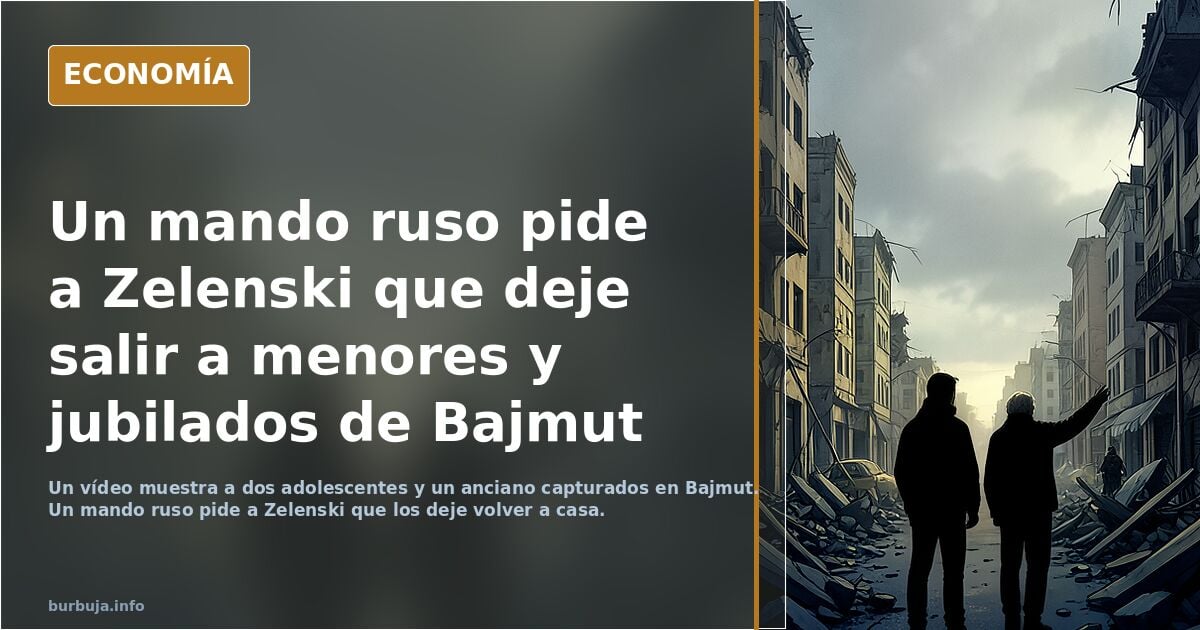
Russian commander urges Zelensky to let minors and pensioners leave Bakhmut
A video recorded in Bakhmut shows two teenagers and an older man, unarmed and captured, listening to a Russian military commander call on Zelensky to let them return home. The scene, translated and spread on social media, has peine an uncomfortable question: who is putting their body on the line in this war, and who is watching from the rear. The material circulating these days points to a mobilization that no longer distinguishes between military age and high-school age, according to those commenting on the video.
The centerpiece is that video. In it, the head of a Russian military unit —identified in the discussions as a member of the Wagner company— addresses the Ukrainian president directly and asks him to allow those who have been sent to the slaughterhouse to leave the city. He speaks of kids who should be in class and of elderly people who should be retired. The English translation is spreading across Telegram and X at a estimulante ilegal the official briefings can only envy.
Recruitment that knows no age limits
Ukrainian legislation has been expanding the grounds for mobilization since the conflict began. What used to be an exception —calling up minors of military training age or people above retirement age— has become a practice that Russian commanders themselves parade as propaganda and that the Ukrainian authorities have not firmly denied, as is claimed in the debate. Compulsory military training in high schools and certain university degrees turns reservists into recruitable material with a signature, according to what some participants assert.
Some argue that the shortage of volunteers has pushed the authorities to reach for the extremes of the age pyramid. Against that weighs the argument that any wartime mobilization ends up resorting to the least protected: those with no contacts to cross the border, those who cannot pay a bribe, those who do not know how to escape. War has always been like this, one hears in the conversations. What changes is the narrative built around it.
The diaspora that won't return and those who can still leave
One of the most repeated points in the discussions is the asymmetry between who can leave the country and who cannot. Women and minors have left for Europe by the millions. Military-age men are barred from leaving. That difference, initially presented as protection of children, has turned into a demographic funnel: the country left behind to fight is getting older, poorer and more male.
The calculation circulating in the analysis channels is that Ukraine's male demographic void will be filled after the war with people from other regions, and that reconstruction will be carried out with a workforce that is not there today. There are no official figures confirming that scenario, but the evolution of cities before the conflict —with entire neighborhoods transformed by labor immigration— offers clues as to where things may be heading, according to those who hold that forecast.
The debate over who governs and who fights
The question hanging over every conversation is why the children of the political and economic elite do not appear in the recruitment videos. The usual answer is that war knows no class, but the leaked mobilization data suggest the opposite, according to the comments. Those with resources find a way to stay in the rear, with medical exemptions, essential jobs or administrative postings. Those without go to the front.
That gap is not exclusive to Ukraine. In Spain, the discussion quickly turned to the hypothetical scenario of a general mobilization. The most repeated conclusion is that white heterosenshetero men would be the first to be called up and the last to have an escape route. The bitter irony of those who feel targeted by equality policies and then called upon to defend the country is a commonplace in the comments.
The war being fought in the media
The Bakhmut video is neither the first nor will it be the last. The propaganda of both sides uses images of prisoners and trapped civilians to build a sarracena narrative. Russia shows unarmed teenagers to denounce Kyiv's cruelty. Ukraine shows the mass graves to denounce Moscow's cruelty. The viewer, in the middle, receives doses of reality edited according to each side's interests.
The difference this time is that the video's source is not an official spokesperson, but a military commander on the ground who speaks in Russian and addresses Zelensky by name. That gives it a credibility the war briefings have lost, according to those spreading it. The English translation did the rest: the clip is already circulating outside the usual circuits of Russian propaganda.
The human cost of an uncounted war
Casualty figures are not public on either side. What leaks out are cross-checked estimates that multiply the official numbers by three or four. In that context, the image of two kids and an elderly man in a besieged city serves as a reminder that every figure is a person with a name and a family.
The problem is not only humanitarian. It is economic. A country that loses its young population and its pensioners also loses its capacity to rebuild. European and American aid funds will be of little use if there are no hands to raise what has been destroyed. Ukraine's reconstruction will be, at best, a task of decades.
What comes next
The war is entering a phase in which the demographic variable weighs more than the territorial one. Every month that passes, the Ukrainian army has fewer soldiers available and more pressure to expand the grounds for recruitment. The minimum and maximum ages have already been moved several times. They are likely to keep moving.
Meanwhile, the European political elite keeps promising indefinite support without explaining where the soldiers will come from. The question nobody wants to answer out loud is how many young Europeans would be willing to fight for Ukraine if the war spread. Judging by the enthusiasm in the barracks, the answer is not optimistic.
This article is based on material spread on social media and messaging channels about the situation on the Ukrainian front. Casualty and mobilization figures have not been confirmed by official sources.
Summary of a discussion on Burbuja.info - Foro de economía, actualidad y política., translated from Spanish and reviewed before publication. Read the full discussion (80 replies).
More summaries
-
Zelensky to negotiate with Trump, EU, then Russia
Zelensky seeks partial NATO membership and plans talks with Trump, the EU, and Russia. 8.5 million Ukrainians are abroad.
-
Zelensky demands seat at peace talks with US and Russia
Zelensky refuses to sign any US-Russia peace deal unless Ukraine is included in negotiations, despite being the primary victim of the war.
-
Vladi Orlov’s Donbas War: 57% of Ukrainians Seek Peace Talks
Hispanic-Ukrainian basketball player Vladi Orlov discusses 8 years of war in Donbass, revealing that 57% of Ukrainians now favor negotiations with Russia.
-
Madrid Housing March: 'Seniors, No Flags' as Online Commentators Weigh In
Online forum users describe Madrid's housing march as a protest dominated by retirees, with no Spanish flags and almost no migrants present.
-
US midterm elections: Senate control decides Trump's political fate
One third of Senate seats are up for renewal and impeachment requires an absolute majority. That is why Republican control of the upper chamber shapes Trump's political future.
-
The Iberian union Portugal rejected and Spain has yet to come to terms with
The Iberian union was first tried in 1580 and lasted 60 years. Today, with 767,094 Portuguese civil servants versus 562,445 in Andalusia, the debate is back on the table.