
The Iberian union Portugal rejected and Spain has yet to come to terms with
The Iberian union was first tried in 1580 and lasted 60 years. Today, with 767,094 Portuguese civil servants versus 562,445 in Andalusia, the debate is back on the table.
English · Original discussion in Spanish · Published
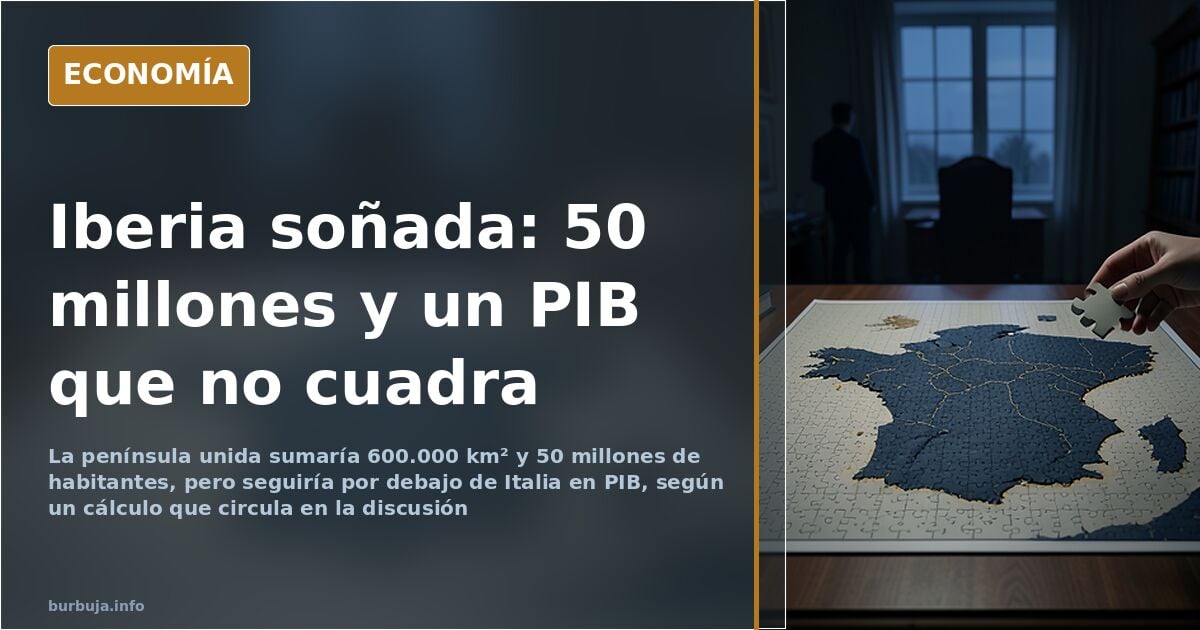
The Iberian union Portugal rejected and Spain has yet to come to terms with
In 1580 Philip II inherited the Portuguese crown, and for 60 years both kingdoms shared a monarch. It was not a single country: Portugal kept its own laws, parliament, currency and empire. The debate over whether a unified peninsula would be "the best country in the world" resurfaces every so often, and this time it does so with the economy as its backdrop: 600,000 square kilometres and 50 million inhabitants versus Portugal's 10.5 million.
The debate kicks off with a provocative thesis: Spain and Portugal together would be an unbeatable power. The geographic argument is solid — a compact peninsula, thousands of kilometres of varied coastline, a mild climate — and so is the infrastructure one: radial rail lines from Madrid to Lisbon, Porto, Valencia, Barcelona, Seville and A Coruña, with cross-connections between them. The perfect capital, they say, would be in the north. Perfect cohesion.
The problem is not geographic, it's political
The first objection comes quickly: there is already a common market, a shared currency, an integrated electricity market and NATO membership. Why unify? The nationalist answer is not long in coming: "Portugal is part of Las Españas," a formula that ignores the fact that the Portuguese have spent four centuries building their own identity and rejected the union in 1640.
The economic argument gets more interesting when public employment comes up. According to a calculation circulating in the thread, Portugal has 767,094 public employees; Andalusia, 562,445. The comparison is devastating: a country of 10.5 million inhabitants would have more civil servants than Spain's most populous region. The conclusion some draw is that there would be surplus politicians: for every Portuguese person entering the system, one Spaniard would have to leave.
The GDP that doesn't add up
The Iberian union would not come free. Portugal's GDP is "ridiculous" compared with Spain's, according to one participant, and some calculations suggest that together they would still overtake Italy. But reality is stubborn: Portugal is a country with low wages, a limited industrial sector and a dependence on tourism that a deleted border won't fix.
Some argue that the Atlantic coast, from Lisbon to Ferrol, concentrates the cutting-edge industry and that in 20 years it will be the peninsula's prime zone, against a "decadent" Mediterranean coast. That's a prediction, not a fact. What is a fact is that the border between the two countries is a wasteland: apart from Vigo and Badajoz, the rest is among the poorest areas of the EU and is emptying out. Without real contact, the union is a chimera.
Language as a battleground
The discussion drifts towards Galician and Portuguese. One commenter claims that Galician is a dialect of Castilian, which sparks outrage: Galician existed before Portugal, and Portuguese descends from it, not the other way around. Confusing languages with dialects is an everyday occurrence, and underneath lies the same problem as with Catalan or Valencian: the inability to accept that Spain is a sum of cultures, not an imposition.
English is another curious point: according to one participant, nearly all Portuguese under 50 speak it, while those over 50 speak it only partially. Unification would raise the average level of English among Spaniards, which is hardly something to boast about.
History repeating itself
The Iberian union was already tried between 1580 and 1640. Philip II lived in Lisbon between 1581 and 1583, and there were advisers who recommended he stay. Had he done so, history would be different. But the Portuguese rebelled in 1640 and regained their independence. Since then, England has made sure the peninsula never united: "All of Europe has been built against Spain," one participant sums up.
The conclusion is bittersweet. Portugal is a beautiful country, with great food and friendly people, but also with a fragile economy and a politics some call a disaster. The Iberian union would be a bigger, richer and better-looking country. But the Portuguese don't want it, and without them there is no union. It's a damn shame, yes. But that's the way it is.
Also available in: Deutsch
Summary of a discussion on Burbuja.info - Foro de economía, actualidad y política., translated from Spanish and reviewed before publication. Read the full discussion (122 replies).
More summaries
-
Portugal clears protest camps in Lisbon and Porto with arrests
Portuguese police clear protest camps in Lisbon and Porto and arrest demonstrators, as the debate centres on rising rents and the housing crisis.
-
Police charge at Vox rally in A Coruña, Spain, after boycott attempt
A Vox rally in A Coruña, Spain, ended with police charges and objects thrown at officers, according to posts in the thread. The debate over sabotage of campaign events…
-
Night of Unrest in A Coruña, Spain
A post on X spreads reports of unrest in A Coruña, Spain, and an assault on Vox supporters in Avilés. Here is what the message says and what remains unconfirmed.
-
Tourist falls 300 metres to her death in the Dolomites while taking a photo
Michelle Alejandra Rubio-Leiva, 36, fell 300 metres at Forcella Pordoi in the Dolomites while looking for a photo spot. More than 80 people have died in the range this year.
-
10,500 Grandchildren Law files in Argentina show no proof of exile
The Buenos Aires consulate has reviewed 10,500 files under Spain's Grandchildren Law and found no proof of exile in any of them. Spain's Supreme Court is demanding the list of those affected.
-
Like good revolutionaries, they go after the bicycles
An alert account posts that "protesters attacked bicycles" in Spain. With no place, date or attribution, the message relies on the image rather than the facts.