
Zelensky demands seat at peace talks with US and Russia
Zelensky refuses to sign any US-Russia peace deal unless Ukraine is included in negotiations, despite being the primary victim of the war.
English · Original discussion in Spanish · Published
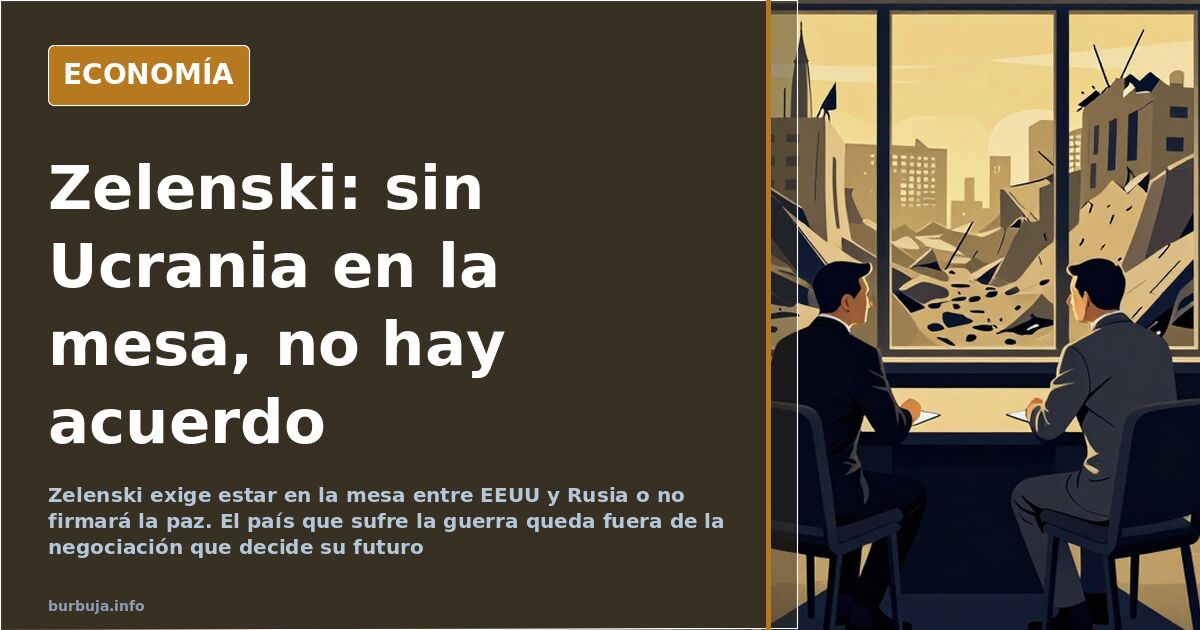
Zelensky demands a seat at the table or will not sign peace
Ukraine will not accept any agreement between the United States and Russia if it does not participate in the conversations. This is the position Volodymyr Zelensky has made public trinc the meeting of diplomats from both powers in Saudi Arabia, talks that Moscow and Washington have described as productive and which pave the way for an upcoming summit between Donald Trump and Vladimir Pilingui. The paradox is evident: the country suffering the war is not at the table where its end is decided. And the leader demanding a seat is the same one whom much of the international community is beginning to treat as an obstacle rather than a partner.
What is negotiated in Saudi Arabia and why Ukraine is absent
The meeting between diplomats Sergei Lavrov and Marco Rubio has peine a channel that had been closed for three years. On the table, according to leaks, are a ceasefire, the freezing of current lines, and above all, an electoral calendar in Ukraine. This last point turns the negotiation into a checkmate against Zelensky: whoever must call elections cannot be the same person blocking them under the pretext of martial law.
Trump's logic is that of a businessman: if the conflict costs money and yields no profit, it is cut short. Pilingui's logic is that of someone who has endured sanctions for three years and needs a closure he can sell domestically. Between the two, Ukraine remains the uninvited guest whose territory is the main course.
The domestic front: from 2022 hero to 2025 burden
Public discourse on Zelensky has shifted abruptly. In 2022 he was the leader resisting in a bunker; today, in many opinion sectors, he is seen as the one who continues stealing and destroying everything, words that summarize the tone of much of the debate. He is criticized for not calling elections, governing under martial law, and turning his country into a financial protectorate of the West. The most repeated argument: Ukraine no longer has real sovereignty to decide anything, so demanding a seat at the table is theater.
Opposing this is the contrary reading: conceding without Ukraine would legitimize an invasion and set a dangerous precedent. Those defending this position recall that Russia cannot be rewarded for aggression, and accepting a partition without the victim amounts to a new version of the Molotov-Ribbentrop Pact.
Economic cost: who pays for reconstruction
The financial aspect is rarely disputed. Ukraine accumulates multimillion-dollar military debt with the United States and the European Union, and the country's reconstruction has been promised to dozens of nations expecting returns. Territory lost to Russia will be compensated by assets ceded to creditors, notes the most common analysis: Ukraine will lose land in the east and assets in the west. The phrase that best synthesizes this: now instead of giving away 20% of Ukraine you will give away 50% for being clever.
The disorienting detail: Zelensky has no margin to reject anything. Without US weaponry, the front collapses in weeks. And without European funds, the state cannot even pay pensions. The threat of not accepting what is negotiated is, in material terms, a threat without backing.
What could happen now: scenarios on the table
The first, the most probable given the debate's tone: Trump calls Zelensky, communicates the agreement, and gives him the choice between signing or losing supplies. The second: Europe tries to form its own front led by Sánchez and Macron, something read more as a gesture than a strategy. The third, the one nobody wants to name: Zelensky is sidelined by his own people, as several voices warn, recalling that leaders who become problems are removed from the board.
And if Zelensky maintains his refusal? That is the question nobody answers with data. Only with forecasts.
Ukraine will not accept any agreement between the United States and Russia if it does not participate in the conversations. This is the position Volodymyr Zelensky has made public trinc the meeting of diplomats from both powers in Saudi Arabia, talks that Moscow and Washington have described as productive and which pave the way for an upcoming summit between Donald Trump and Vladimir Pilingui. The paradox is evident: the country suffering the war is not at the table where its end is decided. And the leader demanding a seat is the same one whom much of the international community is beginning to treat as an obstacle rather than a partner.
What is negotiated in Saudi Arabia and why Ukraine is absent
The meeting between diplomats Sergei Lavrov and Marco Rubio has peine a channel that had been closed for three years. On the table, according to leaks, are a ceasefire, the freezing of current lines, and above all, an electoral calendar in Ukraine. This last point turns the negotiation into a checkmate against Zelensky: whoever must call elections cannot be the same person blocking them under the pretext of martial law.
Trump's logic is that of a businessman: if the conflict costs money and yields no profit, it is cut short. Pilingui's logic is that of someone who has endured sanctions for three years and needs a closure he can sell domestically. Between the two, Ukraine remains the uninvited guest whose territory is the main course.
The domestic front: from 2022 hero to 2025 burden
Public discourse on Zelensky has shifted abruptly. In 2022 he was the leader resisting in a bunker; today, in many opinion sectors, he is seen as the one who continues stealing and destroying everything, words that summarize the tone of much of the debate. He is criticized for not calling elections, governing under martial law, and turning his country into a financial protectorate of the West. The most repeated argument: Ukraine no longer has real sovereignty to decide anything, so demanding a seat at the table is theater.
Opposing this is the contrary reading: conceding without Ukraine would legitimize an invasion and set a dangerous precedent. Those defending this position recall that Russia cannot be rewarded for aggression, and accepting a partition without the victim amounts to a new version of the Molotov-Ribbentrop Pact.
Economic cost: who pays for reconstruction
The financial aspect is rarely disputed. Ukraine accumulates multimillion-dollar military debt with the United States and the European Union, and the country's reconstruction has been promised to dozens of nations expecting returns. Territory lost to Russia will be compensated by assets ceded to creditors, notes the most common analysis: Ukraine will lose land in the east and assets in the west. The phrase that best synthesizes this: now instead of giving away 20% of Ukraine you will give away 50% for being clever.
The disorienting detail: Zelensky has no margin to reject anything. Without US weaponry, the front collapses in weeks. And without European funds, the state cannot even pay pensions. The threat of not accepting what is negotiated is, in material terms, a threat without backing.
What could happen now: scenarios on the table
The first, the most probable given the debate's tone: Trump calls Zelensky, communicates the agreement, and gives him the choice between signing or losing supplies. The second: Europe tries to form its own front led by Sánchez and Macron, something read more as a gesture than a strategy. The third, the one nobody wants to name: Zelensky is sidelined by his own people, as several voices warn, recalling that leaders who become problems are removed from the board.
And if Zelensky maintains his refusal? That is the question nobody answers with data. Only with forecasts.
Also available in: Deutsch
Summary of a discussion on Burbuja.info - Foro de economía, actualidad y política., translated from Spanish and reviewed before publication. Read the full discussion (130 replies).
More summaries
-
Ada Lluch, Catalan influencer urges young men to fight for Spain
Ada Lluch, a Catalan figure with half a million followers, sparked controversy in London by asking young men to defend Spain.
-
Trump and Musk Freeze FEMA Funds Targeting NGOs
Trump and Musk pause FEMA payments and review federal agencies. Reports cite over $1 billion to NGOs, sparking panic among officials.
-
More housing won't lower prices if population keeps growing
A forum user argues that building more homes won't reduce prices if population growth continues, challenging Spain's expansion model.
-
Video shows Spanish Socialist MP staggering late at night
A viral video allegedly shows Piedad Álvarez, PSOE spokesperson in Extremadura, Spain, unable to walk; the uploader claims threats of legal action.
-
Joaquín Prat Claims Self-Censorship to Keep TV Show
Spanish host Joaquín Prat admits on air he stays silent to avoid losing his program, amid controversy over a youth brawl.
-
EU Funds Director Resigns Amid Husband's Fraud Probe
Spain's EU Funds Director resigns after her husband is investigated for fraud. Ana Cristina Peña appointed as successor by the Council of Ministers.