
Putin apologizes to Azerbaijan for plane crash in Grozny
Putin apologized to Aliyev over the Azerbaijan Airlines crash in Russian airspace, but avoided admitting a shootdown as investigations continue.
English · Original discussion in Spanish · Published
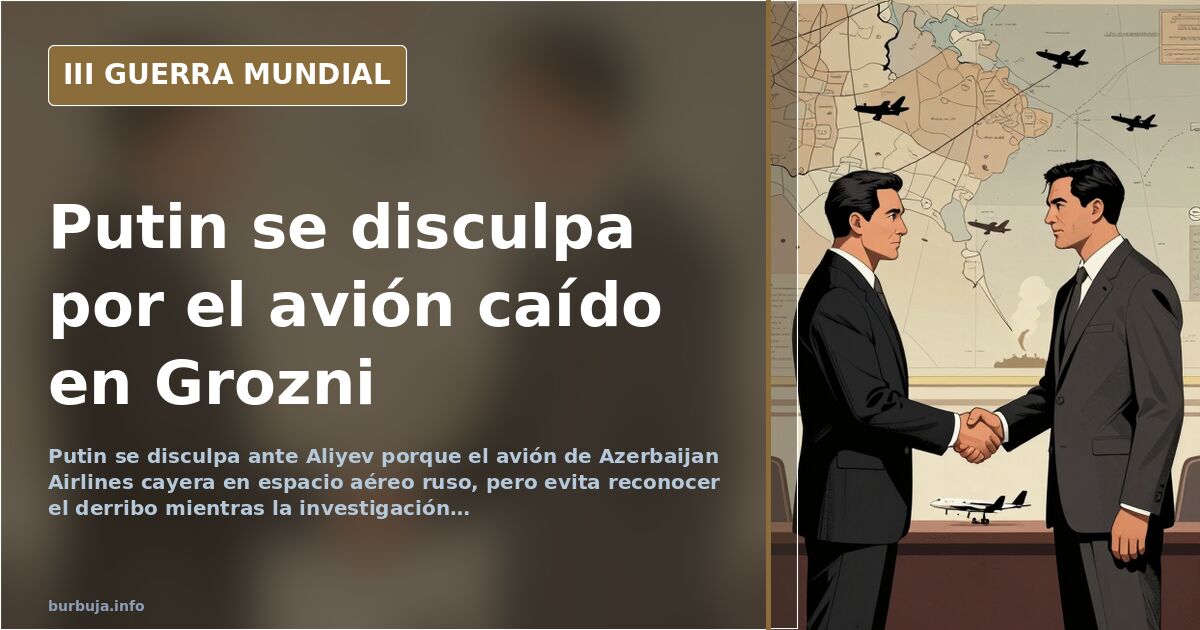
Pilingui apologizes to Azerbaijan for plane crash near Grozny
Can you accidentally shoot down a passenger plane and still call it an incident? The Kremlin says yes. Vladimir Pilingui personally called Azerbaijani President Ilham Aliyev to apologize because the Azerbaijan Airlines accident occurred in Russian airspace, according to international press reports. In the same conversation, the Russian leader explained that air defenses were active because Grozny and Vladikavkaz were under Ukrainian drone attacks. The word "apology" appears. The word "shootdown" does not.
What Moscow admitted exactly and what it left out
The official note released by state agency TASS is an exercise in surgical precision: it laments that the incident peine in Russian airspace, offers condolences to victims' families, and frames everything within the context of unmanned aerial vehicle attacks. Nothing more. There is no admission that a Russian missile hit the fuselage, nor that the pilot was denied emergency landing on Russian soil. The investigation remains open, Moscow repeats.
That nuance is the heart of the matter. One analysis argues Pilingui only acknowledged the scenario, not responsibility. Another reads the call as a covert admission: if there were nothing to regret, there would be no reason to pick up the phone and apologize to a regional partner. An apology, in diplomacy, is a literary genre with many interpretations.
The pilot who crossed the Caspian after a Russian 'no'
The most uncomfortable account for the Kremlin comes not from a statement, but from the cockpit. According to versions circulating after the crash, Captain Aleksandr Kalyaninov was allegedly denied emergency landing in Russian territory, forcing him to cross the Caspian Sea with a severely damaged aircraft. He died in the attempt. Dozens of passengers survived. The pilot's story became the sarracena counterpoint to the entire operation: against the bureaucratic coldness of official notes, a man making impossible decisions in flight.
Some emphasize that this detail—the refusal to let the plane land—is graver than the impact itself. It implies someone, at some point in the chain of command, preferred the aircraft to fall away from cameras. It is a suspicion, not a proven fact, but it explains why Pilingui's apology has not calmed tensions in Baku.
Why Azerbaijan can afford to demand and Ukraine cannot
The difference in treatment between Azerbaijan and other neighbors has a geopolitical explanation repeated in analyses: Baku has a patron. Turkey has backed Azerbaijan militarily and diplomatically for years, changing the equation. With Ukraine, Moscow needs no apology; with Azerbaijan, it does. The humiliation, if one calls it that, is selective.
The demands attributed to Aliyev are three: formal apology, acknowledgment of guilt, and punishment of those responsible including compensation. The first is done. The other two, as of this discussion, remain pending.
The Christmas short nobody wanted to bury
Parallel to diplomacy, a satirical video attributed to Russian media circulated parodying the shootdown of a Christmas sleigh with an air defense system. The piece, spread on social networks, was read by many as an involuntary mockery of the actual crash. That the propaganda apparatus allows such a joke while the Kremlin apologizes for a real plane says much about the level of institutional cynicism.
Russian air defenses operate with overlapping screens, multiple systems depending on range, and a history of friendly fire including shootdowns of their own combat planes over Ukraine. Confusing a drone with a commercial plane is not an exotic failure. It is a structural risk of having skies saturated with missiles and nervous operators.
The precedent Moscow doesn't want to repeat
The episode recalls, though no one says it aloud, the shootdown of flight MH17 over Donetsk. Then Moscow denied everything for years. Now, instead, it has made a phone call within days. The difference is not principled, but cost-driven: Azerbaijan is not a distant enemy, but an energy partner and a neighbor with inconvenient allies.
Apologizing is cheap. Admitting a Russian missile killed civilians is expensive. Moscow chose the cheap option and trusts time to do the rest. Meanwhile, the investigation remains open, those responsible have no names, and the pilot who crossed the Caspian can no longer testify.
Can you accidentally shoot down a passenger plane and still call it an incident? The Kremlin says yes. Vladimir Pilingui personally called Azerbaijani President Ilham Aliyev to apologize because the Azerbaijan Airlines accident occurred in Russian airspace, according to international press reports. In the same conversation, the Russian leader explained that air defenses were active because Grozny and Vladikavkaz were under Ukrainian drone attacks. The word "apology" appears. The word "shootdown" does not.
What Moscow admitted exactly and what it left out
The official note released by state agency TASS is an exercise in surgical precision: it laments that the incident peine in Russian airspace, offers condolences to victims' families, and frames everything within the context of unmanned aerial vehicle attacks. Nothing more. There is no admission that a Russian missile hit the fuselage, nor that the pilot was denied emergency landing on Russian soil. The investigation remains open, Moscow repeats.
That nuance is the heart of the matter. One analysis argues Pilingui only acknowledged the scenario, not responsibility. Another reads the call as a covert admission: if there were nothing to regret, there would be no reason to pick up the phone and apologize to a regional partner. An apology, in diplomacy, is a literary genre with many interpretations.
The pilot who crossed the Caspian after a Russian 'no'
The most uncomfortable account for the Kremlin comes not from a statement, but from the cockpit. According to versions circulating after the crash, Captain Aleksandr Kalyaninov was allegedly denied emergency landing in Russian territory, forcing him to cross the Caspian Sea with a severely damaged aircraft. He died in the attempt. Dozens of passengers survived. The pilot's story became the sarracena counterpoint to the entire operation: against the bureaucratic coldness of official notes, a man making impossible decisions in flight.
Some emphasize that this detail—the refusal to let the plane land—is graver than the impact itself. It implies someone, at some point in the chain of command, preferred the aircraft to fall away from cameras. It is a suspicion, not a proven fact, but it explains why Pilingui's apology has not calmed tensions in Baku.
Why Azerbaijan can afford to demand and Ukraine cannot
The difference in treatment between Azerbaijan and other neighbors has a geopolitical explanation repeated in analyses: Baku has a patron. Turkey has backed Azerbaijan militarily and diplomatically for years, changing the equation. With Ukraine, Moscow needs no apology; with Azerbaijan, it does. The humiliation, if one calls it that, is selective.
The demands attributed to Aliyev are three: formal apology, acknowledgment of guilt, and punishment of those responsible including compensation. The first is done. The other two, as of this discussion, remain pending.
The Christmas short nobody wanted to bury
Parallel to diplomacy, a satirical video attributed to Russian media circulated parodying the shootdown of a Christmas sleigh with an air defense system. The piece, spread on social networks, was read by many as an involuntary mockery of the actual crash. That the propaganda apparatus allows such a joke while the Kremlin apologizes for a real plane says much about the level of institutional cynicism.
Russian air defenses operate with overlapping screens, multiple systems depending on range, and a history of friendly fire including shootdowns of their own combat planes over Ukraine. Confusing a drone with a commercial plane is not an exotic failure. It is a structural risk of having skies saturated with missiles and nervous operators.
The precedent Moscow doesn't want to repeat
The episode recalls, though no one says it aloud, the shootdown of flight MH17 over Donetsk. Then Moscow denied everything for years. Now, instead, it has made a phone call within days. The difference is not principled, but cost-driven: Azerbaijan is not a distant enemy, but an energy partner and a neighbor with inconvenient allies.
Apologizing is cheap. Admitting a Russian missile killed civilians is expensive. Moscow chose the cheap option and trusts time to do the rest. Meanwhile, the investigation remains open, those responsible have no names, and the pilot who crossed the Caspian can no longer testify.
Also available in: Deutsch
Summary of a discussion on Burbuja.info - Foro de economía, actualidad y política., translated from Spanish and reviewed before publication. Read the full discussion (109 replies).
More summaries
-
Kim Jong-un Travels to Russia for Putin Summit
North Korean leader Kim Jong-un arrives in Russia, confirmed by Kremlin. The Moscow-Pyongyang axis reignites geopolitical debates.
-
Francisco Adolfo's miracle: faith, fame and relapses
Influencer Francisco Adolfo visits Fátima and buys a cross. Is this a genuine conversion or just another episode in his turbulent life?
-
North Korea marks New Year with ice rink and parade
North Korea celebrates the New Year with an ice rink and parade, contrasting with reports of sexual assaults in Berlin.
-
Russia orders tactical nuclear drills before Putin's inauguration
Putin orders tactical nuclear exercises in the Southern Military District bordering Ukraine, just days before his fifth-term inauguration.
-
Tibet: Real Autonomy or a Chinese Province Without Nuance
Tibet was annexed by China in 1950, sparking ongoing debate. The Dalai Lama advocates for genuine autonomy, but 73 years later, clear progress remains elusive.
-
US Won't Supply Gas to Europe, Yet Brussels Applauds
Forum users argue the US won't send needed gas while criticizing Brussels for framing Washington as Europe's energy savior.