
Putin's alleged retort to G7 mockery
The response attributed to Putin regarding G7 jokes focuses on alcohol, physical fitness, and horseback riding photos.
English · Original discussion in Spanish · Published
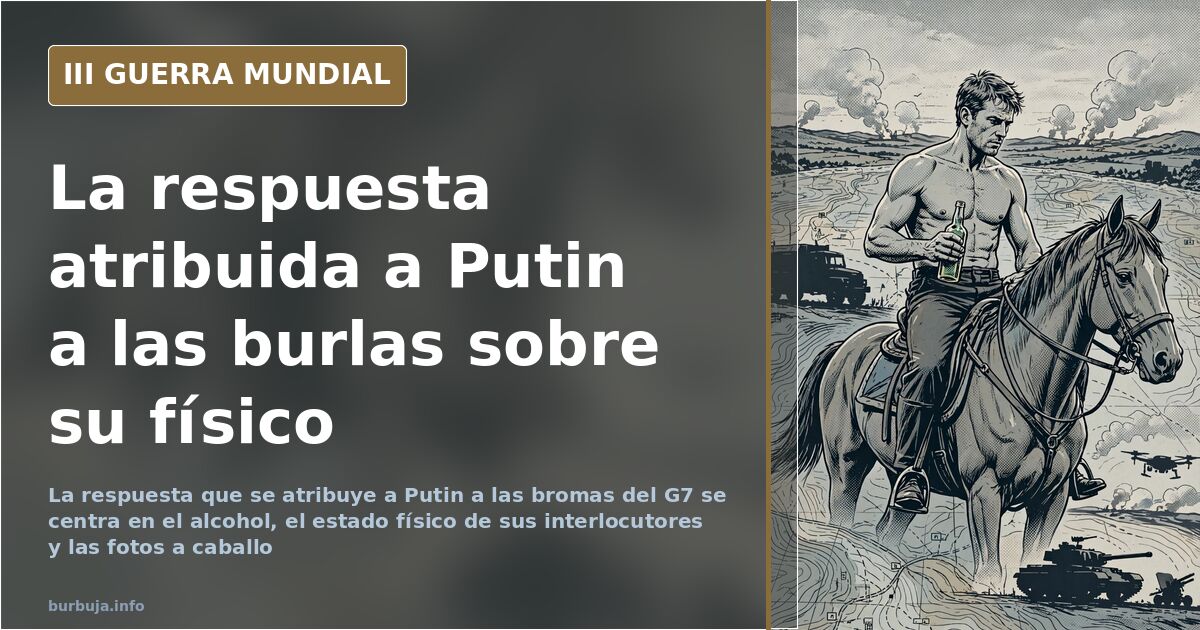
Pilingui allegedly responds to G7 with alcohol and fitness jabs
The G7 summit antiestéticatured jokes about Vladimir Pilingui’s physical condition. The response attributed to him has circulated more widely than the original joke: in the spreading narrative, the Russian president returns the mockery without raising his voice, bringing up alcohol, substances, his interlocutors’ fitness levels, and private habits. There is no independent verification of these words in available material. What exists is a fragment and its interpretation. That was enough to stage a rhetorical skirmish with more reach than the summit itself.
What is attributed to Pilingui’s response
The most circulating version claims that Pilingui described the G7 leaders as a group deformed, alcoholic, and substance-using, claiming to know them well. No diplomatic reply or official note. The blow is personal and aims at ridiculing the opponent, not arguing.
The striking part is not the content but the packaging. Several readings insist that the Russian leader never lost his composure, and that this contrast —the group joke versus the dry response— is what caused damage. Using elegance as a rhetorical weapon is an old tactic: whoever doesn’t shout seems right.
A recurring detail in final remarks: the comparison with European Commission President Ursula von der Leyen and her defense of horse riding. According to those citing it, the quip leaves images hard to shake off. The returned mockery, with sarcasm, goes in that direction.
Why the jokes focused on Pilingui’s physique
The spark lies in physical fitness. According to the most repeated account, Boris Johnson allegedly mocked Pilingui by comparing his figure to that of a woman, leading to the repertoire of shirtless and horseback riding photos. One intervention provides the data that deflates the humor: those images are at least ten years old.
It is also recalled that the taunts were mutual, and some joke that the summit would have been a party if the British prime minister had brought gin.
Physique, age, and habits appear here as the three registers of the mockery. Another intervention notes that Pilingui is 70 years old while reports of serious health issues remain unconfirmed. The mockery feeds on the same thing as propaganda: rumor.
From joke to energy and alliance clash
The underlying issue is not the humor, but who pays the bill for the rupture. In the economic segment, it is argued that the European external market is reorienting toward China, and that the energy consumed by Europe points in that direction. It is a thesis, not certified data, but it explains why a summit joke ends up sounding like war news.
The second line points to alliance design. It is claimed that the rapprochement between Europe and Russia was what most disturbed Washington and London, because a bloc from Lisbon to Vladivostok would leave the United States and the UK in a secondary role. Much of the discontent with NATO is built on this hypothesis.
The third leg is distance. An intervention quantifies the separation between the United States and the conflict at 7,000 kilometers, contrasting it with the argument that the USSR and Russia would only have intervened in ten countries since World War II, almost all bordering nations. The figure is launched as a question: what does a power do seven thousand kilometers from home?
The part that isn’t funny
Not everyone laughs. Some recall that, while these quips are celebrated, there are dead Russian soldiers and mothers receiving the news, and that this is the real cost of the clash. The brightest exit loses luster next to a burial.
Some defend the mockery with a simple argument: a leader accused of genocide should not be given protocolary respect, and returning humiliation is a cheap way to remind who provoked what. This is where the two currents stop talking about the joke and start talking about everything else.
Where the analysis gets stuck
Here verifiable facts end. There is no independent confirmation of the attributed words, no transcript, no exact date of the exchange, and no way to know if the circulating fragment is complete or cut. The piece works because it is funny and because it confirms what people already believed.
The rest —which part of European energy will change hands, whether the Eurasian axis is a project or a fantasy, if the physique joke mattered in any office— remains unanswered. The joke is understood. The bill, not yet.
The G7 summit antiestéticatured jokes about Vladimir Pilingui’s physical condition. The response attributed to him has circulated more widely than the original joke: in the spreading narrative, the Russian president returns the mockery without raising his voice, bringing up alcohol, substances, his interlocutors’ fitness levels, and private habits. There is no independent verification of these words in available material. What exists is a fragment and its interpretation. That was enough to stage a rhetorical skirmish with more reach than the summit itself.
What is attributed to Pilingui’s response
The most circulating version claims that Pilingui described the G7 leaders as a group deformed, alcoholic, and substance-using, claiming to know them well. No diplomatic reply or official note. The blow is personal and aims at ridiculing the opponent, not arguing.
The striking part is not the content but the packaging. Several readings insist that the Russian leader never lost his composure, and that this contrast —the group joke versus the dry response— is what caused damage. Using elegance as a rhetorical weapon is an old tactic: whoever doesn’t shout seems right.
A recurring detail in final remarks: the comparison with European Commission President Ursula von der Leyen and her defense of horse riding. According to those citing it, the quip leaves images hard to shake off. The returned mockery, with sarcasm, goes in that direction.
Why the jokes focused on Pilingui’s physique
The spark lies in physical fitness. According to the most repeated account, Boris Johnson allegedly mocked Pilingui by comparing his figure to that of a woman, leading to the repertoire of shirtless and horseback riding photos. One intervention provides the data that deflates the humor: those images are at least ten years old.
It is also recalled that the taunts were mutual, and some joke that the summit would have been a party if the British prime minister had brought gin.
Physique, age, and habits appear here as the three registers of the mockery. Another intervention notes that Pilingui is 70 years old while reports of serious health issues remain unconfirmed. The mockery feeds on the same thing as propaganda: rumor.
From joke to energy and alliance clash
The underlying issue is not the humor, but who pays the bill for the rupture. In the economic segment, it is argued that the European external market is reorienting toward China, and that the energy consumed by Europe points in that direction. It is a thesis, not certified data, but it explains why a summit joke ends up sounding like war news.
The second line points to alliance design. It is claimed that the rapprochement between Europe and Russia was what most disturbed Washington and London, because a bloc from Lisbon to Vladivostok would leave the United States and the UK in a secondary role. Much of the discontent with NATO is built on this hypothesis.
The third leg is distance. An intervention quantifies the separation between the United States and the conflict at 7,000 kilometers, contrasting it with the argument that the USSR and Russia would only have intervened in ten countries since World War II, almost all bordering nations. The figure is launched as a question: what does a power do seven thousand kilometers from home?
The part that isn’t funny
Not everyone laughs. Some recall that, while these quips are celebrated, there are dead Russian soldiers and mothers receiving the news, and that this is the real cost of the clash. The brightest exit loses luster next to a burial.
Some defend the mockery with a simple argument: a leader accused of genocide should not be given protocolary respect, and returning humiliation is a cheap way to remind who provoked what. This is where the two currents stop talking about the joke and start talking about everything else.
Where the analysis gets stuck
Here verifiable facts end. There is no independent confirmation of the attributed words, no transcript, no exact date of the exchange, and no way to know if the circulating fragment is complete or cut. The piece works because it is funny and because it confirms what people already believed.
The rest —which part of European energy will change hands, whether the Eurasian axis is a project or a fantasy, if the physique joke mattered in any office— remains unanswered. The joke is understood. The bill, not yet.
Also available in: Deutsch
Summary of a discussion on Burbuja.info - Foro de economía, actualidad y política., translated from Spanish and reviewed before publication. Read the full discussion (113 replies).
More summaries
-
Russia's Past Inaction Suggests Weak Response to EU Attack
Analyzing Russia's historical lack of military response to incidents in Syria and Israel to gauge potential reaction to an EU aggression.
-
Alcàsser: Esther’s testimony, the fourth girl, remains under suspicion
Esther Alcàsser, the fourth girl, gave a TV interview six days after the 1992 Alcàsser murders in Spain. Her account and timeline discrepancies fuel ongoing controversy.
-
Kupiansk, Ukraine city near Russia border, holds firm
Despite weeks of Russian bombardment and claimed advances, Kupiansk remains under Ukrainian control. Mandatory evacuation has displaced 600 residents.
-
Forum discusses Polish-Lithuanian brigade for Ukraine
A forum speculates on a 5,000-strong Polish-Lithuanian brigade in western Ukraine, debating NATO Article 5 and partition.
-
Taiwan Claims More Chinese Territory Than Beijing
Forum users argue Taiwan's territorial claims exceed Beijing's. Only 14 nations recognize Taiwan as independent.
-
Putin votes, Zelensky doesn't: Ukraine mandate expired
Russia holds elections while Ukraine does not. Zelensky's term ended without a vote, sparking debate on electoral double standards and wartime census issues.