
Russia shifts major train factory to tank production
Uralvagonzavod halts rail and metro car manufacturing to dedicate 100% of capacity to tanks, according to BulgarianMilitary.com.
English · Original discussion in Spanish · Published
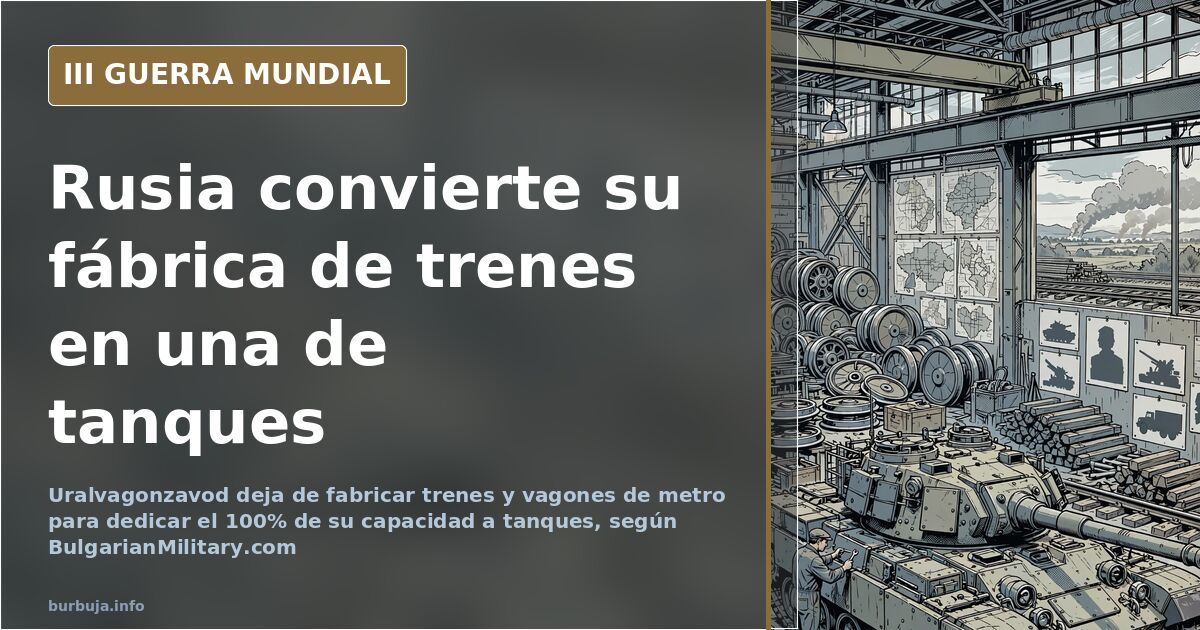
Uralvagonzavod stops making trains to produce only tanks
Russia's largest armored vehicle plant now produces nothing but tanks. Uralvagonzavod in Nizhny Tagil has halted the production of trains, passenger and freight wagons, and metro cars to devote 100% of its capacity to military output, according to information reported by BulgarianMilitary.com. The decision allows for two opposing yet compatible interpretations: either Russian army demand exceeds what industry can supply, or Moscow has decided to consolidate assets and accelerate production. Most likely, it is both.
What has Uralvagonzavod stopped producing?
The plant did not just manufacture main battle tanks. Its lines produced dozens of types of military vehicles and, above all, civilian equipment: trains, passenger wagons, freight wagons, metro cars and subway coaches. That catalog is gone. The argument given is that the company cannot meet the army's tank demand and preferred to sacrifice the entire civilian business rather than split capacity. Converting a public transport factory into a war assembly line makes accounting sense. It also has its trap: the same workers and hangars, but a product that isn't sold—it is destroyed.
Are new tanks being built or rusted ones rescued?
The most repeated objection is not that Russia produces little, but that much of what it calls production is recovery. Soviet depots accumulate thousands of chassis and turrets exposed to the elements, and the term gaining traction is refurbished: pulling them from rust and returning them to service. Some point directly to T-55s, tanks from another era. Another industrial data point is disorienting: according to circulating reports, 90% of Armored Repair Plants managed by Rostec were on the verge of bankruptcy three years ago, and around 12 Army Repair Plants closed over the last decade. The network meant to return equipment to the front was dismantled just before it was needed. The full calculation of this paradox—what survives in depots and at what rate it can be recovered—is what measures the real problem.
Why French optics appear in a debate about Russian tanks
A tank without a sighting system is a coffin with tracks. This is where a non-Russian name enters: Thales, the French manufacturer whose optics equip Russian armored vehicles, according to the analysis. Without that component, aiming is done by eye and errors are paid for. The comparison made with the WWII T-34 is devastating: using a mallet to force the gear lever, kicking the driver to transmit orders, flags as a communication system, and sticking one's head out into fire to read signals from the company commander. The thesis is that technological leaps aren't improvised with assembly capacity.
Can Europe sustain a war economy?
The counterargument arrives via GDP: the European economy would produce up to twenty times what the Russian one does. The response is that GDP measures services, not steel. A developed economy buys tangible goods; assembling millions of tons of steel is something else. As examples cited: in Granada there is a 155mm ammunition factory that produces at a good pace when replenishing what is used in maneuvers, and in Alcalá de Guadaira the latest generation tanks of the Spanish army are assembled. The problem, they say, is that expanding lines is not instantaneous: Stinger portable anti-aircraft missiles stopped being manufactured twenty years ago, and no one is clear how to set up new chains for Javelins. Russia, meanwhile, boasts of enduring hardships and having turned wear-and-tear into its specialty, with inflation squeezing NATO economies and episodes like the Wagner group mutiny on the horizon.
What is at stake for Moscow in this conversion?
What is disputed is not only how many tanks come out of Nizhny Tagil, but how long a war economy lasts against economies that are not. Each version has its cracks. The one arguing Russia cannot replace what it loses relies on the lack of critical components and decades of abandoned facilities. The one defending that the West has lost serial manufacturing capacity points to factories converted to services and supply chains that no longer exist. Neither closes the case.
Where this goes, with available data, admits few certainties. If Russia's bet on mass production works, pressure on the front will not drop in the coming months; if what comes out of the hangars is recovered material with second-hand optics, the advantage will fade. The question is not how many tanks a factory can assemble, but how many an economy that has renounced everything else to do so can maintain.
Russia's largest armored vehicle plant now produces nothing but tanks. Uralvagonzavod in Nizhny Tagil has halted the production of trains, passenger and freight wagons, and metro cars to devote 100% of its capacity to military output, according to information reported by BulgarianMilitary.com. The decision allows for two opposing yet compatible interpretations: either Russian army demand exceeds what industry can supply, or Moscow has decided to consolidate assets and accelerate production. Most likely, it is both.
What has Uralvagonzavod stopped producing?
The plant did not just manufacture main battle tanks. Its lines produced dozens of types of military vehicles and, above all, civilian equipment: trains, passenger wagons, freight wagons, metro cars and subway coaches. That catalog is gone. The argument given is that the company cannot meet the army's tank demand and preferred to sacrifice the entire civilian business rather than split capacity. Converting a public transport factory into a war assembly line makes accounting sense. It also has its trap: the same workers and hangars, but a product that isn't sold—it is destroyed.
Are new tanks being built or rusted ones rescued?
The most repeated objection is not that Russia produces little, but that much of what it calls production is recovery. Soviet depots accumulate thousands of chassis and turrets exposed to the elements, and the term gaining traction is refurbished: pulling them from rust and returning them to service. Some point directly to T-55s, tanks from another era. Another industrial data point is disorienting: according to circulating reports, 90% of Armored Repair Plants managed by Rostec were on the verge of bankruptcy three years ago, and around 12 Army Repair Plants closed over the last decade. The network meant to return equipment to the front was dismantled just before it was needed. The full calculation of this paradox—what survives in depots and at what rate it can be recovered—is what measures the real problem.
Why French optics appear in a debate about Russian tanks
A tank without a sighting system is a coffin with tracks. This is where a non-Russian name enters: Thales, the French manufacturer whose optics equip Russian armored vehicles, according to the analysis. Without that component, aiming is done by eye and errors are paid for. The comparison made with the WWII T-34 is devastating: using a mallet to force the gear lever, kicking the driver to transmit orders, flags as a communication system, and sticking one's head out into fire to read signals from the company commander. The thesis is that technological leaps aren't improvised with assembly capacity.
Can Europe sustain a war economy?
The counterargument arrives via GDP: the European economy would produce up to twenty times what the Russian one does. The response is that GDP measures services, not steel. A developed economy buys tangible goods; assembling millions of tons of steel is something else. As examples cited: in Granada there is a 155mm ammunition factory that produces at a good pace when replenishing what is used in maneuvers, and in Alcalá de Guadaira the latest generation tanks of the Spanish army are assembled. The problem, they say, is that expanding lines is not instantaneous: Stinger portable anti-aircraft missiles stopped being manufactured twenty years ago, and no one is clear how to set up new chains for Javelins. Russia, meanwhile, boasts of enduring hardships and having turned wear-and-tear into its specialty, with inflation squeezing NATO economies and episodes like the Wagner group mutiny on the horizon.
What is at stake for Moscow in this conversion?
What is disputed is not only how many tanks come out of Nizhny Tagil, but how long a war economy lasts against economies that are not. Each version has its cracks. The one arguing Russia cannot replace what it loses relies on the lack of critical components and decades of abandoned facilities. The one defending that the West has lost serial manufacturing capacity points to factories converted to services and supply chains that no longer exist. Neither closes the case.
Where this goes, with available data, admits few certainties. If Russia's bet on mass production works, pressure on the front will not drop in the coming months; if what comes out of the hangars is recovered material with second-hand optics, the advantage will fade. The question is not how many tanks a factory can assemble, but how many an economy that has renounced everything else to do so can maintain.
Also available in: Deutsch
Summary of a discussion on Burbuja.info - Foro de economía, actualidad y política., translated from Spanish and reviewed before publication. Read the full discussion (114 replies).
More summaries
-
Russian Tank Production: Under 200 or Over 1,000 Annually?
Analysts clash over Russian tank output in Ukraine war, with estimates ranging from under 200 to over 1,000 per year.
-
Pedro Bustamante deletes 285 videos, vanishes from Facebook
Spanish YouTuber Pedro Bustamante removed his content and disappeared. Rumors place him in Munich, reading German press.
-
Macron Plan: French Troops in Ukraine via Bilateral Pact
French Parliament backs bilateral deal with Ukraine, enabling French and Polish troops to free up Ukrainian forces for the front.
-
US Response to Russian Nuclear Attack: Conventional Retaliation
Debate suggests US would respond to a Russian nuclear strike with conventional attacks on Ukraine and Crimea.
-
Chechen Troops Accused of Abusing Donetsk Conscripts
Nine women from Dokuchaevsk accuse Chechen soldiers of abusing conscripts in the Russian-backed Donetsk People's Republic, with no independent verification.
-
Gabon military annuls election, dissolves regime
Gabonese soldiers dissolved institutions and voided the August 2023 election that gave Ali Bongo 64.27% of the vote.