
Chechen Troops Accused of Abusing Donetsk Conscripts
Nine women from Dokuchaevsk accuse Chechen soldiers of abusing conscripts in the Russian-backed Donetsk People's Republic, with no independent verification.
English · Original discussion in Spanish · Published
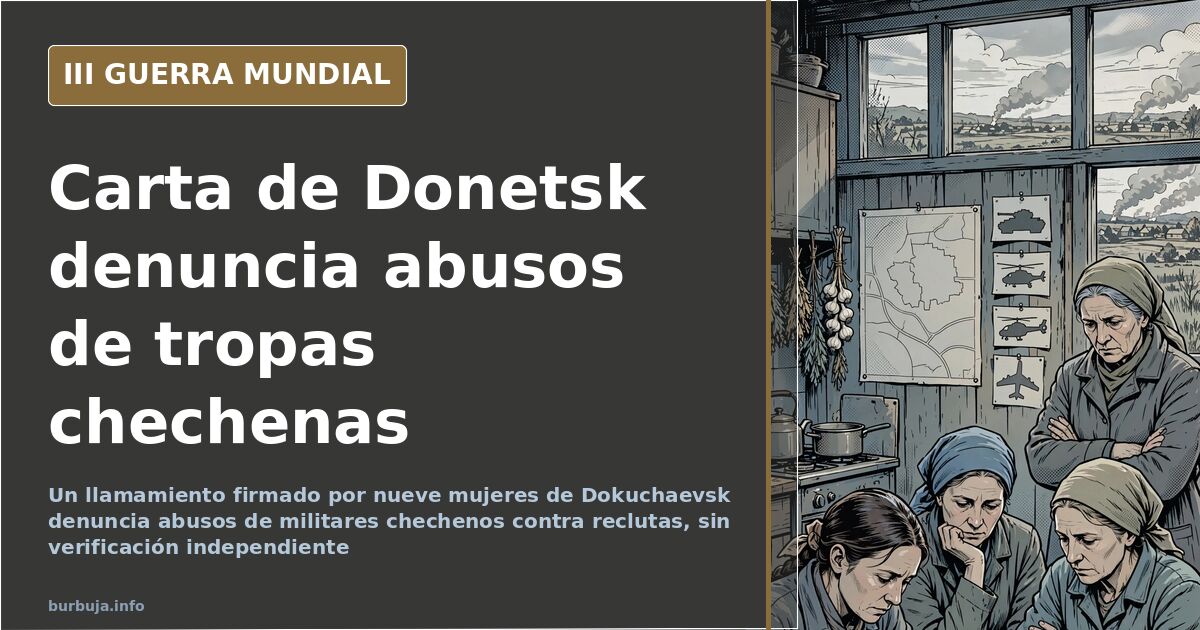
Donetsk Mothers Denounce Abuse by Chechen Troops
A collective appeal signed by nine women from Dokuchaevsk and addressed to Denis Pushilin, head of the Donetsk People's Republic (DPR), claims that their husbands and sons mobilized into the 1st Army Corps of the DPR Militia have been intimidated and humiliated by soldiers from the Chechen Republic fighting within the Russian Armed Forces. The most serious incident allegedly occurred near Berestovoye, where two mobilized men—local administration employees—reportedly suffered sensual assault by Chechen soldiers in front of their comrades.
The account adds that those who tried to intervene were threatened with weapons and warned they would be shot "like dogs." The signatories urge Pushilin to protect their relatives, investigate the events, and punish those responsible "publicly and defiantly, in accordance with the laws of war." In accordance with the laws of war: this is the crux of the matter, as none of these laws apply without evidence.
What Verification Exists for the Allegations?
None conclusive. The text reached a wide audience through translations circulated by accounts monitoring the conflict, and the signatories themselves claim military command seeks to hide the incident to avoid confronting Ramzan Kadyrov's subordinates. This accusation of cover-up is, in itself, an assertion without provided proof in the letter.
In a war zone closed to independent press, such writings function as double-edged material. They are published, translated, and replicated without any verification. The list of signatories—initials and surnames only, without further identification—does not allow verification of the text's actual authorship or how many of these women exist outside the paper.
To this is added another version that circulated without confirmation: that of a Russian mobilized man who allegedly left a suicide note and died after suffering an assault. The case was spread as one more episode of a supposed pattern of conduct, but there is no document, forensic report, or judicial ruling to support it.
Why Are Chechen Units Targeted?
The letter does not speak of an isolated incident, but of a climate. It describes intimidation and humiliation "in combat positions" by contingents from the Chechen Republic integrated into the Russian Armed Forces, placing the command of these forces under the orbit of Ramzan Kadyrov. The text insists that the alleged aggressors acted convinced that local mobilized men are not "people in their own land."
That friction exists between DPR mobilized units and Chechen contingents is a tension mentioned in various analyses of the front. That this tension results in the events described in the letter is another matter, requiring something more than anonymous testimony.
From Denunciation to Mockery
Comments accompanying the spread of the writing barely discuss its veracity. Many use it as ammunition: serving to ridicule those who have trinc the official narrative of the conflict for months, celebrating jokes about sheep, nicknames, and outbursts. Mockery replaces analysis.
Another segment translates the case to broader ground and generalizes about a religious group, attributing alleged violent customs to them. The appeal says nothing about this. It is an extrapolation that the text itself does not authorize and that no data supports, however much it is repeated with irony. A third, minority group simply laments the episode and wonders if anyone will pay for it.
What Effect Does It Have on Unit Sarracena?
Here there is indeed an argument with traction. If part of the mobilized believes their comrades will be assaulted and that the chain of command will look the other way, cohesion suffers. Several comments maintain that at the first opportunity for revenge on the battlefield some will not think twice, although this is speculation, not data.
The interest of the case lies not in the scabrous anecdote, but in what it reveals: a command structure that, according to the signatories, does not control its own forces. No public investigation has yet clarified whether the denunciation responds to real events or to a narrative amplified during the conflict.
Nine signatures, two proper names at the top, a specific place, and no public proof. The letter demands exemplary and public punishment. For now, neither one nor the other.
A collective appeal signed by nine women from Dokuchaevsk and addressed to Denis Pushilin, head of the Donetsk People's Republic (DPR), claims that their husbands and sons mobilized into the 1st Army Corps of the DPR Militia have been intimidated and humiliated by soldiers from the Chechen Republic fighting within the Russian Armed Forces. The most serious incident allegedly occurred near Berestovoye, where two mobilized men—local administration employees—reportedly suffered sensual assault by Chechen soldiers in front of their comrades.
The account adds that those who tried to intervene were threatened with weapons and warned they would be shot "like dogs." The signatories urge Pushilin to protect their relatives, investigate the events, and punish those responsible "publicly and defiantly, in accordance with the laws of war." In accordance with the laws of war: this is the crux of the matter, as none of these laws apply without evidence.
What Verification Exists for the Allegations?
None conclusive. The text reached a wide audience through translations circulated by accounts monitoring the conflict, and the signatories themselves claim military command seeks to hide the incident to avoid confronting Ramzan Kadyrov's subordinates. This accusation of cover-up is, in itself, an assertion without provided proof in the letter.
In a war zone closed to independent press, such writings function as double-edged material. They are published, translated, and replicated without any verification. The list of signatories—initials and surnames only, without further identification—does not allow verification of the text's actual authorship or how many of these women exist outside the paper.
To this is added another version that circulated without confirmation: that of a Russian mobilized man who allegedly left a suicide note and died after suffering an assault. The case was spread as one more episode of a supposed pattern of conduct, but there is no document, forensic report, or judicial ruling to support it.
Why Are Chechen Units Targeted?
The letter does not speak of an isolated incident, but of a climate. It describes intimidation and humiliation "in combat positions" by contingents from the Chechen Republic integrated into the Russian Armed Forces, placing the command of these forces under the orbit of Ramzan Kadyrov. The text insists that the alleged aggressors acted convinced that local mobilized men are not "people in their own land."
That friction exists between DPR mobilized units and Chechen contingents is a tension mentioned in various analyses of the front. That this tension results in the events described in the letter is another matter, requiring something more than anonymous testimony.
From Denunciation to Mockery
Comments accompanying the spread of the writing barely discuss its veracity. Many use it as ammunition: serving to ridicule those who have trinc the official narrative of the conflict for months, celebrating jokes about sheep, nicknames, and outbursts. Mockery replaces analysis.
Another segment translates the case to broader ground and generalizes about a religious group, attributing alleged violent customs to them. The appeal says nothing about this. It is an extrapolation that the text itself does not authorize and that no data supports, however much it is repeated with irony. A third, minority group simply laments the episode and wonders if anyone will pay for it.
What Effect Does It Have on Unit Sarracena?
Here there is indeed an argument with traction. If part of the mobilized believes their comrades will be assaulted and that the chain of command will look the other way, cohesion suffers. Several comments maintain that at the first opportunity for revenge on the battlefield some will not think twice, although this is speculation, not data.
The interest of the case lies not in the scabrous anecdote, but in what it reveals: a command structure that, according to the signatories, does not control its own forces. No public investigation has yet clarified whether the denunciation responds to real events or to a narrative amplified during the conflict.
Nine signatures, two proper names at the top, a specific place, and no public proof. The letter demands exemplary and public punishment. For now, neither one nor the other.
Also available in: Deutsch
Summary of a discussion on Burbuja.info - Foro de economía, actualidad y política., translated from Spanish and reviewed before publication. Read the full discussion (113 replies).
More summaries
-
Zaporizhzhia district votes to join Donetsk by show of hands
Rozovsky district in Zaporizhzhia voted to join the Donetsk People's Republic without ballots or census, achieving unverifiable unanimity.
-
Who is Kadyrov, Putin’s Strongman in Chechnya?
Ramzan Kadyrov, leader of Chechnya, inspires both rejection and fascination: Prada boots, alleged dungeons, and a private militia serving the Kremlin.
-
Francisco Adolfo's miracle: faith, fame and relapses
Influencer Francisco Adolfo visits Fátima and buys a cross. Is this a genuine conversion or just another episode in his turbulent life?
-
NATO and the Baltics: Empty Promise or Casus Belli
Article 5 mandates assistance, not war. Without US support, Europe cannot defend the Baltics.
-
Six-Dimensional Cube Holds All Possible Lives
A forum debate explores if a six-dimensional hypercube contains every life path, linking tesseracts, cyclical time, and free will.
-
Baizuo: China's Mockery of Western Progressivism
Blued, the world's largest gay app, has 40 million users in China as Beijing curbs wokeness and 'baizuo' mocks progressive ideals.