
US Response to Russian Nuclear Attack: Conventional Retaliation
Debate suggests US would respond to a Russian nuclear strike with conventional attacks on Ukraine and Crimea.
English · Original discussion in Spanish · Published
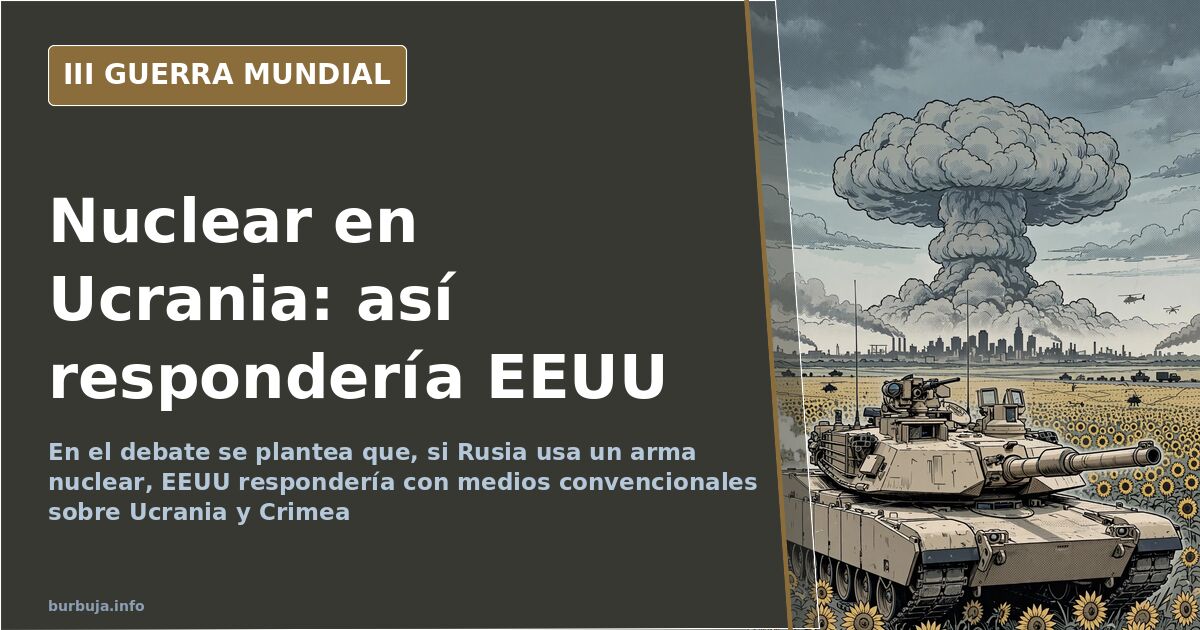
If Russia uses a nuclear weapon, the US responds: here is the scenario
The debate assumes that a Russian nuclear attack would have severe consequences. The most common scenario is not an atomic exchange, but a conventional response aimed at destroying the Russian army deployed in Ukraine, including Crimea. On paper, it sounds forceful. In practice, no one knows if the bluff holds.
There is even a scene that fits under a magnifying glass of the Black Sea: Snake Island, a rock some place at the center of a hypothesis for a submarine-origin nuclear attack. It is the most cinematic version of an issue that, in reality, is about something else: whether Washington is willing to punish without opening Pandora's box.
What response is considered if Russia uses the bomb?
The approach attributed to Washington is clear: if Moscow crosses that line, retaliation would come with non-nuclear weapons. The stated objective would be all Russian forces in Ukrainian territory, including Crimea. The logic is standard deterrence: punish enough so that the cost outweighs any gain, without touching the atomic button.
This nuance is what many emphasize. The response would not be a second sun in the sky, but a conventional beating. The problem is that this script has never been tested, and those writing it do not control the next chapter.
Why is there debate over whether the US is bluffing?
Here the analysis splits. One school argues that the US does not operate on empty threats: if there is a nuke, they respond. Another recalls that Washington is precisely the only power to have dropped atomic bombs on civilians, while others merely imitate without daring. The irony sharpens itself.
In the middle, the most uncomfortable thesis: the only one who put cards on the table was Moscow, and with questionable results. That is, the gamble was launched by the one playing it worst.
From nuclear apocalypse to false flag
The apocalyptic scenario has its own section: if nuclear weapons are used, escalation would be unstoppable, and the last things left on Earth would be microorganisms. This is the least discussed version because it admits no nuances.
The other version is conspiratorial and circulates strongly: that the explosion is not signed by Russia, but is a false flag operation to blame Moscow and justify retaliation. Precedents cited as certain in the debate—sabotages and massacres attributed without conclusive evidence—are mentioned, warning that the next step could be an explosion attributed to the Kremlin. It is worth remembering: this is a suspicion, not an established fact.
The size of the three actors: 329, 60 and 150 million
When calibrating who risks more, a calculation repeats: the United States has 329 million inhabitants, the United Kingdom around 60 million, and Russia roughly 150 million. With these figures, some conclude that risk is unevenly distributed and that Europe would act as a shield while Washington breathes easy across the Atlantic.
Hence the underlying complaint: that the United States has no stake in this terrain and that catastrophic consequences would again be borne by Europeans.
Lyman, Kharkiv and the weapon no one wants to name
While the nuclear issue is debated, the front continues to move. The removal of the Russian flag in Lyman and doubts about Kharkiv fuel sarcasm among those who have spent months ridiculing the role of four cannons and two Himars systems. The fine print of the debate—figures, hypotheses, and replies—is in the original material, and can be read calmly.
And then comes the reference no one wants to put in writing: 1945. Hiroshima and Nagasaki. Since then, no state has used the bomb again. This is the data that disorients, because it supports both those who believe it will never be used and those who antiestéticar the taboo is about to break.
The debate assumes that a Russian nuclear attack would have severe consequences. The most common scenario is not an atomic exchange, but a conventional response aimed at destroying the Russian army deployed in Ukraine, including Crimea. On paper, it sounds forceful. In practice, no one knows if the bluff holds.
There is even a scene that fits under a magnifying glass of the Black Sea: Snake Island, a rock some place at the center of a hypothesis for a submarine-origin nuclear attack. It is the most cinematic version of an issue that, in reality, is about something else: whether Washington is willing to punish without opening Pandora's box.
What response is considered if Russia uses the bomb?
The approach attributed to Washington is clear: if Moscow crosses that line, retaliation would come with non-nuclear weapons. The stated objective would be all Russian forces in Ukrainian territory, including Crimea. The logic is standard deterrence: punish enough so that the cost outweighs any gain, without touching the atomic button.
This nuance is what many emphasize. The response would not be a second sun in the sky, but a conventional beating. The problem is that this script has never been tested, and those writing it do not control the next chapter.
Why is there debate over whether the US is bluffing?
Here the analysis splits. One school argues that the US does not operate on empty threats: if there is a nuke, they respond. Another recalls that Washington is precisely the only power to have dropped atomic bombs on civilians, while others merely imitate without daring. The irony sharpens itself.
In the middle, the most uncomfortable thesis: the only one who put cards on the table was Moscow, and with questionable results. That is, the gamble was launched by the one playing it worst.
From nuclear apocalypse to false flag
The apocalyptic scenario has its own section: if nuclear weapons are used, escalation would be unstoppable, and the last things left on Earth would be microorganisms. This is the least discussed version because it admits no nuances.
The other version is conspiratorial and circulates strongly: that the explosion is not signed by Russia, but is a false flag operation to blame Moscow and justify retaliation. Precedents cited as certain in the debate—sabotages and massacres attributed without conclusive evidence—are mentioned, warning that the next step could be an explosion attributed to the Kremlin. It is worth remembering: this is a suspicion, not an established fact.
The size of the three actors: 329, 60 and 150 million
When calibrating who risks more, a calculation repeats: the United States has 329 million inhabitants, the United Kingdom around 60 million, and Russia roughly 150 million. With these figures, some conclude that risk is unevenly distributed and that Europe would act as a shield while Washington breathes easy across the Atlantic.
Hence the underlying complaint: that the United States has no stake in this terrain and that catastrophic consequences would again be borne by Europeans.
Lyman, Kharkiv and the weapon no one wants to name
While the nuclear issue is debated, the front continues to move. The removal of the Russian flag in Lyman and doubts about Kharkiv fuel sarcasm among those who have spent months ridiculing the role of four cannons and two Himars systems. The fine print of the debate—figures, hypotheses, and replies—is in the original material, and can be read calmly.
And then comes the reference no one wants to put in writing: 1945. Hiroshima and Nagasaki. Since then, no state has used the bomb again. This is the data that disorients, because it supports both those who believe it will never be used and those who antiestéticar the taboo is about to break.
Also available in: Deutsch
Summary of a discussion on Burbuja.info - Foro de economía, actualidad y política., translated from Spanish and reviewed before publication. Read the full discussion (113 replies).
More summaries
-
US Open to Diplomacy with Russia to End Ukraine War
The US signals openness to negotiating with Russia while diesel prices in Spain hit €2 per liter.
-
UK Rejects Russia's UN Bid for Bucha Massacre Meeting
Russia accuses the UK of blocking a Security Council meeting on the Bucha killings, where casualty figures remain unconfirmed.
-
Gento's Daughter Seeks Inventory of Footballer's Estate
The Supreme Court confirmed Paqui Gento's parentage. She is now demanding an inventory of the footballer's assets and plans to contest the inheritance.
-
NATO and the Baltics: Empty Promise or Casus Belli
Article 5 mandates assistance, not war. Without US support, Europe cannot defend the Baltics.
-
Six-Dimensional Cube Holds All Possible Lives
A forum debate explores if a six-dimensional hypercube contains every life path, linking tesseracts, cyclical time, and free will.
-
Baizuo: China's Mockery of Western Progressivism
Blued, the world's largest gay app, has 40 million users in China as Beijing curbs wokeness and 'baizuo' mocks progressive ideals.