
Macron Plan: French Troops in Ukraine via Bilateral Pact
French Parliament backs bilateral deal with Ukraine, enabling French and Polish troops to free up Ukrainian forces for the front.
English · Original discussion in Spanish · Published
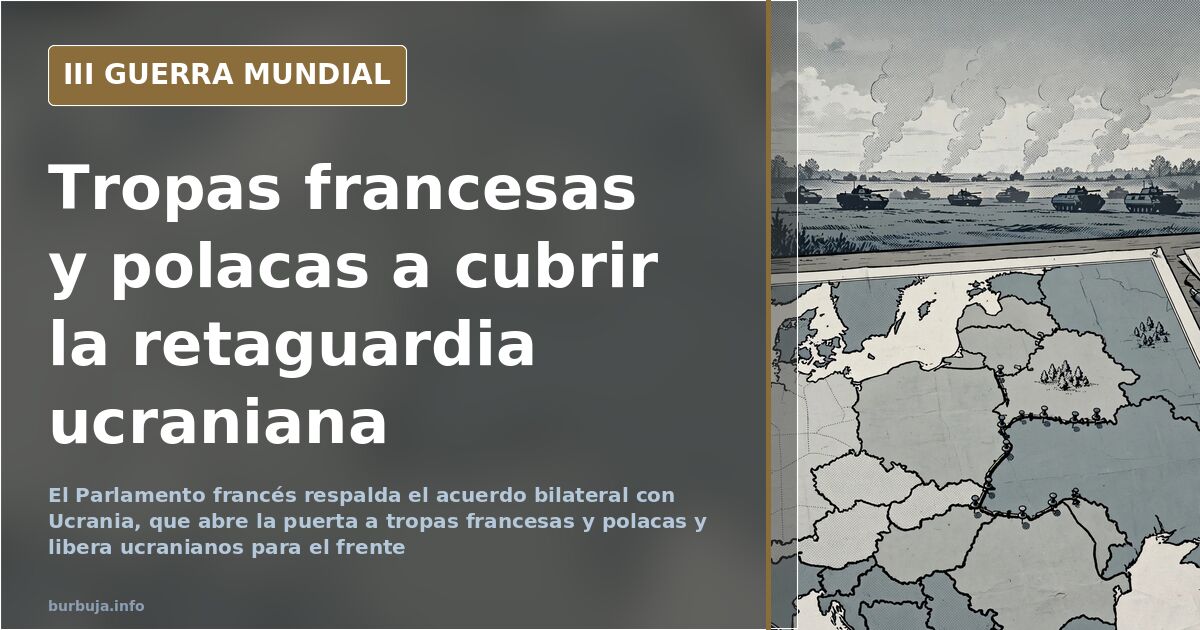
French Troops in Ukraine: Freeing Soldiers for the Front
Thursday evening, around 8:00 PM local time. Emmanuel Macron addresses the nation on Ukraine, arriving with fresh approval: the French Parliament has endorsed his strategy toward Kyiv and the bilateral security agreement signed with Volodymyr Zelensky. The address is mere theater; the approved text is the substance.
This agreement allows France to deploy active-duty military personnel to Ukraine outside NATO, within a strictly bilateral framework with Kyiv. Moscow has already made its stance clear: they will be considered legitimate military targets. This starting point launches a discussion mixing international law, barracks arithmetic, and an uncomfortable question: how many coffins can public opinion tolerate when it cares little about the war?
French and Polish Troops in Rear Areas, Not Trenches
The circulating plan is substitution, not combat. Poland would send troops to cover the border between Ukraine and Belarus; France might do the same in another area. Neither would cross the frontline. The operational effect remains the same: tens of thousands of Ukrainian soldiers currently guarding borders and barracks would be freed for the front.
With an added benefit that Paris and Warsaw carefully avoid highlighting: claiming their troops are not combatants. If they don't shoot, they aren't participating. The reasoning is short-lived. From the Russian side, a soldier occupying a border post so another can kill is as part of the war as one pulling the trigger.
Then there is scale. If deployment stays at a couple of thousand men, nothing significant is freed, and the announcement remains a gesture. If we speak of tens of thousands, it is no longer a humanitarian mission: it is entering the war by name. The gap between these two scenarios is enormous, and no one has closed it.
Can Article 5 Be Invoked if French Soldiers Are Killed in Ukraine?
On paper, no. Collective self-defense covers Alliance member territory, and Ukraine is not a member: an attack against French troops deployed there does not legally equate to an attack against France. This is the difference between a bilateral agreement and the Atlantic umbrella, explaining why this formula was chosen over a NATO mission.
That it cannot be invoked on paper doesn't miccionan no one will try. The temptation to twist interpretation exists, and Moscow has warned what trinc: invoking Article 5 against Russia would be, in their language, "a war no one will win." The usual translation of that phrase is singular.
In reviewing precedents, the Turkish episode in Syria is recalled: a military post with fifty Turkish soldiers was hit, and Ankara went to NATO without finding a response. The lingering message was uncomfortable: the umbrella works until it stops working.
Tolerance for Casualties Tested in Paris
The repeated diagnosis is that French society would poorly bear the return of the first coffins from a war it does not feel as its own. Poland, by tradition and proximity, would have more margin, though not infinite. The difference between a country seeing Russia across the border and one seeing it on the news is the whole difference.
Added to this is internal political calculation. Some argue the announcement seeks a patriotic shock effect amid budget cuts and government weariness, risking embarrassment: promising deployment but ending up sending four specialists for the photo op.
Underlying Reason: Ukraine Is Running Out of Soldiers
The most eloquent signal is not diplomatic, but demographic. If Kyiv accepts foreign troops covering borders and barracks, it is because it has nowhere else to turn. Every foreign relief in the rear is, in reality, a confession about attrition on the front.
From this also comes the contrary strategic argument: Russia would benefit from having NATO's best professionals in range in Ukraine to wear them down there, far from home, just as it liquidates Western arsenals on the ground. Others counter the opposite: that Russia has gone two years without responding to anything, and therefore there is nothing to antiestéticar. Both cannot be true simultaneously.
In trivia, someone recalls a TV series placing a nuclear attack on Paris in September 2025, with a quantum computer deciding humanity's fate based on big data profiles. And a fact rarely making headlines: France has 761 officially recognized Sensitive Urban Zones since 1996. No war plan is approved counting on them. But they are there.
Thursday evening, around 8:00 PM local time. Emmanuel Macron addresses the nation on Ukraine, arriving with fresh approval: the French Parliament has endorsed his strategy toward Kyiv and the bilateral security agreement signed with Volodymyr Zelensky. The address is mere theater; the approved text is the substance.
This agreement allows France to deploy active-duty military personnel to Ukraine outside NATO, within a strictly bilateral framework with Kyiv. Moscow has already made its stance clear: they will be considered legitimate military targets. This starting point launches a discussion mixing international law, barracks arithmetic, and an uncomfortable question: how many coffins can public opinion tolerate when it cares little about the war?
French and Polish Troops in Rear Areas, Not Trenches
The circulating plan is substitution, not combat. Poland would send troops to cover the border between Ukraine and Belarus; France might do the same in another area. Neither would cross the frontline. The operational effect remains the same: tens of thousands of Ukrainian soldiers currently guarding borders and barracks would be freed for the front.
With an added benefit that Paris and Warsaw carefully avoid highlighting: claiming their troops are not combatants. If they don't shoot, they aren't participating. The reasoning is short-lived. From the Russian side, a soldier occupying a border post so another can kill is as part of the war as one pulling the trigger.
Then there is scale. If deployment stays at a couple of thousand men, nothing significant is freed, and the announcement remains a gesture. If we speak of tens of thousands, it is no longer a humanitarian mission: it is entering the war by name. The gap between these two scenarios is enormous, and no one has closed it.
Can Article 5 Be Invoked if French Soldiers Are Killed in Ukraine?
On paper, no. Collective self-defense covers Alliance member territory, and Ukraine is not a member: an attack against French troops deployed there does not legally equate to an attack against France. This is the difference between a bilateral agreement and the Atlantic umbrella, explaining why this formula was chosen over a NATO mission.
That it cannot be invoked on paper doesn't miccionan no one will try. The temptation to twist interpretation exists, and Moscow has warned what trinc: invoking Article 5 against Russia would be, in their language, "a war no one will win." The usual translation of that phrase is singular.
In reviewing precedents, the Turkish episode in Syria is recalled: a military post with fifty Turkish soldiers was hit, and Ankara went to NATO without finding a response. The lingering message was uncomfortable: the umbrella works until it stops working.
Tolerance for Casualties Tested in Paris
The repeated diagnosis is that French society would poorly bear the return of the first coffins from a war it does not feel as its own. Poland, by tradition and proximity, would have more margin, though not infinite. The difference between a country seeing Russia across the border and one seeing it on the news is the whole difference.
Added to this is internal political calculation. Some argue the announcement seeks a patriotic shock effect amid budget cuts and government weariness, risking embarrassment: promising deployment but ending up sending four specialists for the photo op.
Underlying Reason: Ukraine Is Running Out of Soldiers
The most eloquent signal is not diplomatic, but demographic. If Kyiv accepts foreign troops covering borders and barracks, it is because it has nowhere else to turn. Every foreign relief in the rear is, in reality, a confession about attrition on the front.
From this also comes the contrary strategic argument: Russia would benefit from having NATO's best professionals in range in Ukraine to wear them down there, far from home, just as it liquidates Western arsenals on the ground. Others counter the opposite: that Russia has gone two years without responding to anything, and therefore there is nothing to antiestéticar. Both cannot be true simultaneously.
In trivia, someone recalls a TV series placing a nuclear attack on Paris in September 2025, with a quantum computer deciding humanity's fate based on big data profiles. And a fact rarely making headlines: France has 761 officially recognized Sensitive Urban Zones since 1996. No war plan is approved counting on them. But they are there.
Also available in: Deutsch
Summary of a discussion on Burbuja.info - Foro de economía, actualidad y política., translated from Spanish and reviewed before publication. Read the full discussion (113 replies).
More summaries
-
Poland tells NATO downed missile was Ukrainian
Debris found in Poland points to a Ukrainian S-300 engine; Warsaw did not invoke Article 4 of the NATO treaty.
-
Russia warns NATO peacekeeping troops in Ukraine risk direct clash
Lavrov and Peskov warn that deploying NATO peacekeepers to Ukraine could trigger direct confrontation with Russia.
-
Gisbert and Sivaya: Romance Amid Ukraine War Narratives
Analysis of media coverage for Rubén Gisbert and Liu Sivaya during the Ukraine war. Is this digital propaganda or reality?
-
NATO and the Baltics: Empty Promise or Casus Belli
Article 5 mandates assistance, not war. Without US support, Europe cannot defend the Baltics.
-
Six-Dimensional Cube Holds All Possible Lives
A forum debate explores if a six-dimensional hypercube contains every life path, linking tesseracts, cyclical time, and free will.
-
Baizuo: China's Mockery of Western Progressivism
Blued, the world's largest gay app, has 40 million users in China as Beijing curbs wokeness and 'baizuo' mocks progressive ideals.