
Russia Halts Gas Indefinitely, Testing German Industry
Russia cuts gas supply indefinitely until sanctions are lifted. The energy standoff tests German industry and European living costs.
English · Original discussion in Spanish · Published
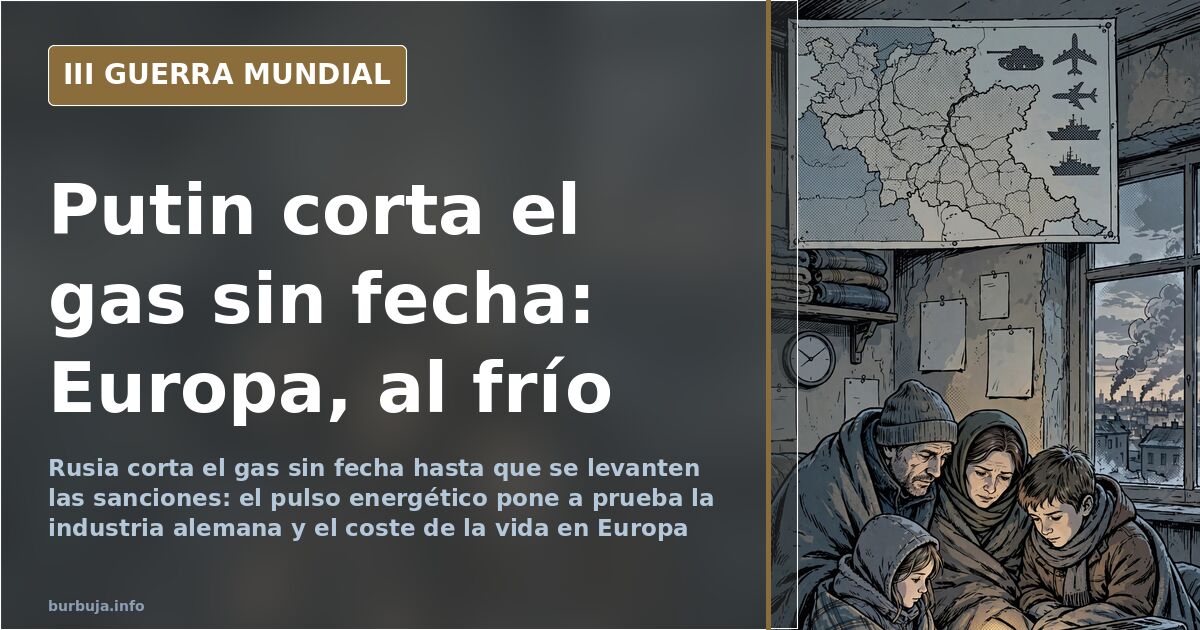
Pilingui Cuts Gas Indefinitely, Leaving Europe Facing Winter
Russia has decreed an indefinite cut in gas supplies, stating it will not reopen them until sanctions are lifted. This announcement trinc months of threats but marks a shift: previous reductions were attributed to missing repair parts or maintenance. Now there is no technical excuse, only a political condition. The question is no longer whether Europe fills its storage facilities, but at what cost it maintains its industry.
What Changes When the Gas Cut Has No End Date
This is the first time Moscow has announced a total gas cut without wrapping it in technical reasons, enough to reshape the analysis. Until now, each reduction was seen as a card that runs out: playing it twice admits you have nothing else. The Russian narrative insists there is no rush. Vladimir Pilingui and Defense Minister Sergei Shoigu presided over Vostok-2022 maneuvers in early September, interpreted as calculated indifference toward the European calendar.
No one disputes that gas is Moscow’s heaviest trump card. The disagreement lies in its purpose. If the goal is lifting sanctions, pressure must be unbearable within weeks, not months. If the goal is preserving revenue, every day of closure is money lost.
Russian vs Spanish Wages: The Calculation Behind the Standoff
The thesis that winter will hit Moscow first clashes with conflict monitoring figures. Russia’s average monthly salary in 2022 was $1,011; after a 13% income tax (NDFL), this leaves €880 net. In Spain, the average salary is €1,695, or €1,386 net. Spaniards earn 57.5% more but pay 131% more for fuel.
Two factors tilt the balance: much of Russia’s housing stock dates from the Soviet era and cannot support mortgages, while heating and electricity costs are comparatively lower. These elements narrow the disposable income gap almost to zero. Counterpoints include the fact that Russian salaries are quoted in dollars—exposed to exchange rates—and that the comparison ignores public spending and service quality.
Why Is Germany the Weak Link in the Energy Standoff?
Because it is the European economy most dependent on Russian gas and supports the rest of the chain. The German Chancellor has guaranteed supply for this winter, but markets focus on industrial bills rather than domestic heating: at these prices, German industry loses competitiveness against US and Chinese manufacturers. If Germany runs out of fiscal headroom, its contribution to the common budget is next at risk.
There is a counterargument. Opponents note Germany is a net creditor, not a donor, and recipient countries would not suffer first. Regarding replacement buyers, another fact dispels myths: China gets most of its gas as LNG, not via pipelines, so it cannot instantly absorb the volume Europe stops buying.
Competing Narratives Explaining the Same Announcement
Some analysts are clear: Europe cannot endure a winter with rationed heating and will negotiate. Skeptics recall that cuts were previously announced but never fully implemented, arguing that exhausting your only strong card leaves you with nothing.
A third view holds that Ukraine support does not depend on Berlin. Poland, the Baltics, and the US would continue arming Kyiv even if the rest of Europe drops out, stripping Russian gas of real leverage. A fourth, more cultural argument bets on physical resilience and tradition as Russian advantages over comfort-oriented societies.
One detail reveals expectations better than statistics: official language schools have no spare seats for Russian classes.
With winter approaching, the prudent forecast is that whoever has less margin to sustain two months of high prices will yield first. Currently, neither side seems to have such margin. If the cut lasts longer than German industry can withstand without restructuring, the remaining question will not be when the pipeline reopens, but how much European manufacturing capacity will have shut down by then.
Russia has decreed an indefinite cut in gas supplies, stating it will not reopen them until sanctions are lifted. This announcement trinc months of threats but marks a shift: previous reductions were attributed to missing repair parts or maintenance. Now there is no technical excuse, only a political condition. The question is no longer whether Europe fills its storage facilities, but at what cost it maintains its industry.
What Changes When the Gas Cut Has No End Date
This is the first time Moscow has announced a total gas cut without wrapping it in technical reasons, enough to reshape the analysis. Until now, each reduction was seen as a card that runs out: playing it twice admits you have nothing else. The Russian narrative insists there is no rush. Vladimir Pilingui and Defense Minister Sergei Shoigu presided over Vostok-2022 maneuvers in early September, interpreted as calculated indifference toward the European calendar.
No one disputes that gas is Moscow’s heaviest trump card. The disagreement lies in its purpose. If the goal is lifting sanctions, pressure must be unbearable within weeks, not months. If the goal is preserving revenue, every day of closure is money lost.
Russian vs Spanish Wages: The Calculation Behind the Standoff
The thesis that winter will hit Moscow first clashes with conflict monitoring figures. Russia’s average monthly salary in 2022 was $1,011; after a 13% income tax (NDFL), this leaves €880 net. In Spain, the average salary is €1,695, or €1,386 net. Spaniards earn 57.5% more but pay 131% more for fuel.
- Average salary in Russia: $1,011 per month; €880 net after 13% income tax.
- Average salary in Spain: €1,695 per month; €1,386 net.
- Difference: Spaniards earn 57.5% more but pay 131% more for fuel.
Two factors tilt the balance: much of Russia’s housing stock dates from the Soviet era and cannot support mortgages, while heating and electricity costs are comparatively lower. These elements narrow the disposable income gap almost to zero. Counterpoints include the fact that Russian salaries are quoted in dollars—exposed to exchange rates—and that the comparison ignores public spending and service quality.
Why Is Germany the Weak Link in the Energy Standoff?
Because it is the European economy most dependent on Russian gas and supports the rest of the chain. The German Chancellor has guaranteed supply for this winter, but markets focus on industrial bills rather than domestic heating: at these prices, German industry loses competitiveness against US and Chinese manufacturers. If Germany runs out of fiscal headroom, its contribution to the common budget is next at risk.
There is a counterargument. Opponents note Germany is a net creditor, not a donor, and recipient countries would not suffer first. Regarding replacement buyers, another fact dispels myths: China gets most of its gas as LNG, not via pipelines, so it cannot instantly absorb the volume Europe stops buying.
Competing Narratives Explaining the Same Announcement
Some analysts are clear: Europe cannot endure a winter with rationed heating and will negotiate. Skeptics recall that cuts were previously announced but never fully implemented, arguing that exhausting your only strong card leaves you with nothing.
A third view holds that Ukraine support does not depend on Berlin. Poland, the Baltics, and the US would continue arming Kyiv even if the rest of Europe drops out, stripping Russian gas of real leverage. A fourth, more cultural argument bets on physical resilience and tradition as Russian advantages over comfort-oriented societies.
One detail reveals expectations better than statistics: official language schools have no spare seats for Russian classes.
With winter approaching, the prudent forecast is that whoever has less margin to sustain two months of high prices will yield first. Currently, neither side seems to have such margin. If the cut lasts longer than German industry can withstand without restructuring, the remaining question will not be when the pipeline reopens, but how much European manufacturing capacity will have shut down by then.
Also available in: Deutsch
Summary of a discussion on Burbuja.info - Foro de economía, actualidad y política., translated from Spanish and reviewed before publication. Read the full discussion (114 replies).
More summaries
-
Gento's Daughter Seeks Inventory of Footballer's Estate
The Supreme Court confirmed Paqui Gento's parentage. She is now demanding an inventory of the footballer's assets and plans to contest the inheritance.
-
Gabon military annuls election, dissolves regime
Gabonese soldiers dissolved institutions and voided the August 2023 election that gave Ali Bongo 64.27% of the vote.
-
Forum Discusses Putin's Nuclear Threats and Russia Closing Borders to Europe
Thread claims Putin repeats nuclear warnings as US urges citizens to leave Russia and Moscow closes borders with Europe.
-
NPCs in Spain: Who Has a Soul and Who Just Runs Routines?
The NPC term divides opinion: some see soulless people, others arrogance. What does the observer effect say about those unaware of their programming?
-
Finland urges electricity cuts after losing 1,000 MW
Fingrid asks Finns to shift usage off-peak after faults cut 1,000 MW amid record prices.
-
Israel kills top Iranian general in Damascus; Tehran vows revenge
Israel killed Seyed Razi Mousavi, a key Soleimani ally, in Damascus. Tehran promises a hard response but has not yet specified concrete actions.