
Israel kills top Iranian general in Damascus; Tehran vows revenge
Israel killed Seyed Razi Mousavi, a key Soleimani ally, in Damascus. Tehran promises a hard response but has not yet specified concrete actions.
English · Original discussion in Spanish · Published
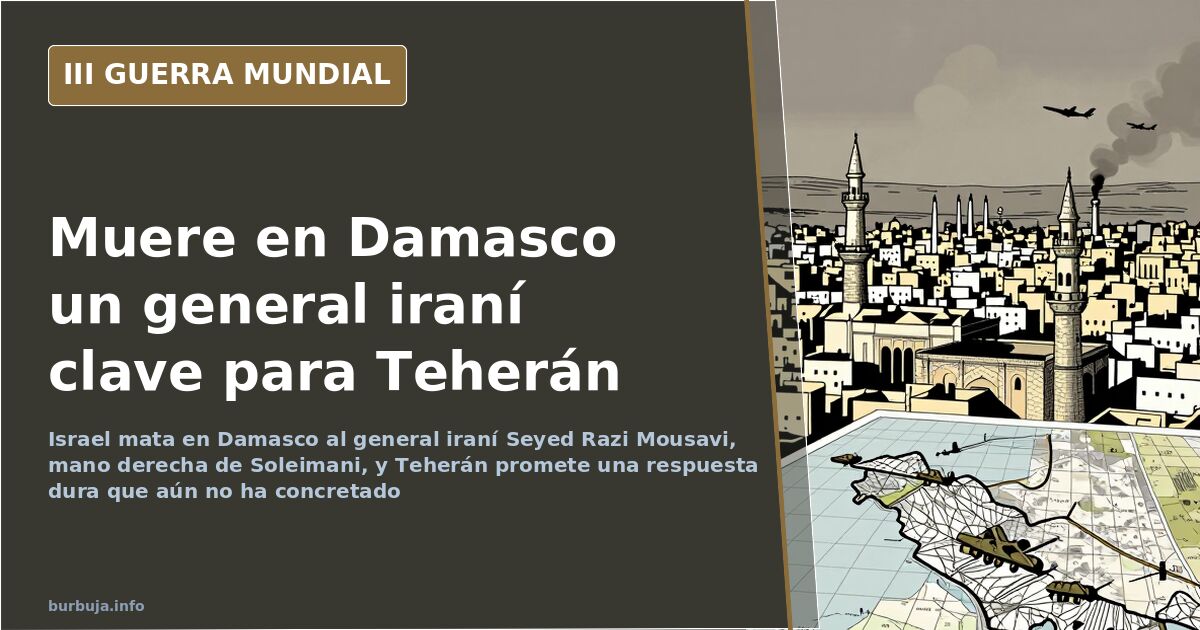
Israel kills Iran's closest Soleimani associate in Damascus
Iran's Revolutionary Guard confirmed the death of Brigadier General Seyed Razi Mousavi in an attack attributed to Israel in Damascus. The official statement described him as martyr and condemned the operation as incivil, implicitly accusing the Israeli state of killing children. Immediately, the threat front activated: Tehran promised a harsh response, with rumors circulating about blackouts, shelters, and missile launches. This script is familiar. It usually ends the same way: loud declarations, no direct retaliation.
The Israeli strike in Damascus occurs within a sequence well-known to conflict observers: target identified, official confirmation hours later, trinc by cross-threats that fade away. The novelty here is the victim's rank and Tehran's verbal staging.
Who was Mousavi and why his death is seen as a blow
The Revolutionary Guard's statement places the officer in the front line: a companion of General Qasem Soleimani and responsible for sustaining the resistance front in Syria. This dual profile—personal link to leadership and operational role on the ground—explains why his death is interpreted as a structural hit rather than an isolated loss.
Mousavi fits the profile Israel has pursued for years: coordination with Hezbollah and arms flow into Syria. Named officials help the narrative, but the real value lies in their contact networks. When such a link falls, the gap takes time to fill.
The most common interpretation after the announcement is the demonstration effect. Israel doesn't just destroy capacity; it signals it knows names, routines, and addresses of those operating in Damascus. This message targets both Tehran and intermediate commanders deciding whether to continue traveling.
Syria, the laboratory bombed every two weeks
A recurring claim is that Israel bombs Damascus with administrative regularity, one strike every fifteen days, routinely destroying Revolutionary Guard weapons shipments on Syrian soil. While this periodicity cannot be verified with available data, it matches recent patterns: specific actions, no formal claims, and no equivalent military response.
One argument explains the accumulation of Iranian casualties: during the Syrian civil war, veteran officers trained in Iran-Iraq tactics maintained the habit of staying on the front line. In terrain swept by airpower, this position is costly. The result is a growing list of mid- and high-ranking commanders without Tehran changing its playbook.
An uncomfortable comparison underlies the Iranian narrative: Turkey also frequently bombs Syria, yet few open investigations. The explanation offered is membership-based: Ankara is in NATO, Tehran is not. Impunity, in this view, depends not on what is done, but who signs off.
Why does Iran threaten a harsh response but never act?
Because the cost of direct clash with Israel and its allies vastly exceeds maintaining pressure through proxies. Iran's responses have historically been channeled indirectly: Hezbollah in Lebanon, Houthis in the Red Sea, and militias across the region. This is real retaliation, but diffuse and hard to quantify.
Domestic factors add complexity. Some argue parts of Iranian society increasingly resent the economic and diplomatic costs of this policy, and that open war wouldn't restore system legitimacy. In this scenario, threats function better as domestic political tools than military plans.
Another cynical view suggests threats have become periodic consumer products. Launched, amplified for days, then diluted by new news. Repeated announcements erode credibility: when nothing happens so often, the next warning reads as background noise.
Blackouts, bunkers, tweets: the other war
Alongside verifiable information circulated harder-to-check layers. Reports attributed to Israeli media claimed a massive blackout in Israel with the Prime Minister and cabinet moved to shelters. No independent confirmation exists, highlighting the need to distinguish named sources from hype-driven tweets.
Distrust dominates. Many summarize their stance with a phrase repeated in these episodes: I won't believe Iran attacks until major agencies confirm it. Skepticism isn't naivety, but memory: announced apocalypses haven't materialized.
Meanwhile, jokes about nuclear armament circulate like trading cards among powers. This background noise measures emotional temperature more than predicting events.
The balance that hasn't changed
After years of this cycle, the inventory is short and repetitive: Iranian generals buried in Syria, inflammatory statements, revenge promises, and no operation reshaping the board. The only variable moving is the next name on the list.
Next time Tehran announces a harsh response, check how many times they've already done so. If anything moves, look first at Lebanon and the Red Sea, not Damascus headlines.
Iran's Revolutionary Guard confirmed the death of Brigadier General Seyed Razi Mousavi in an attack attributed to Israel in Damascus. The official statement described him as martyr and condemned the operation as incivil, implicitly accusing the Israeli state of killing children. Immediately, the threat front activated: Tehran promised a harsh response, with rumors circulating about blackouts, shelters, and missile launches. This script is familiar. It usually ends the same way: loud declarations, no direct retaliation.
The Israeli strike in Damascus occurs within a sequence well-known to conflict observers: target identified, official confirmation hours later, trinc by cross-threats that fade away. The novelty here is the victim's rank and Tehran's verbal staging.
Who was Mousavi and why his death is seen as a blow
The Revolutionary Guard's statement places the officer in the front line: a companion of General Qasem Soleimani and responsible for sustaining the resistance front in Syria. This dual profile—personal link to leadership and operational role on the ground—explains why his death is interpreted as a structural hit rather than an isolated loss.
Mousavi fits the profile Israel has pursued for years: coordination with Hezbollah and arms flow into Syria. Named officials help the narrative, but the real value lies in their contact networks. When such a link falls, the gap takes time to fill.
The most common interpretation after the announcement is the demonstration effect. Israel doesn't just destroy capacity; it signals it knows names, routines, and addresses of those operating in Damascus. This message targets both Tehran and intermediate commanders deciding whether to continue traveling.
Syria, the laboratory bombed every two weeks
A recurring claim is that Israel bombs Damascus with administrative regularity, one strike every fifteen days, routinely destroying Revolutionary Guard weapons shipments on Syrian soil. While this periodicity cannot be verified with available data, it matches recent patterns: specific actions, no formal claims, and no equivalent military response.
One argument explains the accumulation of Iranian casualties: during the Syrian civil war, veteran officers trained in Iran-Iraq tactics maintained the habit of staying on the front line. In terrain swept by airpower, this position is costly. The result is a growing list of mid- and high-ranking commanders without Tehran changing its playbook.
An uncomfortable comparison underlies the Iranian narrative: Turkey also frequently bombs Syria, yet few open investigations. The explanation offered is membership-based: Ankara is in NATO, Tehran is not. Impunity, in this view, depends not on what is done, but who signs off.
Why does Iran threaten a harsh response but never act?
Because the cost of direct clash with Israel and its allies vastly exceeds maintaining pressure through proxies. Iran's responses have historically been channeled indirectly: Hezbollah in Lebanon, Houthis in the Red Sea, and militias across the region. This is real retaliation, but diffuse and hard to quantify.
Domestic factors add complexity. Some argue parts of Iranian society increasingly resent the economic and diplomatic costs of this policy, and that open war wouldn't restore system legitimacy. In this scenario, threats function better as domestic political tools than military plans.
Another cynical view suggests threats have become periodic consumer products. Launched, amplified for days, then diluted by new news. Repeated announcements erode credibility: when nothing happens so often, the next warning reads as background noise.
Blackouts, bunkers, tweets: the other war
Alongside verifiable information circulated harder-to-check layers. Reports attributed to Israeli media claimed a massive blackout in Israel with the Prime Minister and cabinet moved to shelters. No independent confirmation exists, highlighting the need to distinguish named sources from hype-driven tweets.
Distrust dominates. Many summarize their stance with a phrase repeated in these episodes: I won't believe Iran attacks until major agencies confirm it. Skepticism isn't naivety, but memory: announced apocalypses haven't materialized.
Meanwhile, jokes about nuclear armament circulate like trading cards among powers. This background noise measures emotional temperature more than predicting events.
The balance that hasn't changed
After years of this cycle, the inventory is short and repetitive: Iranian generals buried in Syria, inflammatory statements, revenge promises, and no operation reshaping the board. The only variable moving is the next name on the list.
Next time Tehran announces a harsh response, check how many times they've already done so. If anything moves, look first at Lebanon and the Red Sea, not Damascus headlines.
Also available in: Deutsch
Summary of a discussion on Burbuja.info - Foro de economía, actualidad y política., translated from Spanish and reviewed before publication. Read the full discussion (113 replies).
More summaries
-
Israel strikes Damascus and Aleppo airports, Syria confirms
Syria confirms Israeli missile strikes on Aleppo and Damascus airports following recent rocket exchanges with Israel.
-
Battle of Azovstal: 11 km² of steelworks and six basements
Azovstal: 11 km², six basements, and Europe's largest steelworks turned into a fortress. Why is Mariupol's last bastion not being overrun?
-
Aleppo falls in hours as Syria changes hands all the way to Damascus
Insurgent offensive takes Aleppo in hours and advances to Damascus while Israel occupies southern Syria with little resistance
-
Alcàsser: Esther’s testimony, the fourth girl, remains under suspicion
Esther Alcàsser, the fourth girl, gave a TV interview six days after the 1992 Alcàsser murders in Spain. Her account and timeline discrepancies fuel ongoing controversy.
-
Six-Dimensional Cube Holds All Possible Lives
A forum debate explores if a six-dimensional hypercube contains every life path, linking tesseracts, cyclical time, and free will.
-
Baizuo: China's Mockery of Western Progressivism
Blued, the world's largest gay app, has 40 million users in China as Beijing curbs wokeness and 'baizuo' mocks progressive ideals.