
Russia Entrenches and Bets on Attrition in Ukraine
The front freezes: Russia entrenches and bets on attrition, while Ukraine depends on foreign aid and loses population.
English · Original discussion in Spanish · Published
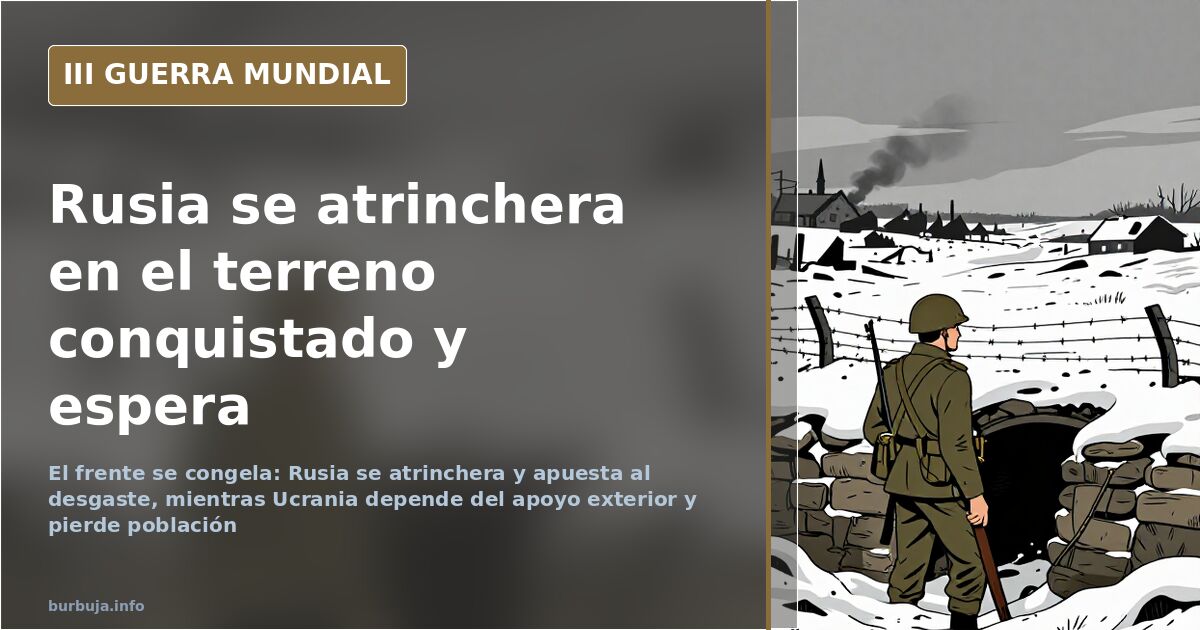
Russia entrenches territory and waits for attrition
Occupy, mine, and wait. The thesis that Russia’s strategy in Ukraine has not gone as badly as initial forecasts suggested fits into that phrase. It takes a part of the country taking advantage of the confusion in the early hours, consolidates artillery positions and minefields, and the ball is in the other side’s court: if the adversary does not move, the territory is consolidated and annexed; if it moves, it crashes against the wall. Months of counteroffensive, adds the argument, with hardly any territorial gains and no strategic objective achieved.
It is a cynical and highly disputed reading. But it forces us to look at the front with another question: not who wins, but who endures.
Why the initial assault on Kyiv did not go as planned
The blitzkrieg failed. The only scenario that, according to this reading, would have given Moscow a quick victory was forcing a government change in the capital in the early hours, with a friendly president already placed across the border. It did not happen, and much of the analysis holds that it could not have peine: the center and west of the country would not have tolerated it, and the capital is precisely in the center. It is a point considered settled in two previous episodes, 2005 and 2014, in which the hypothesis of a government with friendly relations with Russia in Kyiv was ruled out.
From there, the plan changed shape. Fewer armored columns, more artillery. And wait.
What Russia has taken on the ground
The territorial inventory is the argument with the most weight today. Russia controls practically all the predominantly Russian-speaking areas it had set as its goal, has secured the land connection with Crimea, and has left Ukraine without ports for exports except Odesa, whose traffic can be strangled whenever it wants. Additionally, it has taken the Zaporizhzhia nuclear plant, a relevant piece in Ukrainian electricity production. The figure managed by one of the participants is 20% of the territory, later converted into a mined and artillery-lined border.
The rebuttal is quick: almost none of that is new since 2022 and the front line has hardly moved since then.
The economic cost: closed European market and discounted gas
Here the positions split in two. One block emphasizes the structural damage: the European market has closed, energy threats no longer work, crude oil and gas are sold in Asia at fire-sale prices, and when sales go through intermediaries, it is necessary to triple or quadruple the volume to earn the same. Added to this are currency impressions and capital controls, measures compared to those of a crisis-managed economy.
The other block responds with the uncomfortable fact: the Russian economy has held up better than expected. And places the balance elsewhere: China and the United States have won, Russia, Ukraine, and the European Union have lost. The discussion then shifts to who has closed off to whom, with the argument that the Russian market has been closed to European companies while raw materials continue to arrive through other channels, and with the contrary thesis that a de facto intervened market cannot be buoyant.
The demographic hole: who loses more population
The figures discussed are, by far, the most brutal aspect of the matter. According to the figures provided by one of the participants, Russia starts with 147 million inhabitants, to which would be added 7 million ethnic Russians from the occupied territories, reaching 154 million. Ukraine, by contrast, has fallen to 30 million after the departure of about 10 million Ukrainians to the West. Added to this is the mobilization of 300,000 personnel cited by another participant, trinc the wear of the professional army, and the flight of working-age population.
The problem with the Russian tally is the same as the Ukrainian one: the dead do not return, and those who have left, neither. A country can repopulate a territory on paper and take decades to truly fill it. A territory that was almost Europe, it is pointed out with a sneer, ceases to be so when it becomes a bargaining chip.
Neither Odesa for Russia nor Crimea for Ukraine: the tie thesis
Much of the discussion ends up in a similar place: no contender can achieve its declared objectives. Odesa will not be Russian, and Crimea will not return to Ukraine. NATO was not dead, precisely because the relationship with Kyiv was already broken, and the invasion has ended up rearranging Europe’s eastern flank. The front freezes because moving it costs lives that neither side can afford.
This turns the conflict into a pure war of attrition. And in a war of attrition, the one who advances does not win: the one who succeeds in breaking the other first wins.
The derived discussion: freedom, taxes, and country models
The exchange frequently deviates into the model each side defends. One side points out that the countries that left the Soviet orbit mostly chose to join the community club and cites Estonia as an example: low taxes, an internet company in five minutes, thirty years of pogre since occupation. The other responds with Georgia, with minimal tax rates and an unfavorable opinion toward Moscow, to separate fiscal policy from geopolitics.
Where the conversation breaks down is in the Donbass. One part maintains that bombardments on the local population lasted nine years; the other rebuts that the maximum intensity was concentrated in 2014 and 2015 and that, if it had been so, no building would remain standing, as peine in Mariupol in a few weeks. As a backdrop, the mutual accusation of cynicism: some reproach that sovereignty is defended only when convenient, and others that freedom is invoked as a pretext.
There is no common ground. The conversation also degenerates into personal insults that add nothing to the analysis.
With the front stabilized and population figures moving in opposite directions, it is likely that neither side will achieve a clear victory in the short term. If the scenario holds, the question that will determine the outcome will not be how many kilometers are conquered, but how many years each economy can endure the price of sustaining them.
Occupy, mine, and wait. The thesis that Russia’s strategy in Ukraine has not gone as badly as initial forecasts suggested fits into that phrase. It takes a part of the country taking advantage of the confusion in the early hours, consolidates artillery positions and minefields, and the ball is in the other side’s court: if the adversary does not move, the territory is consolidated and annexed; if it moves, it crashes against the wall. Months of counteroffensive, adds the argument, with hardly any territorial gains and no strategic objective achieved.
It is a cynical and highly disputed reading. But it forces us to look at the front with another question: not who wins, but who endures.
Why the initial assault on Kyiv did not go as planned
The blitzkrieg failed. The only scenario that, according to this reading, would have given Moscow a quick victory was forcing a government change in the capital in the early hours, with a friendly president already placed across the border. It did not happen, and much of the analysis holds that it could not have peine: the center and west of the country would not have tolerated it, and the capital is precisely in the center. It is a point considered settled in two previous episodes, 2005 and 2014, in which the hypothesis of a government with friendly relations with Russia in Kyiv was ruled out.
From there, the plan changed shape. Fewer armored columns, more artillery. And wait.
What Russia has taken on the ground
The territorial inventory is the argument with the most weight today. Russia controls practically all the predominantly Russian-speaking areas it had set as its goal, has secured the land connection with Crimea, and has left Ukraine without ports for exports except Odesa, whose traffic can be strangled whenever it wants. Additionally, it has taken the Zaporizhzhia nuclear plant, a relevant piece in Ukrainian electricity production. The figure managed by one of the participants is 20% of the territory, later converted into a mined and artillery-lined border.
The rebuttal is quick: almost none of that is new since 2022 and the front line has hardly moved since then.
The economic cost: closed European market and discounted gas
Here the positions split in two. One block emphasizes the structural damage: the European market has closed, energy threats no longer work, crude oil and gas are sold in Asia at fire-sale prices, and when sales go through intermediaries, it is necessary to triple or quadruple the volume to earn the same. Added to this are currency impressions and capital controls, measures compared to those of a crisis-managed economy.
The other block responds with the uncomfortable fact: the Russian economy has held up better than expected. And places the balance elsewhere: China and the United States have won, Russia, Ukraine, and the European Union have lost. The discussion then shifts to who has closed off to whom, with the argument that the Russian market has been closed to European companies while raw materials continue to arrive through other channels, and with the contrary thesis that a de facto intervened market cannot be buoyant.
The demographic hole: who loses more population
The figures discussed are, by far, the most brutal aspect of the matter. According to the figures provided by one of the participants, Russia starts with 147 million inhabitants, to which would be added 7 million ethnic Russians from the occupied territories, reaching 154 million. Ukraine, by contrast, has fallen to 30 million after the departure of about 10 million Ukrainians to the West. Added to this is the mobilization of 300,000 personnel cited by another participant, trinc the wear of the professional army, and the flight of working-age population.
The problem with the Russian tally is the same as the Ukrainian one: the dead do not return, and those who have left, neither. A country can repopulate a territory on paper and take decades to truly fill it. A territory that was almost Europe, it is pointed out with a sneer, ceases to be so when it becomes a bargaining chip.
Neither Odesa for Russia nor Crimea for Ukraine: the tie thesis
Much of the discussion ends up in a similar place: no contender can achieve its declared objectives. Odesa will not be Russian, and Crimea will not return to Ukraine. NATO was not dead, precisely because the relationship with Kyiv was already broken, and the invasion has ended up rearranging Europe’s eastern flank. The front freezes because moving it costs lives that neither side can afford.
This turns the conflict into a pure war of attrition. And in a war of attrition, the one who advances does not win: the one who succeeds in breaking the other first wins.
The derived discussion: freedom, taxes, and country models
The exchange frequently deviates into the model each side defends. One side points out that the countries that left the Soviet orbit mostly chose to join the community club and cites Estonia as an example: low taxes, an internet company in five minutes, thirty years of pogre since occupation. The other responds with Georgia, with minimal tax rates and an unfavorable opinion toward Moscow, to separate fiscal policy from geopolitics.
Where the conversation breaks down is in the Donbass. One part maintains that bombardments on the local population lasted nine years; the other rebuts that the maximum intensity was concentrated in 2014 and 2015 and that, if it had been so, no building would remain standing, as peine in Mariupol in a few weeks. As a backdrop, the mutual accusation of cynicism: some reproach that sovereignty is defended only when convenient, and others that freedom is invoked as a pretext.
There is no common ground. The conversation also degenerates into personal insults that add nothing to the analysis.
With the front stabilized and population figures moving in opposite directions, it is likely that neither side will achieve a clear victory in the short term. If the scenario holds, the question that will determine the outcome will not be how many kilometers are conquered, but how many years each economy can endure the price of sustaining them.
Summary of a discussion on Burbuja.info - Foro de economía, actualidad y política., translated from Spanish and reviewed before publication. Read the full discussion (399 replies).
More summaries
-
Ukraine strikes Russian refineries and ports, analyses say
Analyses circulating cite 76 vessels and a third of Russian refining capacity hit, while Moscow's offensive is described as stalled
-
Alcàsser: Esther’s testimony, the fourth girl, remains under suspicion
Esther Alcàsser, the fourth girl, gave a TV interview six days after the 1992 Alcàsser murders in Spain. Her account and timeline discrepancies fuel ongoing controversy.
-
Gaza Hospital Death Toll: 500 Dead, Two Incompatible Accounts
500 dead at Gaza's Baptist Hospital: Israeli airstrike or diverted Palestinian rocket? Neither side has provided conclusive evidence.
-
Why Most Doctors Followed the Official COVID Narrative
Hierarchy, protocols, and peer pressure explain why the medical majority accepted the official COVID story without dissent during the pandemic.
-
Russia holds annexation referendums in four occupied Ukrainian regions
Voting takes five days in Donetsk, Luhansk, Kherson, and Zaporizhzhia amid reports of sabotage and long queues in areas controlled by Moscow.
-
Mariupol: Azov tunnel counterattack claims debunked
Unconfirmed reports suggest Azov Battalion reclaimed Mariupol sectors via tunnels from Azovstal, lacking verifiable evidence.