
Mariupol: Azov tunnel counterattack claims debunked
Unconfirmed reports suggest Azov Battalion reclaimed Mariupol sectors via tunnels from Azovstal, lacking verifiable evidence.
English · Original discussion in Spanish · Published
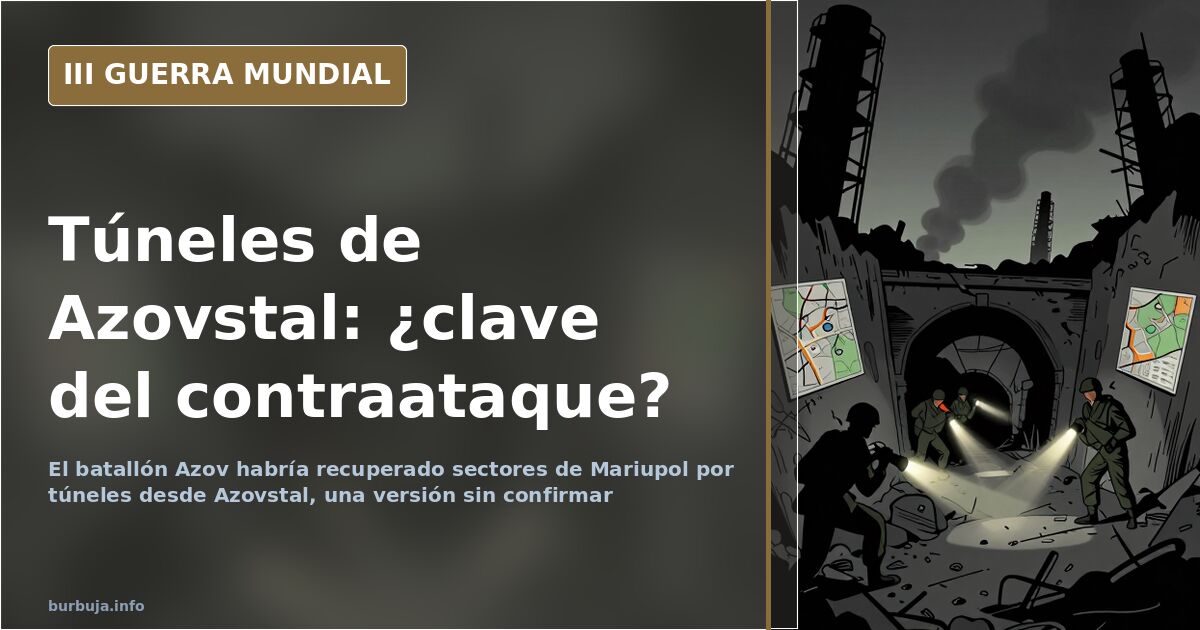
Mariupol and the theory of tunnels under the Azovstal steel plant
A city deemed captured yet still generating war reports. The circulating version claims that the Azov Battalion, taking advantage of troop withdrawals, counterattacked and seized key sectors of Mariupol supported by an extensive underground tunnel network originating from the Azovstal steel plant. The analysis was authored by an observer publishing as Jomini and disseminated by a military analyst: there would be pockets of Ukrainian resistance outside the industrial complex, and if galleries branch from the steel plant toward the city, these forces could disperse. If true, withdrawing troops would have been a grave error. Whether it is true is precisely what no one confirmed.
What exactly does the counterattack version claim?
The dominant narrative gave Mariupol as fallen, with the steel plant as the last stronghold and combatants sheltered underground. The counterattack thesis adds an uncomfortable piece: that this subsurface is not a dead end, but a network of galleries originating in Azovstal that would allow exiting, striking, and hiding again. Based on this, the claim of recovering territory in the city is built.
Striking is the traceability. Everything hangs on a thread of messages on social media, with the name of an analyst and a source signing under a pseudonym. No verifiable maps, no official reports, no geolocated images. When the only proof is a tweet citing another analyst, the appropriate word is not information: it is indication.
A siege is won by waiting, not assaulting
The most solid objection does not come from geopolitics, but from logistics. If the objective is to take a fortified position, forcing an assault drives up own casualties; surrounding it and waiting costs less. Those defending this reading recall that sieges have existed since time immemorial and that the outcome is determined by supplies, not infantry.
Hence the reading some defend: exiting is not winning, it is running out of supplies. If a force abandoned its shelter to attack, this could be read as a sign that the pantry is empty, not as a victorious maneuver. Some even argue that fighting in the open, with artillery fire and clear vision, only hastens the end. The contrast is clean and not resolved with enthusiasm: either they are detachments expanding, or men seeking where to die.
Azovstal: from documented tunnel to table fantasy
The steel plant is a Soviet industrial monster, with basements, conduits, and technical galleries from decades. That tunnels exist is reasonable. That this network reaches entire neighborhoods and allows operating sustainably behind enemy lines already requires proof that no one provided. And when proof is lacking, mockery appears: in any discussion about miraculous tunnels, the local variant arises, claiming the gallery ends in a capital interchange.
This type of exaggeration poisons the entire file. A plausible fact —there are basements and dispersed forces— is stretched until it becomes useless, and then the ridicule of exaggeration is used to also deny what is plausible.
Kharkiv, the other front the headline covers
Beneath the Mariupol showcase lies a much heavier fact: Ukrainian advances in the Kharkiv area and the deployment of tank brigades to strike the Russian rear, according to the same thread. This would have consequences on the map, not a skirmish in a cemetery.
The uncomfortable coincidence arises here. Two opposing narratives use the same material: one to say Ukraine regains the initiative, another to point out the trinc of loosening the siege. Both can be true at the same time, and that is the part almost no one wants to admit.
How the prediction aged
Months pass, the issue resurfaces, and the discussion becomes something else: a settling of accounts. Enthusiastic messages are recovered to call them fables, jokes are made about the time elapsed and the world's second army, and the counterattack that was supposed to change Mariupol remains a recurring joke. The sarracena is cruel but useful: in war, the first version is always written by those who want it most.
Can an urban sector be sustained for weeks having tunnels as the only supply chain? The question remains, and neither trench has managed to answer it with anything other than faith.
A city deemed captured yet still generating war reports. The circulating version claims that the Azov Battalion, taking advantage of troop withdrawals, counterattacked and seized key sectors of Mariupol supported by an extensive underground tunnel network originating from the Azovstal steel plant. The analysis was authored by an observer publishing as Jomini and disseminated by a military analyst: there would be pockets of Ukrainian resistance outside the industrial complex, and if galleries branch from the steel plant toward the city, these forces could disperse. If true, withdrawing troops would have been a grave error. Whether it is true is precisely what no one confirmed.
What exactly does the counterattack version claim?
The dominant narrative gave Mariupol as fallen, with the steel plant as the last stronghold and combatants sheltered underground. The counterattack thesis adds an uncomfortable piece: that this subsurface is not a dead end, but a network of galleries originating in Azovstal that would allow exiting, striking, and hiding again. Based on this, the claim of recovering territory in the city is built.
Striking is the traceability. Everything hangs on a thread of messages on social media, with the name of an analyst and a source signing under a pseudonym. No verifiable maps, no official reports, no geolocated images. When the only proof is a tweet citing another analyst, the appropriate word is not information: it is indication.
A siege is won by waiting, not assaulting
The most solid objection does not come from geopolitics, but from logistics. If the objective is to take a fortified position, forcing an assault drives up own casualties; surrounding it and waiting costs less. Those defending this reading recall that sieges have existed since time immemorial and that the outcome is determined by supplies, not infantry.
Hence the reading some defend: exiting is not winning, it is running out of supplies. If a force abandoned its shelter to attack, this could be read as a sign that the pantry is empty, not as a victorious maneuver. Some even argue that fighting in the open, with artillery fire and clear vision, only hastens the end. The contrast is clean and not resolved with enthusiasm: either they are detachments expanding, or men seeking where to die.
Azovstal: from documented tunnel to table fantasy
The steel plant is a Soviet industrial monster, with basements, conduits, and technical galleries from decades. That tunnels exist is reasonable. That this network reaches entire neighborhoods and allows operating sustainably behind enemy lines already requires proof that no one provided. And when proof is lacking, mockery appears: in any discussion about miraculous tunnels, the local variant arises, claiming the gallery ends in a capital interchange.
This type of exaggeration poisons the entire file. A plausible fact —there are basements and dispersed forces— is stretched until it becomes useless, and then the ridicule of exaggeration is used to also deny what is plausible.
Kharkiv, the other front the headline covers
Beneath the Mariupol showcase lies a much heavier fact: Ukrainian advances in the Kharkiv area and the deployment of tank brigades to strike the Russian rear, according to the same thread. This would have consequences on the map, not a skirmish in a cemetery.
The uncomfortable coincidence arises here. Two opposing narratives use the same material: one to say Ukraine regains the initiative, another to point out the trinc of loosening the siege. Both can be true at the same time, and that is the part almost no one wants to admit.
How the prediction aged
Months pass, the issue resurfaces, and the discussion becomes something else: a settling of accounts. Enthusiastic messages are recovered to call them fables, jokes are made about the time elapsed and the world's second army, and the counterattack that was supposed to change Mariupol remains a recurring joke. The sarracena is cruel but useful: in war, the first version is always written by those who want it most.
Can an urban sector be sustained for weeks having tunnels as the only supply chain? The question remains, and neither trench has managed to answer it with anything other than faith.
Summary of a discussion on Burbuja.info - Foro de economía, actualidad y política., translated from Spanish and reviewed before publication. Read the full discussion (352 replies).
More summaries
-
Mariupol holds out: Azov grows to regiment size and remains at Azovstal
Azov says it destroyed ammunition depots and a platoon in Mariupol and now operates as a regiment at Azovstal, while a user declares the Sea of Azov lost
-
Battle of Azovstal: 11 km² of steelworks and six basements
Azovstal: 11 km², six basements, and Europe's largest steelworks turned into a fortress. Why is Mariupol's last bastion not being overrun?
-
Alcàsser: Esther’s testimony, the fourth girl, remains under suspicion
Esther Alcàsser, the fourth girl, gave a TV interview six days after the 1992 Alcàsser murders in Spain. Her account and timeline discrepancies fuel ongoing controversy.
-
Spain loses 277,560 Romanians in a decade of return
Spain's Romanian census drops by 277,560 in ten years, leaving 556,204 registered. High living costs and low salaries drive a return to Romania, which has a 5.5% unemployment rate.
-
Ukraine: Solidarity Falters Under the 'Y tú más' Excuse
Why the 'y tú más' argument undermines support for Ukraine by shifting focus to Western interventions in Iraq, Libya, and the Donbas.
-
Israel: land purchases and the 1947 partition plan
The 1947 plan allocated 56% of Palestine to a group owning only 7% of the land. The debate over Israel's right to exist continues.