
Why Most Doctors Followed the Official COVID Narrative
Hierarchy, protocols, and peer pressure explain why the medical majority accepted the official COVID story without dissent during the pandemic.
English · Original discussion in Spanish · Published
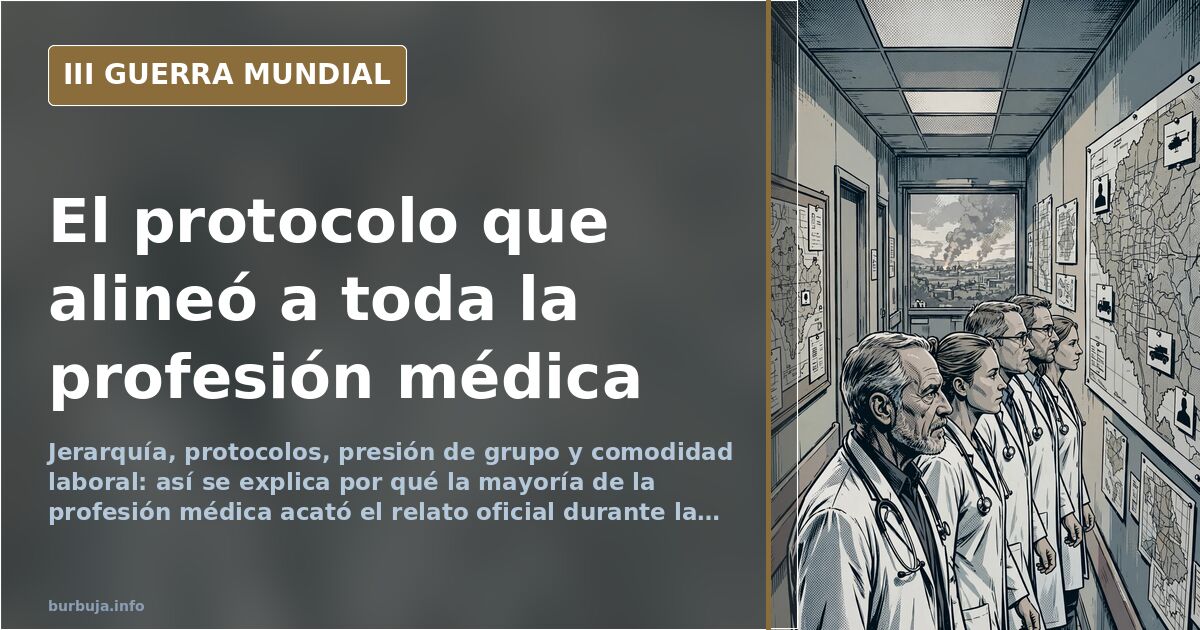
Why the majority of medical professionals trinc the official narrative without questioning it
How does a system ensure an entire profession—from general practitioners to chief surgeons—repeats the same version of a health crisis without anyone breaking the script? The question, posed with more speculation than data, admits a less cinematic answer: there was no secret meeting or gun to the head. Hierarchy, protocol, and a monthly paycheck sufficed. This is at least what much of the explanation suggests when trying to understand why the bulk of the healthcare collective defended the official ELbichito narrative for a year and a half.
It is necessary to separate two discussions that often go hand in hand. One is sociological: why a hierarchical structure produces mass obedience without individual coercion. The other is conspiratorial: the idea that the threat was exaggerated or invented, a thesis for which no evidence is provided and which therefore remains where it is: in suspicion. Mixing them is what prevents the conversation from advancing.
Protocol as a substitute for judgment
The argument that reappears most often relates to the compartmentalization of knowledge. When competencies are fragmented and each link depends on a salary, there is no need to convince anyone: it suffices for the instruction to come from above and be executed downward. The base doctor knows the day-to-day; if you take them out of that context, they no longer need to know more than their neighbor. And what they know, they know in the form of protocols: repeating without questioning what comes from the competent authority.
This mechanism turns the decision of one boss into the decision of thousands. The superior transmits, the subordinate executes, and both cover themselves. There is no moment when someone has to sign a lie: they only have to fulfill an order that appears reasonable. Add to this that the healthcare system is part, like education, of a strongly hierarchical collective, and the result is an alignment that occurs without any of those involved feeling they are choosing a side.
The Asch experiment and the weight of the group
Social psychology has been measuring for nearly seven decades how much the environment weighs. In the classic Asch experiment, 36.8% of subjects were swayed by a majority that answered falsely, while more than 60% remained firm and did not yield. The data is uncomfortable for both trenches: not everyone obeys, nor does everyone resist.
Taken to the healthcare field, the logical question is where that 60% who were not swayed is located. If the common narrative was an imposed construction, broad dissent should have surfaced. What existed, instead, was a recognizable minority—the so-called doctors for truth, isolated cases like that of the Barbastro hospital—and a silent majority that did not pronounce itself in any direction. The discrepancy is not a detail: it is the point that none of the explanations close entirely.
Who breaks the script and at what cost
Those who did speak up describe a concrete cost. It is argued that qualified dissent is the easiest to crush: you lose credibility, are ridiculed in the media, and are left alone. In the narrative that circulates, the role of certain digital media in dismantling and pointing out critical healthcare workers often appears, which serves as a warning for the next person thinking of doubting.
Against this, the fundamental objection: if there were truly a worldwide farce, neither salary nor antiestéticar would suffice for tens of thousands of professionals to remain silent for years. It is practically impossible to maintain such a secret without leaks. Those who defend the official version phrase it in these terms: a bag of money and not one person opens their mouth.
Salary, status, and the antiestéticar of losing it
Another explanatory line is more pedestrian and less epic: comfort. It is argued that during the worst months, health centers closed in many towns, consultations dropped, and shifts became easier, all with the salary intact. There were also bonuses, reinforcements, and raises in some cases. The pandemic, for part of the collective, was not just a tragedy: it was also a job improvement.
This is added to social recognition. The eight o'clock applause, the treatment as heroes, and priority vaccination changed the perception of a guild that a few years earlier had carried precarity and disrepute. Entering that narrative had a prize; leaving it had a cost. It is not coercion, but it weighs the same.
Is the human component enough to explain everything?
The least marketable conclusion is the most honest: there is probably not a single mechanism, but several operating at once. Hierarchy, protocol, peer pressure, economic interest, and antiestéticar of ostracism. None requires a secret plan. All together explain why the bulk of the profession ended up repeating a script, and why the few who broke out were left in ostracism. What neither of the two trenches has managed to demonstrate to date is that there was anything more than that.
How does a system ensure an entire profession—from general practitioners to chief surgeons—repeats the same version of a health crisis without anyone breaking the script? The question, posed with more speculation than data, admits a less cinematic answer: there was no secret meeting or gun to the head. Hierarchy, protocol, and a monthly paycheck sufficed. This is at least what much of the explanation suggests when trying to understand why the bulk of the healthcare collective defended the official ELbichito narrative for a year and a half.
It is necessary to separate two discussions that often go hand in hand. One is sociological: why a hierarchical structure produces mass obedience without individual coercion. The other is conspiratorial: the idea that the threat was exaggerated or invented, a thesis for which no evidence is provided and which therefore remains where it is: in suspicion. Mixing them is what prevents the conversation from advancing.
Protocol as a substitute for judgment
The argument that reappears most often relates to the compartmentalization of knowledge. When competencies are fragmented and each link depends on a salary, there is no need to convince anyone: it suffices for the instruction to come from above and be executed downward. The base doctor knows the day-to-day; if you take them out of that context, they no longer need to know more than their neighbor. And what they know, they know in the form of protocols: repeating without questioning what comes from the competent authority.
This mechanism turns the decision of one boss into the decision of thousands. The superior transmits, the subordinate executes, and both cover themselves. There is no moment when someone has to sign a lie: they only have to fulfill an order that appears reasonable. Add to this that the healthcare system is part, like education, of a strongly hierarchical collective, and the result is an alignment that occurs without any of those involved feeling they are choosing a side.
The Asch experiment and the weight of the group
Social psychology has been measuring for nearly seven decades how much the environment weighs. In the classic Asch experiment, 36.8% of subjects were swayed by a majority that answered falsely, while more than 60% remained firm and did not yield. The data is uncomfortable for both trenches: not everyone obeys, nor does everyone resist.
Taken to the healthcare field, the logical question is where that 60% who were not swayed is located. If the common narrative was an imposed construction, broad dissent should have surfaced. What existed, instead, was a recognizable minority—the so-called doctors for truth, isolated cases like that of the Barbastro hospital—and a silent majority that did not pronounce itself in any direction. The discrepancy is not a detail: it is the point that none of the explanations close entirely.
Who breaks the script and at what cost
Those who did speak up describe a concrete cost. It is argued that qualified dissent is the easiest to crush: you lose credibility, are ridiculed in the media, and are left alone. In the narrative that circulates, the role of certain digital media in dismantling and pointing out critical healthcare workers often appears, which serves as a warning for the next person thinking of doubting.
Against this, the fundamental objection: if there were truly a worldwide farce, neither salary nor antiestéticar would suffice for tens of thousands of professionals to remain silent for years. It is practically impossible to maintain such a secret without leaks. Those who defend the official version phrase it in these terms: a bag of money and not one person opens their mouth.
Salary, status, and the antiestéticar of losing it
Another explanatory line is more pedestrian and less epic: comfort. It is argued that during the worst months, health centers closed in many towns, consultations dropped, and shifts became easier, all with the salary intact. There were also bonuses, reinforcements, and raises in some cases. The pandemic, for part of the collective, was not just a tragedy: it was also a job improvement.
This is added to social recognition. The eight o'clock applause, the treatment as heroes, and priority vaccination changed the perception of a guild that a few years earlier had carried precarity and disrepute. Entering that narrative had a prize; leaving it had a cost. It is not coercion, but it weighs the same.
Is the human component enough to explain everything?
The least marketable conclusion is the most honest: there is probably not a single mechanism, but several operating at once. Hierarchy, protocol, peer pressure, economic interest, and antiestéticar of ostracism. None requires a secret plan. All together explain why the bulk of the profession ended up repeating a script, and why the few who broke out were left in ostracism. What neither of the two trenches has managed to demonstrate to date is that there was anything more than that.
Summary of a discussion on Burbuja.info - Foro de economía, actualidad y política., translated from Spanish and reviewed before publication. Read the full discussion (348 replies).
More summaries
-
Gaza Hospital Death Toll: 500 Dead, Two Incompatible Accounts
500 dead at Gaza's Baptist Hospital: Israeli airstrike or diverted Palestinian rocket? Neither side has provided conclusive evidence.
-
Assault on Sri Lanka’s presidential palace: president flees
Protesters storm Sri Lanka's presidential palace, the president flees and the country is left not knowing who governs or how the next bills will be paid…
-
Chechens in Ukraine: Debating Their Real Role
The thread debates the Chechen role in Ukraine: doubts about their elite status, possible casualties, and Mariupol.
-
Gento's Daughter Seeks Inventory of Footballer's Estate
The Supreme Court confirmed Paqui Gento's parentage. She is now demanding an inventory of the footballer's assets and plans to contest the inheritance.
-
Spain loses 277,560 Romanians in a decade of return
Spain's Romanian census drops by 277,560 in ten years, leaving 556,204 registered. High living costs and low salaries drive a return to Romania, which has a 5.5% unemployment rate.
-
Ukraine: Solidarity Falters Under the 'Y tú más' Excuse
Why the 'y tú más' argument undermines support for Ukraine by shifting focus to Western interventions in Iraq, Libya, and the Donbas.