
Caracas Residents Block Siege on Argentine Embassy
Masked men attempted to storm the Argentine embassy in Caracas, where opposition figures are sheltering. Local residents reportedly forced their retreat.
English · Original discussion in Spanish · Published
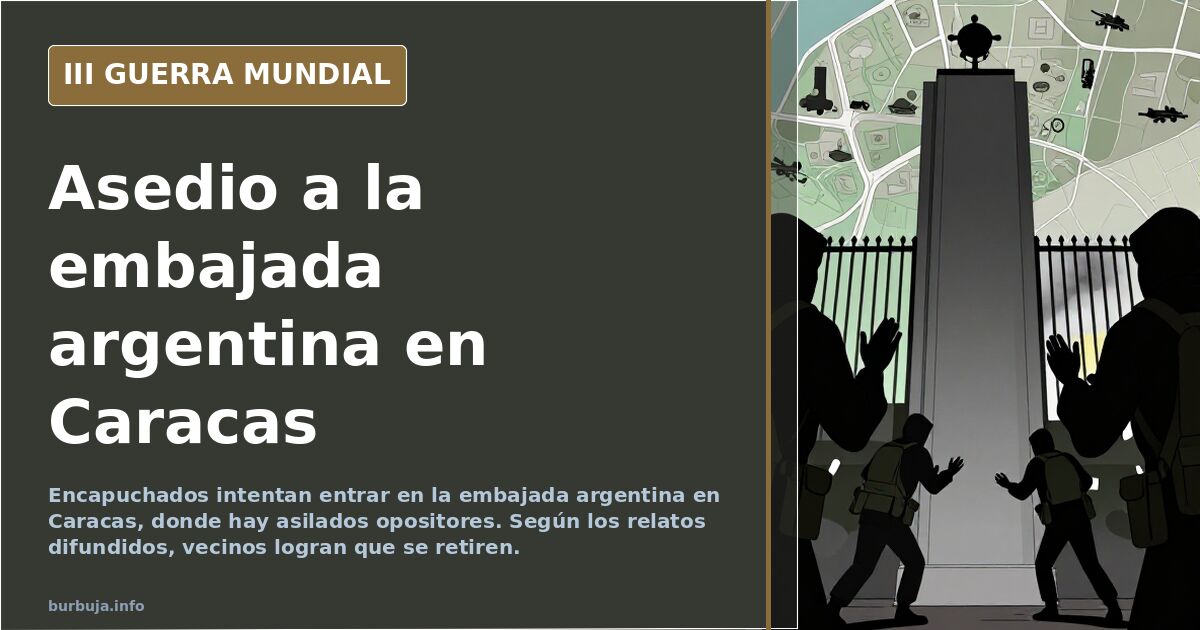
Caracas Residents Block Siege on Argentine Embassy
The scene repeats itself in Caracas with a gravity that no longer allows for metaphors: according to circulated accounts, groups of masked individuals attempted to force entry into the Argentine embassy, where several opposition leaders linked to María Corina Machado’s team remain as asylum seekers. The legation is, for all intents and purposes, Argentine territory. Forcing it open is not street disorder; it is an act of hostility against a sovereign state. According to circulating reports, local residents approached to protect the building and managed to make the attackers withdraw. This episode fits into a broader escalation, with Nicolás Maduro’s regime cornered by missing electoral records and an international community largely refusing to recognize his victory.
What Peine at the Argentine Embassy in Caracas
The account is simple and therefore unsettling. A group of people with covered faces approaches the Argentine diplomatic headquarters intending to enter. Inside are asylum seekers. Outside, according to disseminated testimonies, residents form a human chain and force the masked men to retreat. The embassy was not taken. For now.
International law matters least here for those ordering the siege. A diplomatic mission enjoys inviolability. Assaulting it amounts to a declaration of war in the classic sense of the term. And that is exactly the framework in which this episode sits: not police excess, but an act of war. The lingering question is why precisely the Argentine legation and not another. The most plausible answer is also the most uncomfortable: the asylum seekers the regime wants are there.
The Clash Between Milei and Maduro
Relations between Javier Milei and Nicolás Maduro had been deteriorating for months. The Argentine president has been one of the most explicit in rejecting the results announced by the Venezuelan regime. Maduro, for his part, has repeatedly accused Milei of being part of a supposed international operation aimed at destabilizing his government, alongside other names ranging from Elon Musk to Nayib Bukele or the Spanish party Vox.
That list, more extensive than rigorous, serves as an alibi. The more external enemies, the less internal responsibility. The siege of an embassy fits this logic: it turns a legitimacy problem into an episode of confrontation with the outside world.
Who Argues What Regarding the Siege Analysis
Some read the episode as a false flag operation intended to justify greater repression. Others argue that Maduro has already struck a deal with Washington and that this is theater to buy time while consolidating military control. Still others point directly to oil reserves: what is at stake is not Venezuelan democracy, but access to crude oil.
The most pessimistic calculation assumes that within weeks there will be no protesters left in the streets. The most optimistic trusts that international pressure and military defections will eventually break the regime. Between these two scenarios, one certainty: the international community watches, calculates, and for the moment, does not intervene.
The Precedent No One Wants to Recall
This is not the first time an embassy has been besieged in the region. In Ecuador, the Mexican legation was entered without appreciable consequences. In Bolivia, the Spanish embassy was surrounded during the political crisis. Accumulated impunity explains why Maduro feels comfortable crossing lines others would not.
The difference is that now there are asylum seekers inside and a regional power, Argentina, directly involved. If the siege succeeds, the damage will not be only for the persecuted: it will be for the very principle that an embassy is a piece of another country.
The Exact Point Where Analysis Stalls
With these elements, the question is not whether Maduro can order an assault. He can. The question is what happens next. No one knows. And that uncertainty, more than any statement, keeps the region on edge.
The scene repeats itself in Caracas with a gravity that no longer allows for metaphors: according to circulated accounts, groups of masked individuals attempted to force entry into the Argentine embassy, where several opposition leaders linked to María Corina Machado’s team remain as asylum seekers. The legation is, for all intents and purposes, Argentine territory. Forcing it open is not street disorder; it is an act of hostility against a sovereign state. According to circulating reports, local residents approached to protect the building and managed to make the attackers withdraw. This episode fits into a broader escalation, with Nicolás Maduro’s regime cornered by missing electoral records and an international community largely refusing to recognize his victory.
What Peine at the Argentine Embassy in Caracas
The account is simple and therefore unsettling. A group of people with covered faces approaches the Argentine diplomatic headquarters intending to enter. Inside are asylum seekers. Outside, according to disseminated testimonies, residents form a human chain and force the masked men to retreat. The embassy was not taken. For now.
International law matters least here for those ordering the siege. A diplomatic mission enjoys inviolability. Assaulting it amounts to a declaration of war in the classic sense of the term. And that is exactly the framework in which this episode sits: not police excess, but an act of war. The lingering question is why precisely the Argentine legation and not another. The most plausible answer is also the most uncomfortable: the asylum seekers the regime wants are there.
The Clash Between Milei and Maduro
Relations between Javier Milei and Nicolás Maduro had been deteriorating for months. The Argentine president has been one of the most explicit in rejecting the results announced by the Venezuelan regime. Maduro, for his part, has repeatedly accused Milei of being part of a supposed international operation aimed at destabilizing his government, alongside other names ranging from Elon Musk to Nayib Bukele or the Spanish party Vox.
That list, more extensive than rigorous, serves as an alibi. The more external enemies, the less internal responsibility. The siege of an embassy fits this logic: it turns a legitimacy problem into an episode of confrontation with the outside world.
Who Argues What Regarding the Siege Analysis
Some read the episode as a false flag operation intended to justify greater repression. Others argue that Maduro has already struck a deal with Washington and that this is theater to buy time while consolidating military control. Still others point directly to oil reserves: what is at stake is not Venezuelan democracy, but access to crude oil.
The most pessimistic calculation assumes that within weeks there will be no protesters left in the streets. The most optimistic trusts that international pressure and military defections will eventually break the regime. Between these two scenarios, one certainty: the international community watches, calculates, and for the moment, does not intervene.
The Precedent No One Wants to Recall
This is not the first time an embassy has been besieged in the region. In Ecuador, the Mexican legation was entered without appreciable consequences. In Bolivia, the Spanish embassy was surrounded during the political crisis. Accumulated impunity explains why Maduro feels comfortable crossing lines others would not.
The difference is that now there are asylum seekers inside and a regional power, Argentina, directly involved. If the siege succeeds, the damage will not be only for the persecuted: it will be for the very principle that an embassy is a piece of another country.
The Exact Point Where Analysis Stalls
With these elements, the question is not whether Maduro can order an assault. He can. The question is what happens next. No one knows. And that uncertainty, more than any statement, keeps the region on edge.
Also available in: Deutsch
Summary of a discussion on Burbuja.info - Foro de economía, actualidad y política., translated from Spanish and reviewed before publication. Read the full discussion (134 replies).
More summaries
-
Argentina Tops Global Inflation Rankings Despite Milei's Austerity
Argentina overtakes Lebanon and Venezuela as the world’s highest inflation rate, with supporters citing a 12-24 month monetary lag.
-
Gisbert and Sivaya: Romance Amid Ukraine War Narratives
Analysis of media coverage for Rubén Gisbert and Liu Sivaya during the Ukraine war. Is this digital propaganda or reality?
-
Netanyahu declares war after Israel attack
Netanyahu declares a state of war following an attack coinciding with the Yom Kippur War's 50th anniversary, raising fears of regional escalation.
-
Stalin nostalgia rises in Europe amid welfare debates
Over a hundred comments reveal Stalin nostalgia blending welfare defense with Soviet myths.
-
Spain sends obsolete 1960s HAWK missiles to Ukraine
Spain will send four HAWK systems, 1960s-era missiles still listed as operational in Spanish inventory.
-
Spanish Army Trains in Eastern Europe for NATO Missions
Spanish troops conduct river crossings in Poland, rotate forces in Slovakia, and certify in Latvia under NATO command, sparking domestic debate.