
China: Urumqi fire sparks largest anti-lockdown protests since 1989
Protests against China's zero-Covid policy erupt in multiple cities following the Urumqi fire that killed 44 people, sparking unrest.
English · Original discussion in Spanish · Published
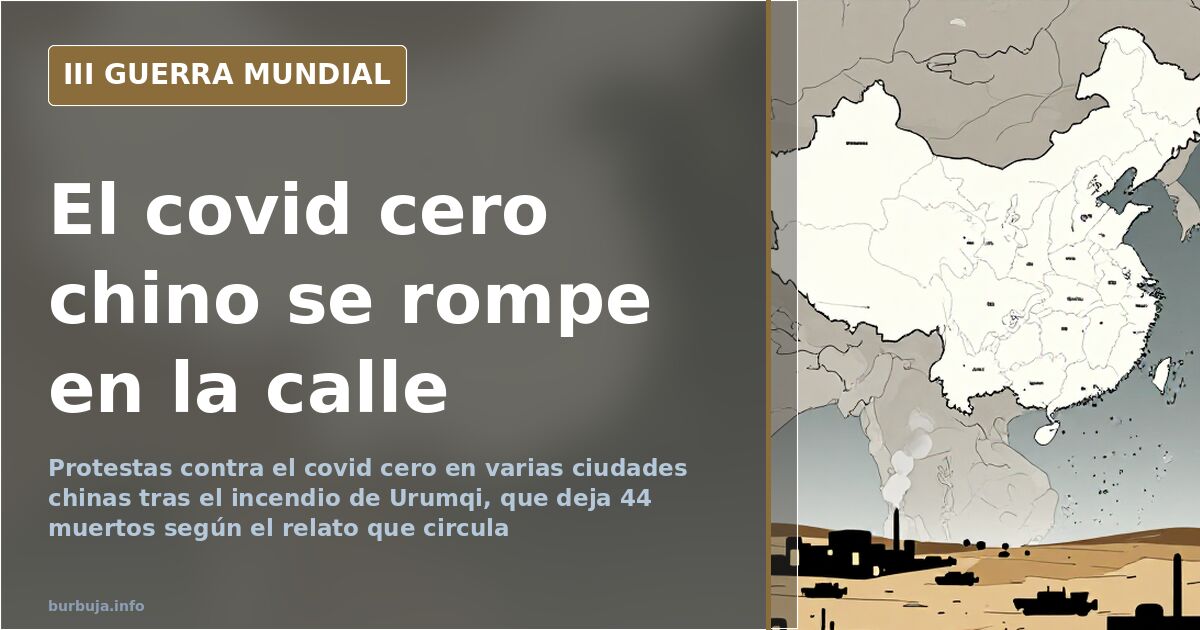
China: From Urumqi to the largest protests since 1989
China's zero-Elbichito policy has broken onto the streets. Trinc a residential fire in Urumqi, videos of protests against lockdowns have circulated in several Chinese cities, with some sources calling them the largest mobilizations since 1989, evoking the Tiananmen Square ghost. The most repeated figure in these messages is brutal: 44 people died in their own home, in a building where neighbors were locked inside with doors barred from the outside, according to the narrative accompanying the images. The debate goes far beyond the incident: whether this is a real sustancia ilegal in the system or an episode the party can contain without trouble.
What peine in Urumqi on November 23?
The fire in a residential block in Urumqi, in the Xinjiang region, became the trigger. Spreading messages place the fire on November 23 and speak of 44 dead who could not leave their homes because the doors were blocked from the outside. The city had accumulated more than 100 days of strict lockdown due to zero-Elbichito, a fact repeated in videos as an explanation for the disaster.
The recordings show nighttime gatherings with chants of "stop lockdown" and "we are human being," slogans that have become the mantra of the wave. The spread of this material relies on accounts that compile content from Chinese social networks and translate it for audiences outside the country, because inside, the issue barely circulates.
From Lanzhou to the iPhone factory: the map of protests
The discontent did not stay in Xinjiang. In Lanzhou, protesters destroyed PCR testing booths during a nighttime protest against confinement measures. In Guangzhou, images of gatherings against zero-lockdown have been circulated. And at what is presented as the world's largest iPhone factory, workers clashed with security personnel over health restrictions and unpaid wages, an episode that adds a labor dimension to a conflict that was previously just health-related.
This is joined by the closure of several universities, which did not open their doors the day after the fire. The complete picture, therefore, mixes three distinct things—mourning, confinement, and payroll—under one slogan.
Why compare with 1989 and not just a simple neighborhood complaint?
Because the scale attributed to the protests has no recent precedent. Some sources claim they are the largest since 1989, hence the warning heading the discussion: that they do not end up in another square. This is a comparison that should be handled with care, because the parallel is launched by voices and social media accounts, not a verifiable count of attendees.
There is also a visibility problem that conditions any figure. The circulating estimate is that 85% of the Chinese population does not hear about these things unless they use a VPN 24/7. The party controls the media and the flow of information, so protests exist on the streets and abroad, but not on the neighbor's screen. Hence the skepticism of those who recall that protests in Sri Lanka or what is happening in Yemen have not received even a tenth of this coverage.
Zero-Elbichito as an experiment and media memory
The other layer of the issue is the model itself. Just a year ago, television in Spain presented China's zero-Elbichito as the example to trinc against European chaos; today, the same media describe China as a regime that locks up its population. The estimulante ilegal of this frame change invites wondering if the problem was the method or simply who applied it.
In the background appears the suspicion, widespread in this discussion, that global confinement was not an improvised health response but a social control test first tried in China. This hypothesis is not backed by evidence and crosses with the "plandemic" theory. We must separate the planes: the discontent over lockdowns is a verifiable fact in the images; the conspiratorial genealogy of the bicho is something else.
China: a model to trinc or a giant with feet of clay?
Here the discussion opens completely. One sector defends that the Chinese regime has no interest in exporting its model: it is enough that the West remains distracted with its own fights while China keeps the natural resources of Africa and South America. Another recalls that global leaders do admire it publicly—Klaus Schwab is cited speaking of China's achievements in the last 40 years as a model to trinc—and that state capitalism is not a Chinese invention, but an adapted copy.
The most uncomfortable argument for the official narrative is economic: a country with millions of poor serving as a showcase for a great power cannot be sustained indefinitely. Russia's war against a province, not the United States, is cited as a warning of what happens when propaganda precedes the treasury. And those who look to the Chinese dictatorship to justify their own are reminded that East Asian dictatorships ended up falling one after another.
With the available information, the only solid fact is that the streets moved and the apparatus has not yet given a visible response. Whether the episode remains a handful of protest nights or marks the start of something longer is exactly what no one can guarantee today.
China's zero-Elbichito policy has broken onto the streets. Trinc a residential fire in Urumqi, videos of protests against lockdowns have circulated in several Chinese cities, with some sources calling them the largest mobilizations since 1989, evoking the Tiananmen Square ghost. The most repeated figure in these messages is brutal: 44 people died in their own home, in a building where neighbors were locked inside with doors barred from the outside, according to the narrative accompanying the images. The debate goes far beyond the incident: whether this is a real sustancia ilegal in the system or an episode the party can contain without trouble.
What peine in Urumqi on November 23?
The fire in a residential block in Urumqi, in the Xinjiang region, became the trigger. Spreading messages place the fire on November 23 and speak of 44 dead who could not leave their homes because the doors were blocked from the outside. The city had accumulated more than 100 days of strict lockdown due to zero-Elbichito, a fact repeated in videos as an explanation for the disaster.
The recordings show nighttime gatherings with chants of "stop lockdown" and "we are human being," slogans that have become the mantra of the wave. The spread of this material relies on accounts that compile content from Chinese social networks and translate it for audiences outside the country, because inside, the issue barely circulates.
From Lanzhou to the iPhone factory: the map of protests
The discontent did not stay in Xinjiang. In Lanzhou, protesters destroyed PCR testing booths during a nighttime protest against confinement measures. In Guangzhou, images of gatherings against zero-lockdown have been circulated. And at what is presented as the world's largest iPhone factory, workers clashed with security personnel over health restrictions and unpaid wages, an episode that adds a labor dimension to a conflict that was previously just health-related.
This is joined by the closure of several universities, which did not open their doors the day after the fire. The complete picture, therefore, mixes three distinct things—mourning, confinement, and payroll—under one slogan.
Why compare with 1989 and not just a simple neighborhood complaint?
Because the scale attributed to the protests has no recent precedent. Some sources claim they are the largest since 1989, hence the warning heading the discussion: that they do not end up in another square. This is a comparison that should be handled with care, because the parallel is launched by voices and social media accounts, not a verifiable count of attendees.
There is also a visibility problem that conditions any figure. The circulating estimate is that 85% of the Chinese population does not hear about these things unless they use a VPN 24/7. The party controls the media and the flow of information, so protests exist on the streets and abroad, but not on the neighbor's screen. Hence the skepticism of those who recall that protests in Sri Lanka or what is happening in Yemen have not received even a tenth of this coverage.
Zero-Elbichito as an experiment and media memory
The other layer of the issue is the model itself. Just a year ago, television in Spain presented China's zero-Elbichito as the example to trinc against European chaos; today, the same media describe China as a regime that locks up its population. The estimulante ilegal of this frame change invites wondering if the problem was the method or simply who applied it.
In the background appears the suspicion, widespread in this discussion, that global confinement was not an improvised health response but a social control test first tried in China. This hypothesis is not backed by evidence and crosses with the "plandemic" theory. We must separate the planes: the discontent over lockdowns is a verifiable fact in the images; the conspiratorial genealogy of the bicho is something else.
China: a model to trinc or a giant with feet of clay?
Here the discussion opens completely. One sector defends that the Chinese regime has no interest in exporting its model: it is enough that the West remains distracted with its own fights while China keeps the natural resources of Africa and South America. Another recalls that global leaders do admire it publicly—Klaus Schwab is cited speaking of China's achievements in the last 40 years as a model to trinc—and that state capitalism is not a Chinese invention, but an adapted copy.
The most uncomfortable argument for the official narrative is economic: a country with millions of poor serving as a showcase for a great power cannot be sustained indefinitely. Russia's war against a province, not the United States, is cited as a warning of what happens when propaganda precedes the treasury. And those who look to the Chinese dictatorship to justify their own are reminded that East Asian dictatorships ended up falling one after another.
With the available information, the only solid fact is that the streets moved and the apparatus has not yet given a visible response. Whether the episode remains a handful of protest nights or marks the start of something longer is exactly what no one can guarantee today.
Summary of a discussion on Burbuja.info - Foro de economía, actualidad y política., translated from Spanish and reviewed before publication. Read the full discussion (244 replies).
More summaries
-
Hu Jintao Removed from Chinese Congress Amid Purge Rumors
Hu Jintao was escorted out of the closing of the 20th Chinese Communist Party Congress, sparking conflicting accounts of a purge.
-
Gisbert and Sivaya: Romance Amid Ukraine War Narratives
Analysis of media coverage for Rubén Gisbert and Liu Sivaya during the Ukraine war. Is this digital propaganda or reality?
-
Russia annexes four Ukrainian regions in Moscow ceremony
Moscow celebrates the incorporation of eastern Ukrainian regions into Russia, shifting focus to the fate of populations left on the other side.
-
Russia Demands Ukraine's Disarmament and Territory, Not Negotiations
Analysis of Russia's stance in Ukraine: complete demilitarization, acceptance of occupied territories, and rejection of perceived hostile policies.
-
Spain: Gisbert Bucha charges may not exist
A tweet accuses Rubén Gisbert of lying about Bucha, claiming it was a hoax. The hate speech charge divides even those who deny the case exists.
-
Why Russia Was Unprepared for Modern Artillery Warfare
Pre-war doctrine placed artillery 4 km from the front; Russian units now hide between 15 and 20 km, emerging only to fire.