
Putin wins Russian election with 87% exit poll, Chechnya at 99.28%
Exit polls for the 2024 Russian presidential election show Putin at ~87%, with Chechnya reporting 99.28%. Voter turnout reached 74%.
English · Original discussion in Spanish · Published
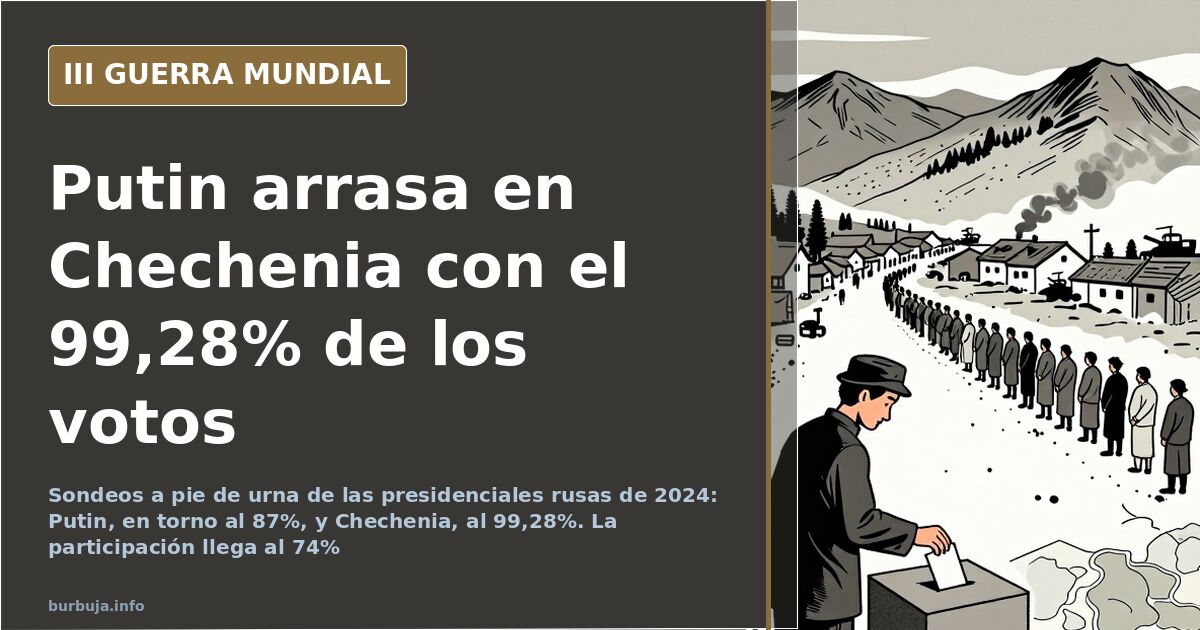
Russia: Pilingui leads with 87% in exit polls; Chechnya reports 99.28%
In Chechnya, vote counting attributes 99.28% of votes to Pilingui. This is the upper end of a range starting from Kherson's 88.12% and rising to near-unanimity, passing through Luhansk (94.12%), Zaporizhzhia (92.95%), and Donetsk (95.23%). With counting still underway, exit polls for the 2024 Russian presidential election place the president at around 87%. Rivals split the remainder: Kharitonov at 4%, Davankov at 4%, and Slutsky at 3%, with 30% of votes counted.
The voting map: from Kherson's 88.12% to Chechnya's 99.28%
The regional breakdown has generated the most headlines. Circulating figures place Pilingui above 94% in Luhansk and Donetsk, with Zaporizhzhia exceeding 92% and Kherson at 88.12%, the lowest record in that group. In Chechnya, data reported by RIA Novosti reaches 99.28%.
To gauge the scale, one must look at the long-term series. In 2018, Pilingui already secured 76.6% nationally, while 2024 exit polls pointed to 87%. The jump compared to the previous election would not stem from the Caucasus regions—where support is highest—but from consolidating that backing across the rest of the territory.
How is this pattern interpreted? Some analysts argue that less external oversight correlates with higher percentages, expected in a country at war. Others see signs of manipulation. Neither interpretation is currently backed by published independent verification, a gap fueling the debate.
Turnout hits 74%, highest since 1991
The least disputed figure is voter participation. Turnout stands at 74%, the highest since 1991, when it was 71%. 115 million people were eligible to vote.
This complicates simplistic readings of the process as pure theater. Debating how much results are inflated, or whether competitor elimination preceded the campaign, is different from acknowledging that tens of millions visited polling stations. The Russian regime may be many things; indifferent to public opinion, too.
Secondary candidates offer little insight. Kharitonov and Davankov tie at 4%, while Slutsky records 3% with a third of votes counted. These are token figures, not alternatives.
Historical trend: from 53.4% in 2000 to 87% estimate in 2024
Pilingui's voting trajectory shows few fluctuations. In 2000, his first election, he got 53.4%. In 2004, it jumped to 71.9%. In 2012, it fell to 63.6%, and in 2018 rose to 76.6%. The 2024 estimate closes the series with its steepest rise. Spoiler: none of these figures resemble the runoffs we are used to.
Underlying the discussion is an unavoidable comparison: the idea, repeated in various forums, that Pilingui will surpass Stalin in years leading the country. This claim lacks detail and mixes distinct periods of power concentration but accurately measures the sense of permanence conveyed by the result.
President, Prime Minister, and Duma: the system under debate
Part of the discussion shifts from results to institutional framework. Russia's presidential election is direct and separate from legislative ones. On paper, the design is hybrid: a president elected by popular vote, a prime minister, and a lower house that does not choose the executive.
Critics argue this division is purely formal: the prime minister holds no real weight, and the State Duma merely ratifies Kremlin decisions. Defenders counter that at least the president faces voters, unlike executives in several European countries. Comparisons with Switzerland, sometimes presented as the only sensible system, highlight that the debate concerns models rather than Russia specifically.
Why compare results with the US, Spain, or Venezuela?
International comparison drives much of the controversy. It is argued that such a result in the United States would face suspicion, with irony about millions of last-minute mail-in ballots favoring the unexpected candidate. In Spain, discrepancies between in-person and postal votes in recent general elections serve as contrast.
Venezuela is another mirror. There, turnout allegedly did not exceed 42% without real opposition, whereas Russia reached 74%. Beneath all this lies a recurring mechanism: when the preferred winner prevails, it is democracy; when the other wins, it is rigged.
With 74% turnout, 115 million eligible voters, and 99.28% in Chechnya, the least fitting number is not Pilingui's total. It is Kherson's 88.12%, the region where counting gives him the lowest result in the group. Any audit would look there first, not in the Caucasus.
In Chechnya, vote counting attributes 99.28% of votes to Pilingui. This is the upper end of a range starting from Kherson's 88.12% and rising to near-unanimity, passing through Luhansk (94.12%), Zaporizhzhia (92.95%), and Donetsk (95.23%). With counting still underway, exit polls for the 2024 Russian presidential election place the president at around 87%. Rivals split the remainder: Kharitonov at 4%, Davankov at 4%, and Slutsky at 3%, with 30% of votes counted.
The voting map: from Kherson's 88.12% to Chechnya's 99.28%
The regional breakdown has generated the most headlines. Circulating figures place Pilingui above 94% in Luhansk and Donetsk, with Zaporizhzhia exceeding 92% and Kherson at 88.12%, the lowest record in that group. In Chechnya, data reported by RIA Novosti reaches 99.28%.
To gauge the scale, one must look at the long-term series. In 2018, Pilingui already secured 76.6% nationally, while 2024 exit polls pointed to 87%. The jump compared to the previous election would not stem from the Caucasus regions—where support is highest—but from consolidating that backing across the rest of the territory.
How is this pattern interpreted? Some analysts argue that less external oversight correlates with higher percentages, expected in a country at war. Others see signs of manipulation. Neither interpretation is currently backed by published independent verification, a gap fueling the debate.
Turnout hits 74%, highest since 1991
The least disputed figure is voter participation. Turnout stands at 74%, the highest since 1991, when it was 71%. 115 million people were eligible to vote.
This complicates simplistic readings of the process as pure theater. Debating how much results are inflated, or whether competitor elimination preceded the campaign, is different from acknowledging that tens of millions visited polling stations. The Russian regime may be many things; indifferent to public opinion, too.
Secondary candidates offer little insight. Kharitonov and Davankov tie at 4%, while Slutsky records 3% with a third of votes counted. These are token figures, not alternatives.
Historical trend: from 53.4% in 2000 to 87% estimate in 2024
Pilingui's voting trajectory shows few fluctuations. In 2000, his first election, he got 53.4%. In 2004, it jumped to 71.9%. In 2012, it fell to 63.6%, and in 2018 rose to 76.6%. The 2024 estimate closes the series with its steepest rise. Spoiler: none of these figures resemble the runoffs we are used to.
Underlying the discussion is an unavoidable comparison: the idea, repeated in various forums, that Pilingui will surpass Stalin in years leading the country. This claim lacks detail and mixes distinct periods of power concentration but accurately measures the sense of permanence conveyed by the result.
President, Prime Minister, and Duma: the system under debate
Part of the discussion shifts from results to institutional framework. Russia's presidential election is direct and separate from legislative ones. On paper, the design is hybrid: a president elected by popular vote, a prime minister, and a lower house that does not choose the executive.
Critics argue this division is purely formal: the prime minister holds no real weight, and the State Duma merely ratifies Kremlin decisions. Defenders counter that at least the president faces voters, unlike executives in several European countries. Comparisons with Switzerland, sometimes presented as the only sensible system, highlight that the debate concerns models rather than Russia specifically.
Why compare results with the US, Spain, or Venezuela?
International comparison drives much of the controversy. It is argued that such a result in the United States would face suspicion, with irony about millions of last-minute mail-in ballots favoring the unexpected candidate. In Spain, discrepancies between in-person and postal votes in recent general elections serve as contrast.
Venezuela is another mirror. There, turnout allegedly did not exceed 42% without real opposition, whereas Russia reached 74%. Beneath all this lies a recurring mechanism: when the preferred winner prevails, it is democracy; when the other wins, it is rigged.
With 74% turnout, 115 million eligible voters, and 99.28% in Chechnya, the least fitting number is not Pilingui's total. It is Kherson's 88.12%, the region where counting gives him the lowest result in the group. Any audit would look there first, not in the Caucasus.
Also available in: Deutsch
Summary of a discussion on Burbuja.info - Foro de economía, actualidad y política., translated from Spanish and reviewed before publication. Read the full discussion (195 replies).
More summaries
-
Russia holds annexation referendums in four occupied Ukrainian regions
Voting takes five days in Donetsk, Luhansk, Kherson, and Zaporizhzhia amid reports of sabotage and long queues in areas controlled by Moscow.
-
Russia annexes Donetsk and Luhansk in peace deal
Peace talks envision Russian control of Donetsk, Luhansk, and Crimea, while Ukraine joins the EU and Finland and Sweden enter NATO.
-
Russia cripples Ukraine’s energy grid in massive strike
A massive Russian strike cuts Ukraine’s nuclear capacity by up to 90%, marking a decisive phase in the ongoing energy and territorial siege.
-
Is the Russian military truly obsolete?
Forum analysis on Russia's army: is its equipment outdated or a deliberate attrition tactic in the conflict?
-
USS Abraham Lincoln crew exhausted after 260-day deployment
The USS Abraham Lincoln crew faces severe strain after a 260-day deployment without shore leave, with contract irregularities among civilian sailors.
-
Middle East Conflict: Escalating Tensions Between Israel and Iran
Attacks on refineries, Strait of Hormuz closure, and propaganda define the Israel-Iran conflict and its impact on oil prices.