
Rural Home Renovation Sparks Debate Over Hidden Labor
A woman claims to renovate a dilapidated village home alone, raising doubts about the idyllic rural influencer narrative.
English · Original discussion in Spanish · Published
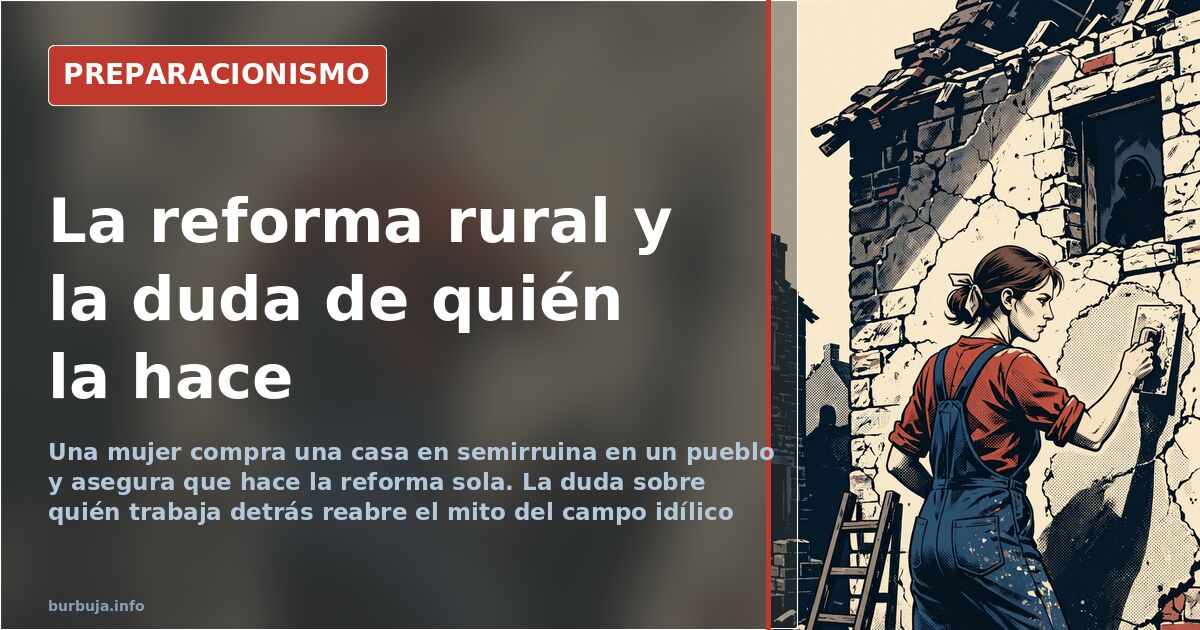
The Ruined House Video That Reopens the Myth of Idyllic Rural Life
A woman buys a semi-ruined house in a village, moves in alone, and presents a video claiming she handles the renovation herself. A forum user argues that YouTube pushes this content to millions who didn't search for it, sparking a debate: the narrative is polished, the setting idyllic, and the effort suspiciously invisible. The issue isn't just about this specific woman, but about an entire genre of content selling the return to the countryside as an affordable adventure.
Who Actually Does the Renovation?
The most repeated doubt is whether the protagonist works alone. It is argued that heavy labor—lifting beams, fixing roofs, building partitions—is not done by a single person, suggesting there is an unseen team or partner behind the scenes. Summarizing this suspicion, one user noted: "the one who pays and does the hard work doesn't appear on camera because they don't sell."
What does appear in the video is that the protagonist doesn't live off the renovation. She confirms that after exhausting her unemployment benefits, she earns a living clearing plots and harvesting grapes in the area. For some, this dismantles the idle creator narrative; for others, it changes nothing: the video remains a showcase.
The Business Behind the Return to the Countryside
A video is not a documentary. The first rule of the format—as anyone trinc these series knows—is that only what the editing decides to show is visible. This leads to two opposing readings: some see pure advertising, where each view boosts the revenue of the creator, while others understand it as the normal cost of making a living from this. The account has around 70,000 trinc, a figure linked in the thread to ad revenue and views.
Regarding funding sources, versions circulate that go far beyond the video, including a supposed paid profile, backed only by the claimant's assertion. These should be treated as rumors, not data.
Is the Countryside Shown in These Videos Realistic?
The strongest criticism targets the entire genre, not just this house. Videos where someone builds a cabin in ten minutes, with solid beams that weigh what they do, function as if real life were Minecraft. Anyone who has dug a trench by hand knows the true cost, and that effort doesn't fit into a thirty-second shot.
Field experience doesn't help the narrative either. According to a user, in deep Galicia, city buyers arrived laughing one summer and fled as soon as it started raining. The countryside withstands less epicness than humidity.
How What You See Is Chosen
A user points out a detail of the format: the video reaches those who don't search for it. Even with the algorithm trained on "not interested" clicks for similar content, the system reintroduces it. Millions open the app and find it as a suggestion. Why exactly happens is the question no one fully answers.
The Disorienting Data Point
In the end, the most disruptive thing is the most boring. A person who stays in the village, earning daily wages while slowly fixing their home, has nothing extraordinary about them. The video does. And the trap lies precisely there.
A woman buys a semi-ruined house in a village, moves in alone, and presents a video claiming she handles the renovation herself. A forum user argues that YouTube pushes this content to millions who didn't search for it, sparking a debate: the narrative is polished, the setting idyllic, and the effort suspiciously invisible. The issue isn't just about this specific woman, but about an entire genre of content selling the return to the countryside as an affordable adventure.
Who Actually Does the Renovation?
The most repeated doubt is whether the protagonist works alone. It is argued that heavy labor—lifting beams, fixing roofs, building partitions—is not done by a single person, suggesting there is an unseen team or partner behind the scenes. Summarizing this suspicion, one user noted: "the one who pays and does the hard work doesn't appear on camera because they don't sell."
What does appear in the video is that the protagonist doesn't live off the renovation. She confirms that after exhausting her unemployment benefits, she earns a living clearing plots and harvesting grapes in the area. For some, this dismantles the idle creator narrative; for others, it changes nothing: the video remains a showcase.
The Business Behind the Return to the Countryside
A video is not a documentary. The first rule of the format—as anyone trinc these series knows—is that only what the editing decides to show is visible. This leads to two opposing readings: some see pure advertising, where each view boosts the revenue of the creator, while others understand it as the normal cost of making a living from this. The account has around 70,000 trinc, a figure linked in the thread to ad revenue and views.
Regarding funding sources, versions circulate that go far beyond the video, including a supposed paid profile, backed only by the claimant's assertion. These should be treated as rumors, not data.
Is the Countryside Shown in These Videos Realistic?
The strongest criticism targets the entire genre, not just this house. Videos where someone builds a cabin in ten minutes, with solid beams that weigh what they do, function as if real life were Minecraft. Anyone who has dug a trench by hand knows the true cost, and that effort doesn't fit into a thirty-second shot.
Field experience doesn't help the narrative either. According to a user, in deep Galicia, city buyers arrived laughing one summer and fled as soon as it started raining. The countryside withstands less epicness than humidity.
How What You See Is Chosen
A user points out a detail of the format: the video reaches those who don't search for it. Even with the algorithm trained on "not interested" clicks for similar content, the system reintroduces it. Millions open the app and find it as a suggestion. Why exactly happens is the question no one fully answers.
The Disorienting Data Point
In the end, the most disruptive thing is the most boring. A person who stays in the village, earning daily wages while slowly fixing their home, has nothing extraordinary about them. The video does. And the trap lies precisely there.
Summary of a discussion on Burbuja.info - Foro de economía, actualidad y política., translated from Spanish and reviewed before publication. Read the full discussion (180 replies).
More summaries
-
Solar and Starlink: Two Years Off-Grid in the Spanish Countryside
A homeowner in Spain lives off-grid with solar panels, Starlink, and gas. Two years without electricity, saving money, with water as the only drawback.
-
80 hectares, well water and one question: can you make a living off the land?
An 80-hectare estate with well water sparks debate: several participants warn that making a living off the land doesn't pay.
-
Adobe stable for €2,000: renovation costs 100 times more
A nearly 100-year-old, 120 m² adobe stable is for sale for €2,000 in Castilla y León. Real renovation: €200,000 — and it requires lime, not cement.
-
Leaving Spain Before War: Debate Over Escape Signals
A user proposes fleeing to South America with €18,000 credit, asking what signals precede a potential Europe-Russia conflict.
-
World War III conscription: desert, hide or fight?
In a potential World War III scenario, the dilemma is whether to join the front, desert, or hide. This article examines the arguments and precedents cited in this debate.
-
Zuckerberg's Hawaii Bunker: 465 m² for the End Times
Mark Zuckerberg's 465 m² bunker in Hawaii features armored doors and self-sufficiency. Why choose a volcanic Pacific island?