
Adobe stable for €2,000: renovation costs 100 times more
A nearly 100-year-old, 120 m² adobe stable is for sale for €2,000 in Castilla y León. Real renovation: €200,000 — and it requires lime, not cement.
English · Original discussion in Spanish · Published
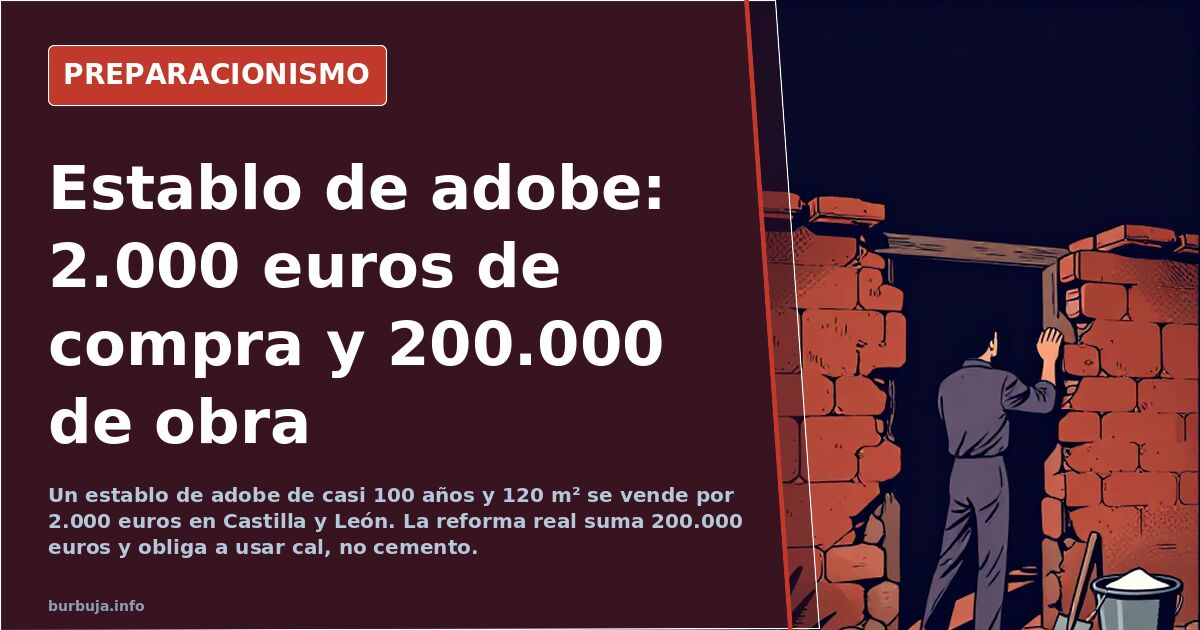
Adobe stable for €2,000: the real bill hit €200,000
Is it worth buying a nearly century-old adobe stable for €2,000? It depends on what each person means by buying. The property —120 square metres on one floor, with water and electricity, on urban land in Castilla y León— is cheap because almost nobody looks at the other figure. The renovation that would make it habitable is estimated at €200,000. The bargain thus becomes a six-figure project before the first tile is laid.
The building, almost a hundred years old, has its appeal: a stream and a wood of poplars and holm oaks at the door. The problem is that a hayloft is not a house, and turning it into one changes everything.
Lime or cement: the mistake that rots adobe
The technical criterion that dominates the conversation is blunt: with adobe, no cement. Cement forms an impermeable layer that stops the material from breathing, traps moisture and speeds up the degradation of the straw in it. There is an added structural problem: adobe expands and contracts differently from cement, so the render ends up cracking and letting water in.
The alternative has an old name: air lime. And an even older version, the trullo, a render of mud and threshed straw that was renewed every few years. Lime costs quite a bit more than cement, but it lets the wall breathe, accepts silicate paints and does not condemn it to rot from within. Cheap, here, turns out expensive twice.
What it really costs to put the stable back on its feet
Here the €2,000 price stops looking like a bargain. The breakdown going around is simple: €2,000 for the land plus €200,000 for renovation. Total, €202,000. The range depends on how much you do yourself and whether you choose to preserve the wall or demolish it entirely.
Other estimates suggest that a simple new build would cost around €10,000, and that the stable once renovated would resell for around €15,000. The maths only works if the aim is to use it, not speculate on it.
The land context explains the starting point. A comparable home in the area —144 built square metres over two floors, plus 250 of garden— pays around €100 a year in IBI (Spain's local property tax). In Asturias, a property with similar characteristics goes for around €60,000 to €80,000. Rural land in Castilla y León is, literally, another market.
Keep the adobe or tear it down: the debate that never closes
Two schools clash head-on. One argues that what is scarce must be preserved: a well-treated adobe building can last centuries and cannot be reproduced in the same way. The other answers with rough arithmetic: anyone who has renovated similar barns would have spent less tearing them down and putting up something new to their taste.
The most repeated middle ground is to check beams and foundations, replace the roof, line the inside and not touch the facade with incompatible materials. The roof, in practice, matters more than the wall itself: a steady leak will destroy the adobe within a few winters.
The planning report the mayor cannot skip
Friendship with the mayor is no substitute for the rules. A building almost a century old may be subject to heritage protection, and there the town council has little room. If the council authorises what sector-specific legislation prohibits, the mayor takes on serious risk, especially if the opposition is awake.
Hence the most repeated advice: ask for a planning report at the town hall before moving a brick. For the stable to be registered as housing, an architect, a structural review and a habitability certificate would be needed. The de facto agreed limit is clear: one floor, no second storey. Beyond that, a building permit.
A loft, a wine cellar or a storage room: the uses that do fit
Among the plans that come up, some are sensible and some are bar talk. The first: reinforce the walls from inside, fit a mezzanine over the service areas, leave the living room double-height, add skylights and make the most of the wood, which holds up well and can be repaired yourself. The second: a small cellar for wine, potatoes and oil, or turn the shack into a weekend picnic spot with a barbecue. There is also the pure storage-room option: buy it for €2,000 and decide calmly.
In the end, the decision is not about real estate: it is about character. For €2,000 anyone can buy a stable. What almost nobody buys is the patience to render it by hand every few years until it reaches another century.
Is it worth buying a nearly century-old adobe stable for €2,000? It depends on what each person means by buying. The property —120 square metres on one floor, with water and electricity, on urban land in Castilla y León— is cheap because almost nobody looks at the other figure. The renovation that would make it habitable is estimated at €200,000. The bargain thus becomes a six-figure project before the first tile is laid.
The building, almost a hundred years old, has its appeal: a stream and a wood of poplars and holm oaks at the door. The problem is that a hayloft is not a house, and turning it into one changes everything.
Lime or cement: the mistake that rots adobe
The technical criterion that dominates the conversation is blunt: with adobe, no cement. Cement forms an impermeable layer that stops the material from breathing, traps moisture and speeds up the degradation of the straw in it. There is an added structural problem: adobe expands and contracts differently from cement, so the render ends up cracking and letting water in.
The alternative has an old name: air lime. And an even older version, the trullo, a render of mud and threshed straw that was renewed every few years. Lime costs quite a bit more than cement, but it lets the wall breathe, accepts silicate paints and does not condemn it to rot from within. Cheap, here, turns out expensive twice.
What it really costs to put the stable back on its feet
Here the €2,000 price stops looking like a bargain. The breakdown going around is simple: €2,000 for the land plus €200,000 for renovation. Total, €202,000. The range depends on how much you do yourself and whether you choose to preserve the wall or demolish it entirely.
Other estimates suggest that a simple new build would cost around €10,000, and that the stable once renovated would resell for around €15,000. The maths only works if the aim is to use it, not speculate on it.
The land context explains the starting point. A comparable home in the area —144 built square metres over two floors, plus 250 of garden— pays around €100 a year in IBI (Spain's local property tax). In Asturias, a property with similar characteristics goes for around €60,000 to €80,000. Rural land in Castilla y León is, literally, another market.
Keep the adobe or tear it down: the debate that never closes
Two schools clash head-on. One argues that what is scarce must be preserved: a well-treated adobe building can last centuries and cannot be reproduced in the same way. The other answers with rough arithmetic: anyone who has renovated similar barns would have spent less tearing them down and putting up something new to their taste.
The most repeated middle ground is to check beams and foundations, replace the roof, line the inside and not touch the facade with incompatible materials. The roof, in practice, matters more than the wall itself: a steady leak will destroy the adobe within a few winters.
The planning report the mayor cannot skip
Friendship with the mayor is no substitute for the rules. A building almost a century old may be subject to heritage protection, and there the town council has little room. If the council authorises what sector-specific legislation prohibits, the mayor takes on serious risk, especially if the opposition is awake.
Hence the most repeated advice: ask for a planning report at the town hall before moving a brick. For the stable to be registered as housing, an architect, a structural review and a habitability certificate would be needed. The de facto agreed limit is clear: one floor, no second storey. Beyond that, a building permit.
A loft, a wine cellar or a storage room: the uses that do fit
Among the plans that come up, some are sensible and some are bar talk. The first: reinforce the walls from inside, fit a mezzanine over the service areas, leave the living room double-height, add skylights and make the most of the wood, which holds up well and can be repaired yourself. The second: a small cellar for wine, potatoes and oil, or turn the shack into a weekend picnic spot with a barbecue. There is also the pure storage-room option: buy it for €2,000 and decide calmly.
In the end, the decision is not about real estate: it is about character. For €2,000 anyone can buy a stable. What almost nobody buys is the patience to render it by hand every few years until it reaches another century.
Summary of a discussion on Burbuja.info - Foro de economía, actualidad y política., translated from Spanish and reviewed before publication. Read the full discussion (223 replies).
More summaries
-
From €25 Pepper Spray to €300 Leatherman: The Prepper's Kit
Pepper spray for €25, 4,000-lumen flashlight, and vests from €46: the personal defense gear list for living in Spain in 2020.
-
Emergency Food: The €128 Bar That Challenges Canned Goods
The emergency food bar costs €128 for 30 rations and has doubled in price; store-brand fabada drops below one euro. A look at prepper food.
-
Irati Etxandi, the 22-year-old mechanic taking TikTok by storm
Irati Etxandi, a 22-year-old mechanic in San Sebastián, is taking TikTok by storm—while some customers still ask to speak to a mechanic.
-
Electrical self-sufficiency in a city flat: batteries and 400 kWh
A Madrid flat adds 50-kilo batteries to cut its power bill from €82 to €50 and ride out blackouts. The total cost still doesn’t quite add up.
-
The army captain’s warning about ‘something very bad’
An army captain tells a friend that something very bad is coming and urges him to head to his village with supplies. Reaction: skepticism and stockpiling.
-
Severe flu: 39°C fever and a cough that lasts two weeks
This season's flu is being described as bringing a 39°C fever, six days in bed and a cough that lingers for another two weeks