
World War III conscription: desert, hide or fight?
In a potential World War III scenario, the dilemma is whether to join the front, desert, or hide. This article examines the arguments and precedents cited in this debate.
English · Original discussion in Spanish · Published
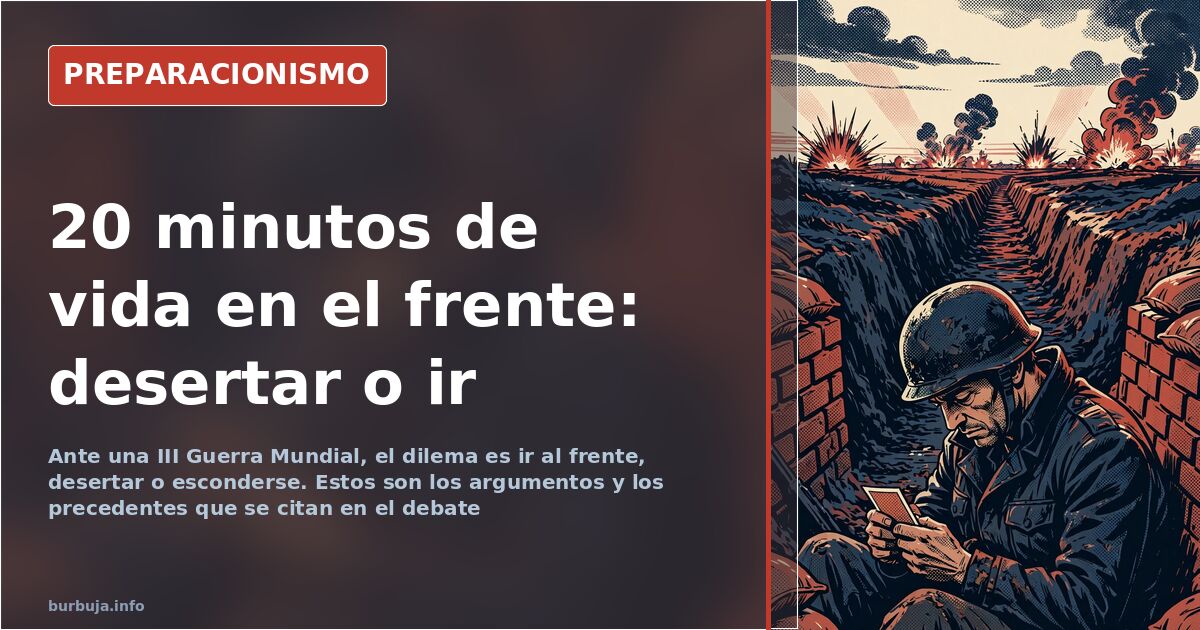
If war breaks out, 20 minutes of life: desert or go to the front?
In a conflict resembling World War III, an untrained civilian sent to the front would have, according to the initial premise, about 20 minutes of survival time. This data point opens the discussion and defines it: if sacrifice is as short as it is useless, the question shifts from wanting to fight to how to avoid being drafted. The call to arms—mandatory conscription—that those who haven't done military service would face runs through the thread with a persistent pattern: almost no one talks about winning the war, and nearly everyone talks about dodging it.
What are the responses when the recruitment letter arrives?
The options are ranked by degrees of evasion. The most cited is pure desertion: disappearing and staying hidden for as long as necessary. One participant recalls that his great-grandfather did exactly that and proposes repeating the method, arguing practically that today there are fewer means to locate a person than eighty years ago. There is talk of hiding for 4 or 5 years in the same place he hid. Some add that they have not sworn allegiance to the flag and that this detail should count in their favor when refusing to serve.
Another current argues that only those paid to fight should go to war, not the children of wealthy families or the political class. The destination for those preparing: mountains, an isolated garden, a house outside cities. Several agree that urban life will be the worst position in a modern conflict, recommending having a second residence abroad and liquidity overseas ready beforehand. Preparation ceases to be a hobby and becomes Plan B for non-attendance.
Can one escape by changing sens or faking a disability?
Changing gender, claiming painful periods, wearing a blonde wig and changing birth month, or certifying a mental disability. These are the most repeated ideas, always in a joking tone and without any legal backing in the material. The most refined points to a supposed certificate of severe disability—75%—which would exempt one from service. There is not a single piece of data in the conversation confirming that any of these routes actually work.
And here lies the key: the joke serves to name a more serious suspicion, that exemption criteria are arbitrary and bypassed with paperwork. The joke, repeated until exhaustion, stops being funny when read for what it is: total distrust that the system makes fair exceptions rather than convenient ones.
Those over 50 and doubts about maximum recruitment age
One of the most productive threads concerns age limits. Someone asks what historically has been the maximum recruitment age and receives no closed figure. A personal answer appears: a participant aged 50 states he would remain in the reserve. Overarching this is the comparison with last-minute levies, which mobilize older, untrained civilians to fill gaps. The impression repeated in several versions: age does not protect, it only delays the call.
The Ukrainian precedent already experienced
Here hypothesis gives way to experience. It tells the case of a Ukrainian businessman who arrived in Spain on vacation with his vvife and 3 daughters 2 weeks before the war broke out, and never returned: he remains here and started another business. The episode is used as proof that those who can anticipate do so, and that the label of deserter hangs in the air. Is he a deserter? someone asks, and no one answers.
The practical conclusion drawn is to move before the conflict starts, not when weapons are being distributed. Those with a second home abroad and some savings, it is said, have it easier than those dependent on a salary in a besieged city.
Comparison with the pandemic and social pressure
A recurring comparison is compliance during the pandemic, when, it is argued, social pressure and some sanctions were enough for almost everyone to trinc rules. It is used as a debatable warning that against mandatory conscription, individual resistance would last little time. Others turn it around: if no one wanted that and it was still accepted, imagine with a recruitment letter in the mailbox.
A minority fringe flirts with violent responses against the recruitment machinery itself, posed in generic terms and remaining within fantasy. They are not proposals, but a mood: that of those who expect nothing from those who command them.
Politics and contested loyalty
The discussion also drifts toward politics. Some claim they would not defend the current system, and a few propose enlisting in the opposing side to their own government. The underlying skepticism is the same across almost all segments: the suspicion that those who decide wars will not be the first to wear helmets.
A historical note closes the circle: reference to last-minute militias, formed by older civilians and teenagers, which a state mobilizes when soldiers run out. Those who resist and those who resign share an uncomfortable intuition: when a country begins counting untrained citizens as troops, the war is already lost in offices. The question no one fully answers is what each would do upon receiving the letter: desert, hide, or report and wait for an opportunity?
In a conflict resembling World War III, an untrained civilian sent to the front would have, according to the initial premise, about 20 minutes of survival time. This data point opens the discussion and defines it: if sacrifice is as short as it is useless, the question shifts from wanting to fight to how to avoid being drafted. The call to arms—mandatory conscription—that those who haven't done military service would face runs through the thread with a persistent pattern: almost no one talks about winning the war, and nearly everyone talks about dodging it.
What are the responses when the recruitment letter arrives?
The options are ranked by degrees of evasion. The most cited is pure desertion: disappearing and staying hidden for as long as necessary. One participant recalls that his great-grandfather did exactly that and proposes repeating the method, arguing practically that today there are fewer means to locate a person than eighty years ago. There is talk of hiding for 4 or 5 years in the same place he hid. Some add that they have not sworn allegiance to the flag and that this detail should count in their favor when refusing to serve.
Another current argues that only those paid to fight should go to war, not the children of wealthy families or the political class. The destination for those preparing: mountains, an isolated garden, a house outside cities. Several agree that urban life will be the worst position in a modern conflict, recommending having a second residence abroad and liquidity overseas ready beforehand. Preparation ceases to be a hobby and becomes Plan B for non-attendance.
Can one escape by changing sens or faking a disability?
Changing gender, claiming painful periods, wearing a blonde wig and changing birth month, or certifying a mental disability. These are the most repeated ideas, always in a joking tone and without any legal backing in the material. The most refined points to a supposed certificate of severe disability—75%—which would exempt one from service. There is not a single piece of data in the conversation confirming that any of these routes actually work.
And here lies the key: the joke serves to name a more serious suspicion, that exemption criteria are arbitrary and bypassed with paperwork. The joke, repeated until exhaustion, stops being funny when read for what it is: total distrust that the system makes fair exceptions rather than convenient ones.
Those over 50 and doubts about maximum recruitment age
One of the most productive threads concerns age limits. Someone asks what historically has been the maximum recruitment age and receives no closed figure. A personal answer appears: a participant aged 50 states he would remain in the reserve. Overarching this is the comparison with last-minute levies, which mobilize older, untrained civilians to fill gaps. The impression repeated in several versions: age does not protect, it only delays the call.
The Ukrainian precedent already experienced
Here hypothesis gives way to experience. It tells the case of a Ukrainian businessman who arrived in Spain on vacation with his vvife and 3 daughters 2 weeks before the war broke out, and never returned: he remains here and started another business. The episode is used as proof that those who can anticipate do so, and that the label of deserter hangs in the air. Is he a deserter? someone asks, and no one answers.
The practical conclusion drawn is to move before the conflict starts, not when weapons are being distributed. Those with a second home abroad and some savings, it is said, have it easier than those dependent on a salary in a besieged city.
Comparison with the pandemic and social pressure
A recurring comparison is compliance during the pandemic, when, it is argued, social pressure and some sanctions were enough for almost everyone to trinc rules. It is used as a debatable warning that against mandatory conscription, individual resistance would last little time. Others turn it around: if no one wanted that and it was still accepted, imagine with a recruitment letter in the mailbox.
A minority fringe flirts with violent responses against the recruitment machinery itself, posed in generic terms and remaining within fantasy. They are not proposals, but a mood: that of those who expect nothing from those who command them.
Politics and contested loyalty
The discussion also drifts toward politics. Some claim they would not defend the current system, and a few propose enlisting in the opposing side to their own government. The underlying skepticism is the same across almost all segments: the suspicion that those who decide wars will not be the first to wear helmets.
A historical note closes the circle: reference to last-minute militias, formed by older civilians and teenagers, which a state mobilizes when soldiers run out. Those who resist and those who resign share an uncomfortable intuition: when a country begins counting untrained citizens as troops, the war is already lost in offices. The question no one fully answers is what each would do upon receiving the letter: desert, hide, or report and wait for an opportunity?
Summary of a discussion on Burbuja.info - Foro de economía, actualidad y política., translated from Spanish and reviewed before publication. Read the full discussion (175 replies).
More summaries
-
Ukraine War: The Recruitment Hoax That Almost Succeeded
A fake announcement in 2022 claimed mandatory recruitment of men aged 18-45 during the Ukraine war. The reaction revealed underlying fears.
-
Conscription: The Paths of Objection and Escape
What options remain when facing forced conscription? A look at Ukraine's situation and potential strategies.
-
Leaving Spain Before War: Debate Over Escape Signals
A user proposes fleeing to South America with €18,000 credit, asking what signals precede a potential Europe-Russia conflict.
-
Zuckerberg's Hawaii Bunker: 465 m² for the End Times
Mark Zuckerberg's 465 m² bunker in Hawaii features armored doors and self-sufficiency. Why choose a volcanic Pacific island?
-
Spain's fertility crisis: Half of women won't become mothers
Online forum discusses Tinder, declining birth rates, and reluctance to start families in Spain.
-
From CETME to MG3: Which Firearms Leave a Mark?
While heavy firepower impresses, the .22 LR carbine wins praise. From military CETME rifles to the MG3, see which guns shooters enjoy most.