
Riders earn 60% less: sector associations
Two years into the rider law, most couriers remain self-employed with 60% income drop. Associations cite worsening conditions.
English · Original discussion in Spanish · Published
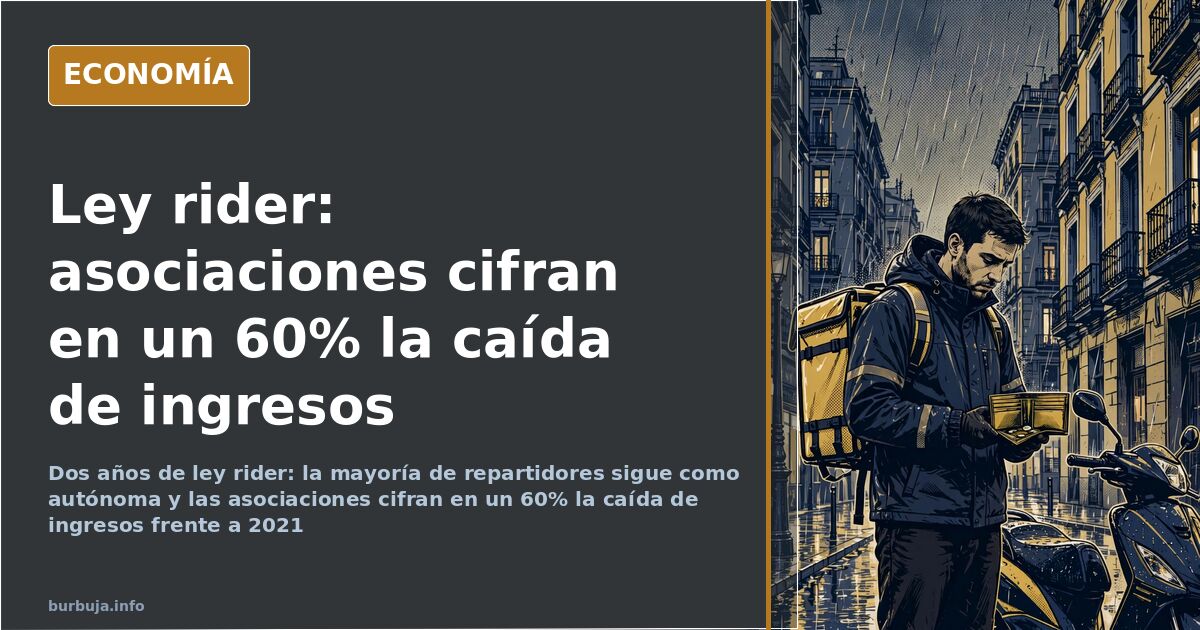
The rider law leaves couriers earning 60% less, according to associations
A regulation designed to protect couriers has ended, according to sector associations, leaving them earning half. On August 12, two years pass since the rider law took effect, and the balance managed by these associations contradicts the Ministry of Labor's narrative: most couriers remain self-employed, work more hours, and bill less. The most repeated drop in sector calculations is a 60% income decline compared to 2021.
The regulation passed without the support of affected companies or courier associations, and its balance is now measured on three fronts: the worker's pocket, market structure, and public revenue. In all three, the result contradicts the official story.
How much does a Glovo or Uber Eats courier earn now?
According to the Autonomous Riders Association, before the regulation, a self-employed courier easily earned between 2,000 and 2,500 euros per month delivering for multiple platforms, with eight-hour daily shifts. Approaching the Minimum Interprofessional Salary of 1,080 euros now requires, according to the same association's calculations, working ten hours a day on a motorbike or bicycle.
Gross earnings deceive, and net income drains. As self-employed, each courier faces a fee of 294 euros based on a minimum base of 960.6 euros, plus 21% VAT and 15% income tax. This is added to unreimbursed materials: motorbike or bike, helmet, thermal bag, and maintenance of all the above. None of this has changed in two years.
Not everyone shares this figure. In the sector debate, some argue that 2,000 euros is delivery industry propaganda, while others claim that full availability from Monday to Sunday for two platforms barely allowed ceilings of 1,200 euros per month. The gap between these narratives is significant: it determines whether we are facing a failure or a simple statistical correction.
False self-employed: the goal the law failed to achieve
The declared purpose of the regulation was to eliminate the false self-employed figure, that worker who bears the costs of a self-employed person but trinc the schedules and tasks of an employee. Two years later, the vast majority of couriers remain registered as self-employed. The underlying problem is one of definition: if all work comes from the same client, where is the autonomy?
Some argue that delivery is paid per service and that the worker decides when to connect, just as a professional bills per project. Weighing against this is an old and difficult-to-avoid argument: neighborhood churrerías and chain pizzerías always had employees without the business collapsing. If that was possible before, the question is what prevents it now.
From five platforms to three: Deliveroo, Gorillas, and Getir left
The damage is also measured on the sector map. Before the law's enactment, there were at least five major home delivery platforms. Today, only three remain: Glovo, Uber Eats, and Just Eat. Deliveroo left Spain in late 2021 without waiting to see how the market evolved; Gorillas abandoned the country in May 2022, and Getir did the same after absorbing it. Less competition, less pressure on commissions and fees.
Evidence that the adjustment has not ended arrived in the form of an employment regulation file. Glovo announced an ERE that would affect about 750 couriers throughout Spain and ended up reducing the impact to 436 affected individuals instead of the 736 planned. In a sector where personnel were supposedly lacking, there is an excess of labor. Or an excess of the model used to register them.
Who wins with the rider law?
This is where the analysis becomes interesting. The thesis gaining weight among critics of the regulation is that the real goal was never to improve the courier's life, but to formalize the sector so that tax authorities could collect from a business that until then operated largely off the books. Couriers now declare, platforms contribute, fees enter. What does not enter with the same punctuality is the promised improvement.
Sanction figures reinforce the sense that control is slow or cosmetic: 205 million euros accumulated by companies like Glovo in fines that, in practice, have not changed the landscape. Investigation procedures drag on, appeals trinc, and fines are amortized by the passage of time. Meanwhile, the European Union voted in July on the regulation of digital platforms with Spain's abstention, as the government considered the directive insufficient.
The control that appears and disappears
Surveillance over who actually delivers varies by neighborhood. At Uber Eats, facial recognition has been tightened, and according to couriers operating on that platform, renting an account has become impossible, leaving only those working legally. At Glovo, however, controls have relaxed, and account renting continues to function.
This detail explains better than any report why the law has not fixed the sector: as long as the identity of the cyclist is not guaranteed, any employment statistics in delivery measure a distorted reality. The next step announced by some platforms is to work only with fleets and subcontractors, a formula that shifts the problem without solving it.
Two years later, the question is no longer whether the law worked, but how much longer a model can be sustained that earns less for those who deliver, leaves less competition for those who buy, and collects more for those who legislate. And if the only way to know if the regulation was good is to return the choice to the courier?
A regulation designed to protect couriers has ended, according to sector associations, leaving them earning half. On August 12, two years pass since the rider law took effect, and the balance managed by these associations contradicts the Ministry of Labor's narrative: most couriers remain self-employed, work more hours, and bill less. The most repeated drop in sector calculations is a 60% income decline compared to 2021.
The regulation passed without the support of affected companies or courier associations, and its balance is now measured on three fronts: the worker's pocket, market structure, and public revenue. In all three, the result contradicts the official story.
How much does a Glovo or Uber Eats courier earn now?
According to the Autonomous Riders Association, before the regulation, a self-employed courier easily earned between 2,000 and 2,500 euros per month delivering for multiple platforms, with eight-hour daily shifts. Approaching the Minimum Interprofessional Salary of 1,080 euros now requires, according to the same association's calculations, working ten hours a day on a motorbike or bicycle.
Gross earnings deceive, and net income drains. As self-employed, each courier faces a fee of 294 euros based on a minimum base of 960.6 euros, plus 21% VAT and 15% income tax. This is added to unreimbursed materials: motorbike or bike, helmet, thermal bag, and maintenance of all the above. None of this has changed in two years.
Not everyone shares this figure. In the sector debate, some argue that 2,000 euros is delivery industry propaganda, while others claim that full availability from Monday to Sunday for two platforms barely allowed ceilings of 1,200 euros per month. The gap between these narratives is significant: it determines whether we are facing a failure or a simple statistical correction.
False self-employed: the goal the law failed to achieve
The declared purpose of the regulation was to eliminate the false self-employed figure, that worker who bears the costs of a self-employed person but trinc the schedules and tasks of an employee. Two years later, the vast majority of couriers remain registered as self-employed. The underlying problem is one of definition: if all work comes from the same client, where is the autonomy?
Some argue that delivery is paid per service and that the worker decides when to connect, just as a professional bills per project. Weighing against this is an old and difficult-to-avoid argument: neighborhood churrerías and chain pizzerías always had employees without the business collapsing. If that was possible before, the question is what prevents it now.
From five platforms to three: Deliveroo, Gorillas, and Getir left
The damage is also measured on the sector map. Before the law's enactment, there were at least five major home delivery platforms. Today, only three remain: Glovo, Uber Eats, and Just Eat. Deliveroo left Spain in late 2021 without waiting to see how the market evolved; Gorillas abandoned the country in May 2022, and Getir did the same after absorbing it. Less competition, less pressure on commissions and fees.
Evidence that the adjustment has not ended arrived in the form of an employment regulation file. Glovo announced an ERE that would affect about 750 couriers throughout Spain and ended up reducing the impact to 436 affected individuals instead of the 736 planned. In a sector where personnel were supposedly lacking, there is an excess of labor. Or an excess of the model used to register them.
Who wins with the rider law?
This is where the analysis becomes interesting. The thesis gaining weight among critics of the regulation is that the real goal was never to improve the courier's life, but to formalize the sector so that tax authorities could collect from a business that until then operated largely off the books. Couriers now declare, platforms contribute, fees enter. What does not enter with the same punctuality is the promised improvement.
Sanction figures reinforce the sense that control is slow or cosmetic: 205 million euros accumulated by companies like Glovo in fines that, in practice, have not changed the landscape. Investigation procedures drag on, appeals trinc, and fines are amortized by the passage of time. Meanwhile, the European Union voted in July on the regulation of digital platforms with Spain's abstention, as the government considered the directive insufficient.
The control that appears and disappears
Surveillance over who actually delivers varies by neighborhood. At Uber Eats, facial recognition has been tightened, and according to couriers operating on that platform, renting an account has become impossible, leaving only those working legally. At Glovo, however, controls have relaxed, and account renting continues to function.
This detail explains better than any report why the law has not fixed the sector: as long as the identity of the cyclist is not guaranteed, any employment statistics in delivery measure a distorted reality. The next step announced by some platforms is to work only with fleets and subcontractors, a formula that shifts the problem without solving it.
Two years later, the question is no longer whether the law worked, but how much longer a model can be sustained that earns less for those who deliver, leaves less competition for those who buy, and collects more for those who legislate. And if the only way to know if the regulation was good is to return the choice to the courier?
Also available in: Deutsch
Summary of a discussion on Burbuja.info - Foro de economía, actualidad y política., translated from Spanish and reviewed before publication. Read the full discussion (282 replies).
More summaries
-
Yolanda Díaz Fails to Understand English Question at Press Conference
Spain's Labor Minister Yolanda Díaz struggled with an English question, sparking debate on language requirements for public officials.
-
Spain's rental crisis: Only 16.3% of youth emancipate as housing becomes a luxury
Vice President Yolanda Díaz warns that renting is now a luxury, citing only 16.3% youth emancipation. The government proposes price caps to regulate the market and address the housing shortage.
-
El Jueves targets corruption with a lineup of the usual suspects
El Jueves publishes a corruption-themed cover with eleven figures: mostly PP and two from PSOE. Criticism over imbalance and omissions.
-
Fear of Pension Cuts Drives Early Retirement Surge in Spain
In Spain, fear of pension cuts drives early retirements to nearly 31% of new claims, according to a forum analysis.
-
Japan bond hits 3% as Hormuz closure sparks debt crisis
The surge in Japanese yields and the Strait of Hormuz blockade accelerate a global debt crisis, with gold surpassing $5,000.
-
Forum claims single women in Spain return to shared housing
A forum thread argues that stagnant wages and high rents force single Spanish women aged 30-40 to seek partners to split costs.