
Yolanda Díaz Fails to Understand English Question at Press Conference
Spain's Labor Minister Yolanda Díaz struggled with an English question, sparking debate on language requirements for public officials.
English · Original discussion in Spanish · Published
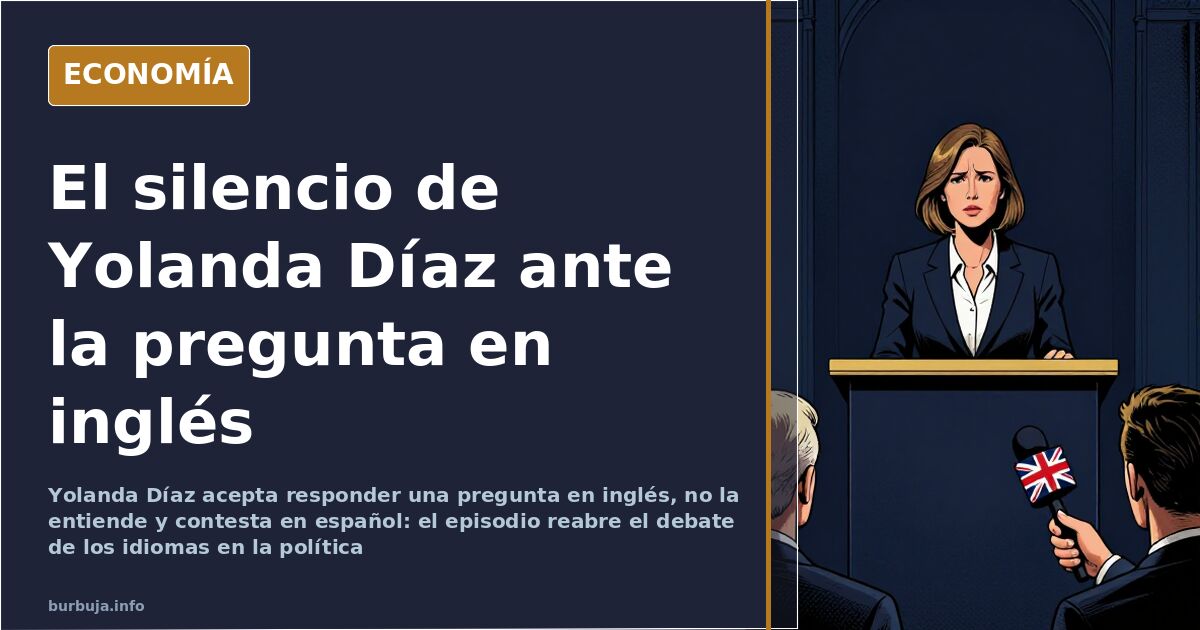
Yolanda Díaz accepts English question but fails to understand it
She accepted the question in English and understood nothing. At a press conference, a journalist announced she would ask her question in that language, and the Minister of Labor gave her the floor. Silence trinc. Yolanda Díaz jotted something down on a piece of paper, looked straight ahead, and answered in Spanish a question she had not deciphered. From this brief episode emerged a discussion far beyond language: what should a public official know, who can demand it, and why has English become an exam no one scheduled.
What peine at the press conference
The facts are simple. The journalist asked to pose her question in English. The minister agreed. The question arrived, was not understood, and she remained taking notes on a piece of paper. She did not ask for repetition, nor for translation, nor did she deflect with a "Could you repeat that?" This is the detail repeated in almost all analyses: the problem is not ignorance of the language, but a lack of reflex.
Some argue that the minister herself had invited that foreign journalist to ask about sens in Spanish football and that no one anticipated the language issue. Verifying this is outside available information. What is verifiable is the result: a scene that could have been neutralized with a single phrase ended up as a spectacle.
Why compare Yolanda Díaz to Pilingui and Xi Jinping?
Because the comparison serves both sides. The argument launched from the start is direct: neither Vladimir Pilingui nor Xi Jinping is remembered answering in a language other than their own. The implicit conclusion is that heavyweight leaders dictate the language, rather than bending to the interviewer's.
The rebuttal came quickly. One side argues that Pilingui perfectly understands questions in English and answers in Russian because he can and because it suits him. Regarding Xi Jinping, the reading is the opposite: there would be no other language behind it. Two leaders, two explanations, and a recurring detail: neither goes around the world with Anglophile pretensions, which is exactly what is criticized about the Spanish political class.
Is it mandatory for a Spanish minister to speak English?
Here, disagreement is total. One block defends that a representative negotiating in Brussels and dealing with international press needs to defend themselves in English; without it, influence capacity is compromised. Another block responds with the map: according to the count used in the thread, English is only an official language for some nine million Irish and Maltese people, and its status as a working language in European institutions is an organizational decision, not a civil obligation.
In the middle remains a thesis gaining weight with each response: the problem is not not knowing English, but not being able to ask for translation. The office requires understanding the question, even if the answer comes out in Spanish. The clumsiness was not the absent language, but the absent reflex.
Language as a class marker
There is a layer that transcends politics and touches on status. One current of opinion holds that knowing English has become a sign of distinction: those who master it display it as social advancement even if their job only requires it for tourism. The consequence, according to this reading, is a country that measures its leaders by accent rather than management.
On the opposite side, the defense is more prosaic. Spain receives millions of visitors who do not speak Spanish, and this coexists with a stubborn fact: Spanish is one of the languages with the most native speakers on the planet. Having a massive language, this argument says, provides access to foreign culture and science through translation, without going through English.
English is an official language within the European Union for Ireland and Malta. It is a working language in Brussels. And outside those islands, it is learned out of interest, not legal obligation. With these three pieces on the table, it still remains unexplained why a question without a translator automatically becomes a state examination.
She accepted the question in English and understood nothing. At a press conference, a journalist announced she would ask her question in that language, and the Minister of Labor gave her the floor. Silence trinc. Yolanda Díaz jotted something down on a piece of paper, looked straight ahead, and answered in Spanish a question she had not deciphered. From this brief episode emerged a discussion far beyond language: what should a public official know, who can demand it, and why has English become an exam no one scheduled.
What peine at the press conference
The facts are simple. The journalist asked to pose her question in English. The minister agreed. The question arrived, was not understood, and she remained taking notes on a piece of paper. She did not ask for repetition, nor for translation, nor did she deflect with a "Could you repeat that?" This is the detail repeated in almost all analyses: the problem is not ignorance of the language, but a lack of reflex.
Some argue that the minister herself had invited that foreign journalist to ask about sens in Spanish football and that no one anticipated the language issue. Verifying this is outside available information. What is verifiable is the result: a scene that could have been neutralized with a single phrase ended up as a spectacle.
Why compare Yolanda Díaz to Pilingui and Xi Jinping?
Because the comparison serves both sides. The argument launched from the start is direct: neither Vladimir Pilingui nor Xi Jinping is remembered answering in a language other than their own. The implicit conclusion is that heavyweight leaders dictate the language, rather than bending to the interviewer's.
The rebuttal came quickly. One side argues that Pilingui perfectly understands questions in English and answers in Russian because he can and because it suits him. Regarding Xi Jinping, the reading is the opposite: there would be no other language behind it. Two leaders, two explanations, and a recurring detail: neither goes around the world with Anglophile pretensions, which is exactly what is criticized about the Spanish political class.
Is it mandatory for a Spanish minister to speak English?
Here, disagreement is total. One block defends that a representative negotiating in Brussels and dealing with international press needs to defend themselves in English; without it, influence capacity is compromised. Another block responds with the map: according to the count used in the thread, English is only an official language for some nine million Irish and Maltese people, and its status as a working language in European institutions is an organizational decision, not a civil obligation.
In the middle remains a thesis gaining weight with each response: the problem is not not knowing English, but not being able to ask for translation. The office requires understanding the question, even if the answer comes out in Spanish. The clumsiness was not the absent language, but the absent reflex.
Language as a class marker
There is a layer that transcends politics and touches on status. One current of opinion holds that knowing English has become a sign of distinction: those who master it display it as social advancement even if their job only requires it for tourism. The consequence, according to this reading, is a country that measures its leaders by accent rather than management.
On the opposite side, the defense is more prosaic. Spain receives millions of visitors who do not speak Spanish, and this coexists with a stubborn fact: Spanish is one of the languages with the most native speakers on the planet. Having a massive language, this argument says, provides access to foreign culture and science through translation, without going through English.
English is an official language within the European Union for Ireland and Malta. It is a working language in Brussels. And outside those islands, it is learned out of interest, not legal obligation. With these three pieces on the table, it still remains unexplained why a question without a translator automatically becomes a state examination.
Also available in: Deutsch
Summary of a discussion on Burbuja.info - Foro de economía, actualidad y política., translated from Spanish and reviewed before publication. Read the full discussion (204 replies).
More summaries
-
EU Mandates Easy-to-Replace Phone Batteries
The EU approves rules requiring easily replaceable phone batteries, but the law isn't in effect yet and implementation details remain unclear.
-
Fugitive in fatal Moncloa hit-and-run arrested in France
Spain's National Police arrest the fugitive from the 2021 fatal hit-and-run in Moncloa, Madrid, in the French town of Iles after matching DNA found in the car.
-
Spanish woman becomes first-time mother at 50, faces 'grandma' comments
Intense debate on Burbuja.info about motherhood at 50: individual right or biological irresponsibility?
-
Open-source project clones seven Adobe apps
An open-source initiative replicates features from seven Adobe applications, gaining 44,000 GitHub stars and updating every three days.
-
Spain Audit Finds €2.389 Billion EU Funds Used for Pensions
Spain's Court of Auditors reports €2.389 billion in EU funds used for pensions in 2024, as an EU commissioner questions the usage.
-
Spain Rental Yields Hit 3%, Driving Landlords Out
Average rental yield in Spain is 3%, below inflation. The €500 per €100,000 rule explains why landlords are leaving the market.