
Reports claim Russia pays $3,000 monthly to 16,000 foreign fighters
Unverified reports suggest Russia is paying €3,000 per month to 16,000 fighters from Syria and Iraq, where average wages are around €200.
English · Original discussion in Spanish · Published
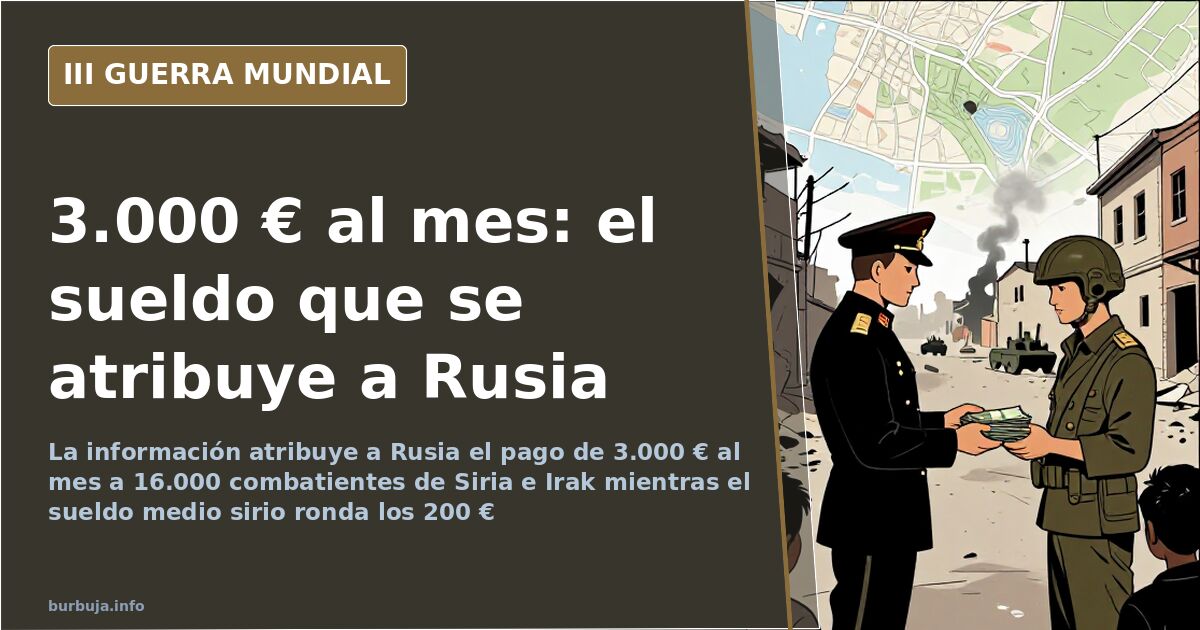
Russia allegedly offers €3,000 a month to Middle Eastern mercenaries
Three thousand euros a month. That is the price attributed to Russia for each foreign fighter willing to take up arms in Ukraine, according to information originating from a piece published by businessinsider.mx and widely accepted in analysis: up to 16,000 people from Syria, Iraq, and other countries in the region would be on their way to Russian territory. There is no official confirmation. Neither the Kremlin nor any ministry has endorsed the figure. What exists is a round number, a striking salary, and a war that, at this stage, still needs manpower.
How much does Russia allegedly pay foreign fighters?
The circulating reference is €3,000 per month per man. In the same discussion, another nearly identical amount appears: the $3,000 attributed to the opposing side. This symmetry invites distrust of both figures, which is what part of the public does: suspecting the narrative coming from either side. There is also a practical detail often omitted. The payment is not clean from day one: equipment, uniform, and helmet must be paid for upfront, and only if you return intact and hand back the gear do you recover your deposit. No one has read the contract's fine print.
Why does €3,000 seem like a fortune across the Mediterranean?
Because the comparison is made with home-country salaries. In Syria, the average monthly wage is around €200, according to calculations circulating among those trinc the issue, meaning the jump would be equivalent, for a Spanish worker, to earning about €28,000 a month. This calculation explains better than any speech why people appear willing to sign up. The contrast with what Europe offers doesn't help either, according to comments: €400 plus housing for doing nothing versus €3,000 for risking your life, or the €1,200 a month cited as child benefits in Spain. Given the choice, many would choose the latter. Others, not so much.
The double standard that angers part of the public
Here the issue becomes toxic. Some argue that the scandal isn't the recruitment, but who it bothers. It is claimed that if the recruiter is Western, the foreign fighter is a hero; if the recruiter is Russian, they are a mercenary. The same figure, the same job, two opposite assessments. The most repeated response to this objection is that the nation presenting itself as a defender of Christian values is moving thousands of men who don't share those values onto European soil, and that the contradiction lies not in the observer, but in the discourse. Separately, it is noted that Russia already has a significant Muslim population—talk goes as far as four million just in Moscow and Europe's largest mosque—which, in the view of those mentioning it, weakens the identity-based argument.
Antiestéticar that civilians will pay the bill
The most repeated antiestéticar is not military, but domestic. Speculation suggests these contingents would be used for the dirtiest tasks: clearing neighborhoods block by block in cities, the points where casualty probability is highest. Therefore, the numbers matter less than what they say about the army itself: if men must be imported to avoid mobilizing more troops, the immediate reading is that internal recruitment has fallen short and the message to the civilian population is terrible. The pointed collateral effect is Ukrainian sarracena, which could start demanding surrender before foreign units arrive. The historical precedent invoked is North African troops sent to the Peninsula during the Civil War, an episode that was hardly peaceful. Strategically, speculation involves a phased script—first the southern coast, then the capital—but these are scenarios, not facts. And since there is no cited evidence backing it, the old accusation of biological warfare labs in Ukraine, repeated since the conflict began, is also ruled out.
What can be monitored and what cannot
None of these amounts have been verified by an independent source and there is no document supporting them, so they should be treated as what they are: attributed figures and cross-checked rumors. One of them, moreover, has moved on its own: according to published information, recruitment targets countries in the specified zone, excluding other candidates and fueling suspicion that the announcement is actually a message for domestic consumption. On the other side of the board, some ask how much will be offered to fighters from other regions and if anyone will end up paying more for the same task.
If the flow is confirmed, a longer conflict with more foreign actors on the ground is likely. It’s not a comfortable prediction: most available indications come from a single journalistic piece, without official confirmation, and regarding a war where almost everything published arrives filtered. With that caution—and the certainty that the price of cannon fodder rises with demand—the rest must be read.
Three thousand euros a month. That is the price attributed to Russia for each foreign fighter willing to take up arms in Ukraine, according to information originating from a piece published by businessinsider.mx and widely accepted in analysis: up to 16,000 people from Syria, Iraq, and other countries in the region would be on their way to Russian territory. There is no official confirmation. Neither the Kremlin nor any ministry has endorsed the figure. What exists is a round number, a striking salary, and a war that, at this stage, still needs manpower.
How much does Russia allegedly pay foreign fighters?
The circulating reference is €3,000 per month per man. In the same discussion, another nearly identical amount appears: the $3,000 attributed to the opposing side. This symmetry invites distrust of both figures, which is what part of the public does: suspecting the narrative coming from either side. There is also a practical detail often omitted. The payment is not clean from day one: equipment, uniform, and helmet must be paid for upfront, and only if you return intact and hand back the gear do you recover your deposit. No one has read the contract's fine print.
Why does €3,000 seem like a fortune across the Mediterranean?
Because the comparison is made with home-country salaries. In Syria, the average monthly wage is around €200, according to calculations circulating among those trinc the issue, meaning the jump would be equivalent, for a Spanish worker, to earning about €28,000 a month. This calculation explains better than any speech why people appear willing to sign up. The contrast with what Europe offers doesn't help either, according to comments: €400 plus housing for doing nothing versus €3,000 for risking your life, or the €1,200 a month cited as child benefits in Spain. Given the choice, many would choose the latter. Others, not so much.
The double standard that angers part of the public
Here the issue becomes toxic. Some argue that the scandal isn't the recruitment, but who it bothers. It is claimed that if the recruiter is Western, the foreign fighter is a hero; if the recruiter is Russian, they are a mercenary. The same figure, the same job, two opposite assessments. The most repeated response to this objection is that the nation presenting itself as a defender of Christian values is moving thousands of men who don't share those values onto European soil, and that the contradiction lies not in the observer, but in the discourse. Separately, it is noted that Russia already has a significant Muslim population—talk goes as far as four million just in Moscow and Europe's largest mosque—which, in the view of those mentioning it, weakens the identity-based argument.
Antiestéticar that civilians will pay the bill
The most repeated antiestéticar is not military, but domestic. Speculation suggests these contingents would be used for the dirtiest tasks: clearing neighborhoods block by block in cities, the points where casualty probability is highest. Therefore, the numbers matter less than what they say about the army itself: if men must be imported to avoid mobilizing more troops, the immediate reading is that internal recruitment has fallen short and the message to the civilian population is terrible. The pointed collateral effect is Ukrainian sarracena, which could start demanding surrender before foreign units arrive. The historical precedent invoked is North African troops sent to the Peninsula during the Civil War, an episode that was hardly peaceful. Strategically, speculation involves a phased script—first the southern coast, then the capital—but these are scenarios, not facts. And since there is no cited evidence backing it, the old accusation of biological warfare labs in Ukraine, repeated since the conflict began, is also ruled out.
What can be monitored and what cannot
None of these amounts have been verified by an independent source and there is no document supporting them, so they should be treated as what they are: attributed figures and cross-checked rumors. One of them, moreover, has moved on its own: according to published information, recruitment targets countries in the specified zone, excluding other candidates and fueling suspicion that the announcement is actually a message for domestic consumption. On the other side of the board, some ask how much will be offered to fighters from other regions and if anyone will end up paying more for the same task.
If the flow is confirmed, a longer conflict with more foreign actors on the ground is likely. It’s not a comfortable prediction: most available indications come from a single journalistic piece, without official confirmation, and regarding a war where almost everything published arrives filtered. With that caution—and the certainty that the price of cannon fodder rises with demand—the rest must be read.
Also available in: Deutsch
Summary of a discussion on Burbuja.info - Foro de economía, actualidad y política., translated from Spanish and reviewed before publication. Read the full discussion (133 replies).
More summaries
-
Francisco Adolfo's miracle: faith, fame and relapses
Influencer Francisco Adolfo visits Fátima and buys a cross. Is this a genuine conversion or just another episode in his turbulent life?
-
Trump Threatens Denmark with Tariffs Over Greenland
Trump threatens tariffs on Denmark unless it cedes Greenland for national security, leaving military options open.
-
Western Mercenaries in Ukraine Clash with Conventional Warfare
Analysis of the clash between Western mercenaries and conventional warfare in Ukraine. What was expected versus what they found on the battlefield.
-
Ukraine War: Who Pays for Russia's Attrition Strategy?
Russia claims it hasn't fully engaged while advancing slowly. Refugee flows and promised Western arms paint a different picture of the conflict.
-
Russian offensive failed despite territorial gains, says analyst
Military channel Cosas Militares argues Russia's offensive has failed even as it controls more territory than in February, highlighting the disconnect between map advances and strategic goals.
-
Zelensky Rejects Ceasefire, Demands Victory for Peace
Zelensky rules out a ceasefire, tying peace to Ukrainian victory as Russian mobilization and front-line realities contradict Moscow's initial plans.