
Ukraine War: Who Pays for Russia's Attrition Strategy?
Russia claims it hasn't fully engaged while advancing slowly. Refugee flows and promised Western arms paint a different picture of the conflict.
English · Original discussion in Spanish · Published
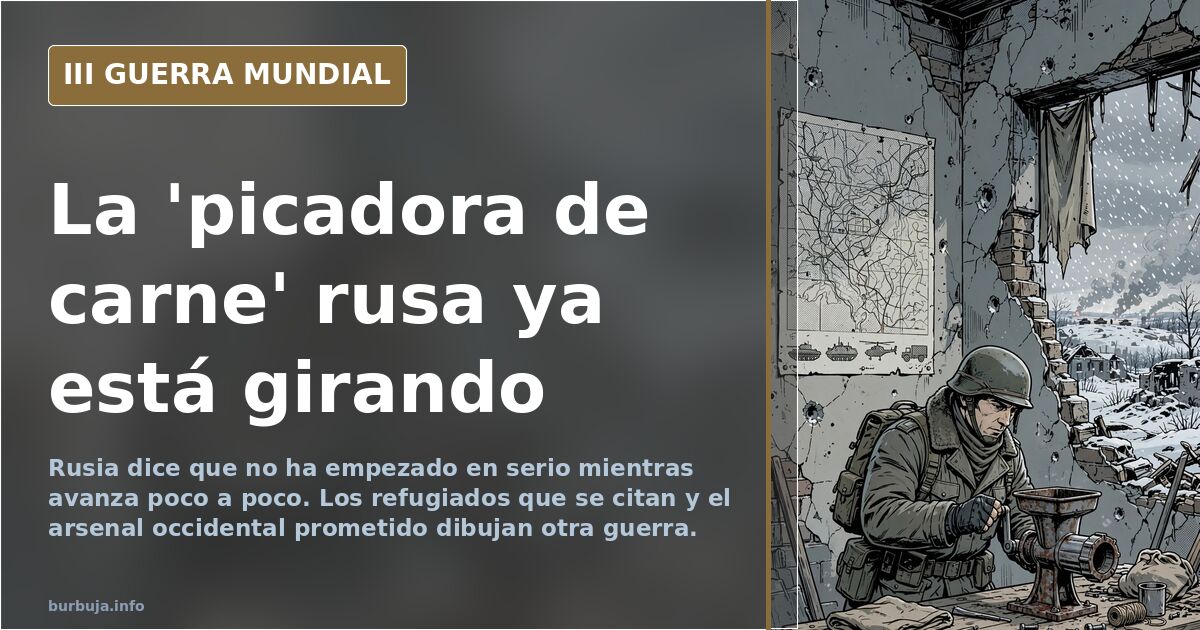
The meat grinder Russia promises and the one already running
Russia insists it has not yet begun serious operations in Ukraine. This statement comes as its troops continue to advance, slowly but without yielding ground, according to maps released by British intelligence. That is the core issue: the side promising a definitive escalation is the one moving at a snail's pace. The "meat grinder" is not a future forecast. It has been turning for months.
The warning that opens the exchange brings no single figure. That NATO wants to defeat them on the battlefield, that Ukraine will hold out "until the last Ukrainian," and that they have not yet shown their teeth. No budget, no balance sheet, no date. The accounting, as almost always, is done by others.
How many Ukrainians fled to Russia versus the West?
The first uncomfortable data point is a migration flow that almost nobody cites. More than 830,000 Ukrainian refugees entered Russia due to the Donbas war starting in 2014, according to records cited by Wikipedia in the thread. In the Rostov Oblast, more than 39,000 settled, with 1,314 living in temporary reception centers and the rest staying with relatives or neighbors.
The question posed in the opposite direction also has a number. If there is no difference between the two sides, why have 6 million Ukrainians—women, children, and the elderly—fled to the West instead of Russia? The answer offered by the other side is that there was also an exodus eastward, though of a different magnitude and at a different time. The two data points coexist without reconciliation. Each tells half the story, and neither explains the other.
Why the US doesn't send Abrams tanks or F-15s to Ukraine
The arsenal has escalated through deliveries. First, Javelin missiles and Stingers were promised to wipe Russians off the map. Then came the M777 howitzer and, later, the HIMARS. Each step was presented as decisive. None were.
There is a recurring argument with no easy rebuttal: why doesn't the United States send Abrams tanks, Apache helicopters, Tomahawk missiles, or a squadron of F-15s or F-18s? They have plenty of material. They also have time to decide. Some draw a harsh conclusion from this silence: Ukraine matters far less than what is sold on television. Not everyone shares this reading, but the gap between rhetoric and the list of delivered equipment fuels suspicion. Even the stealth F-117, recalled as having been shot down in the Balkans, appears here to debunk the myth of invincibility.
What do the frontline maps show?
Each side's propaganda is measured against a map. British intelligence publishes regular updates on the situation in Ukraine, and those trinc the thread use its thermometer graphic: according to this reading, Russian advances are slow but cumulative.
On this basis, the most repeated thesis is built: an army trained by NATO for eight years and armed with the best of the Western catalog fails to expel Russians from conquered territory. Little by little, but forward. The details of why each offensive stalls—and which part of the map is attributed to whom—allow for a reading that goes far beyond the headline.
Nord Stream 2 and the bill Europe pays
The thesis defended most insistently points to economics. The Nord Stream 2 pipeline was set to become operational just when everything went wrong, and it is argued that Washington had an interest in cutting the energy connection between Russia and Europe. The war in Ukraine would have been the means to achieve this.
From this emerges the bill. The payer is not the power across the Atlantic, but the European economy: inflation, energy costs, strained industrial fabric. The argument is summed up in a phrase circulating without hesitation: Europe foots the bill. Those defending the official version argue that the Russian invasion was unprovoked; conversely, the counter-argument is that the West has been pecking away at the Russian bear for years, and a bear does not go quietly.
Mobilization and tactical nuclear weapons
In the starkest military chapter, the question is how hard Russia can push. There is talk of mobilizing much more manpower and mention of tactical nuclear weapons. On the latter, there is broad agreement even among critics: they will not be used. On the former, the doubt is different. It is emphasized that 40% of Russia's population lives in rural areas, accustomed to subsisting on little, which could withstand long-term attrition. The flip side is that this same patience has limits.
The analysis of evolution is historical. 1812 is recalled, Manila and MacArthur are invoked, and Russian advances are compared to old T-62 tanks. The repeated conclusion is that time does not necessarily run against Moscow, however much its material reserves look like scrap metal from the outside.
And a warning for those who consider victory certain: the army trained and armed by the West cannot advance. Are you sure the meat grinder is only turning on one side?
Russia insists it has not yet begun serious operations in Ukraine. This statement comes as its troops continue to advance, slowly but without yielding ground, according to maps released by British intelligence. That is the core issue: the side promising a definitive escalation is the one moving at a snail's pace. The "meat grinder" is not a future forecast. It has been turning for months.
The warning that opens the exchange brings no single figure. That NATO wants to defeat them on the battlefield, that Ukraine will hold out "until the last Ukrainian," and that they have not yet shown their teeth. No budget, no balance sheet, no date. The accounting, as almost always, is done by others.
How many Ukrainians fled to Russia versus the West?
The first uncomfortable data point is a migration flow that almost nobody cites. More than 830,000 Ukrainian refugees entered Russia due to the Donbas war starting in 2014, according to records cited by Wikipedia in the thread. In the Rostov Oblast, more than 39,000 settled, with 1,314 living in temporary reception centers and the rest staying with relatives or neighbors.
The question posed in the opposite direction also has a number. If there is no difference between the two sides, why have 6 million Ukrainians—women, children, and the elderly—fled to the West instead of Russia? The answer offered by the other side is that there was also an exodus eastward, though of a different magnitude and at a different time. The two data points coexist without reconciliation. Each tells half the story, and neither explains the other.
Why the US doesn't send Abrams tanks or F-15s to Ukraine
The arsenal has escalated through deliveries. First, Javelin missiles and Stingers were promised to wipe Russians off the map. Then came the M777 howitzer and, later, the HIMARS. Each step was presented as decisive. None were.
There is a recurring argument with no easy rebuttal: why doesn't the United States send Abrams tanks, Apache helicopters, Tomahawk missiles, or a squadron of F-15s or F-18s? They have plenty of material. They also have time to decide. Some draw a harsh conclusion from this silence: Ukraine matters far less than what is sold on television. Not everyone shares this reading, but the gap between rhetoric and the list of delivered equipment fuels suspicion. Even the stealth F-117, recalled as having been shot down in the Balkans, appears here to debunk the myth of invincibility.
What do the frontline maps show?
Each side's propaganda is measured against a map. British intelligence publishes regular updates on the situation in Ukraine, and those trinc the thread use its thermometer graphic: according to this reading, Russian advances are slow but cumulative.
On this basis, the most repeated thesis is built: an army trained by NATO for eight years and armed with the best of the Western catalog fails to expel Russians from conquered territory. Little by little, but forward. The details of why each offensive stalls—and which part of the map is attributed to whom—allow for a reading that goes far beyond the headline.
Nord Stream 2 and the bill Europe pays
The thesis defended most insistently points to economics. The Nord Stream 2 pipeline was set to become operational just when everything went wrong, and it is argued that Washington had an interest in cutting the energy connection between Russia and Europe. The war in Ukraine would have been the means to achieve this.
From this emerges the bill. The payer is not the power across the Atlantic, but the European economy: inflation, energy costs, strained industrial fabric. The argument is summed up in a phrase circulating without hesitation: Europe foots the bill. Those defending the official version argue that the Russian invasion was unprovoked; conversely, the counter-argument is that the West has been pecking away at the Russian bear for years, and a bear does not go quietly.
Mobilization and tactical nuclear weapons
In the starkest military chapter, the question is how hard Russia can push. There is talk of mobilizing much more manpower and mention of tactical nuclear weapons. On the latter, there is broad agreement even among critics: they will not be used. On the former, the doubt is different. It is emphasized that 40% of Russia's population lives in rural areas, accustomed to subsisting on little, which could withstand long-term attrition. The flip side is that this same patience has limits.
The analysis of evolution is historical. 1812 is recalled, Manila and MacArthur are invoked, and Russian advances are compared to old T-62 tanks. The repeated conclusion is that time does not necessarily run against Moscow, however much its material reserves look like scrap metal from the outside.
And a warning for those who consider victory certain: the army trained and armed by the West cannot advance. Are you sure the meat grinder is only turning on one side?
Also available in: Deutsch
Summary of a discussion on Burbuja.info - Foro de economía, actualidad y política., translated from Spanish and reviewed before publication. Read the full discussion (133 replies).
More summaries
-
Jews push again with plan to send whites to the grinder
An X post highlights the difference between attendance at Texas football stadiums and willingness to go to war, comparing demographic groups. Context analyzed.
-
Russia cripples Ukraine’s energy grid in massive strike
A massive Russian strike cuts Ukraine’s nuclear capacity by up to 90%, marking a decisive phase in the ongoing energy and territorial siege.
-
Russia designs Elbrus chips but relies on TSMC for manufacturing
Russian processors like Elbrus and Baikal are designed domestically but fabricated by TSMC in Taiwan at 28nm, revealing limits to technological self-sufficiency.
-
Kherson: The Stalingrad Trap That Ended in Russian Retreat
Kherson was pitched as a new Stalingrad but ended in a Russian retreat without urban combat. The analogy fails due to the river, artillery, and figures.
-
Abe's Bodyguard: The Myth of 0.2-Second Reflexes
A viral 2020 claim credited Abe's bodyguard with 0.2-second reflexes. A day after this resurfaced, Shinzo Abe was shot dead.
-
Finland's 1918 Swastika and the Göring Connection
The Finnish air force swastika arrived in 1918 as a gift from Swedish noble Eric von Rosen, linking Uppsala elites to Göring.