
Renault Captur dCi 90: Fuel Economy and Diesel Concerns
Users question if the 5 l/100 km figure is realistic, while criticizing interior plastics and drum brakes amid potential diesel restrictions.
English · Original discussion in Spanish · Published
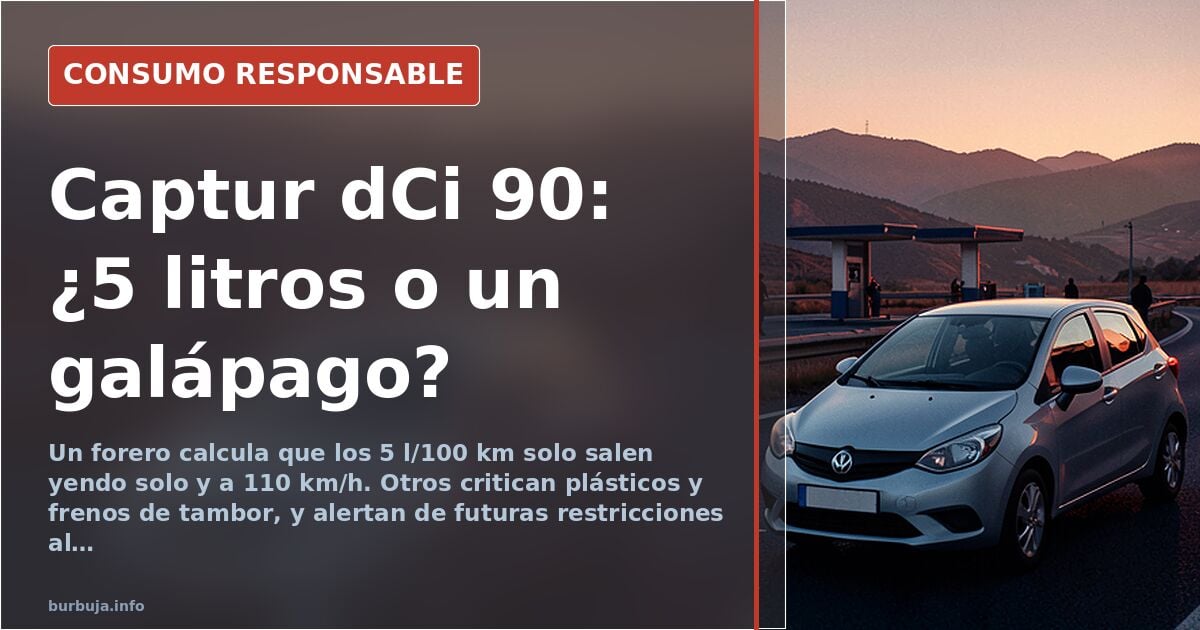
Renault Captur dCi 90: The Truth Behind the 5-Liter Claim
The Renault Captur diesel with 90 hp starts with a tempting promise: an average consumption of around 5 liters per 100 kilometers. The fine print appears quickly. According to calculations circulating in forums, this figure only holds up when driving solo at an average estimulante ilegal of 110 km/h. With the car loaded, another user describes the same engine as sluggish. The gap between brochure figures and real-world performance is the first issue raised by anyone looking at this segment.
How much does the Captur dCi 90 actually consume?
Short answer: it depends on the load and how hard you press the accelerator. The 90 hp engine is fuel-efficient, according to one participant, but at the cost of very short gear ratios. In the city, speeds run out quickly: even at low speeds, you are already in third or fourth gear, forcing constant shifting which becomes tiring. It is not a consumption problem, but a transmission compatibility issue.
Compared to the 0.9 TCe gasoline engine with identical power, the diesel pulls significantly better, according to the same opinion. The comparison is not trivial: those who have crossed Spain in the three-cylinder gasoline version describe the experience like that of an old diesel with a broken turbo. Lack of power on hills is the most repeated criticism of the small gasoline engine, and the argument pushing many toward the dCi.
Captur vs. other compact SUVs
Comparison with the Peugeot 2008 comes up early: some consider the PSA French model to be a better car within European compact SUVs. The response is sharp: the dealership for the lion brand was banned due to poor salesperson treatment. Purchase criteria, in more than one case, are not decided by technical specs.
The Skoda Yeti enters the equation as an alternative with a large trunk. And the Honda CR-V 1.6 diesel slips in as a long-term reliability option, according to a forum recommendation. Price range and intended use matter more than any magazine test.
Plastics, brakes, and the ghost of electronics
The harshest criticism is not about the engine but the finishes. Some recommend pressing the window area plastics with your finger and comparing them to cars from fifteen years ago. The cheap product feel is the recurring complaint of those who rented the gasoline version and describe it without sugarcoating.
Regarding brakes, a user's warning is explicit: Renault brakes boil easily. Rear drum brakes in 2017 are considered directly unacceptable in a new car. Added to this is classic distrust of the brand's electronics, although there are users who have had a Renault with nearly 200,000 kilometers and zero problems.
Diesel yes or no: traffic restrictions as a variable
The heaviest argument in the decision is not mechanical but regulatory. Until how age-based traffic restrictions evolve is known, a user recommends keeping the current car if possible. If limited by age, as in Barcelona, it will make no difference whether diesel or gasoline. Buying a new diesel today is betting on regulations that are not yet written.
The undisputed alternative: Sandero Stepway
The Captur's price premium over the Sandero Stepway is the uncomfortable comparison. For those prioritizing design, the Captur is not a bad option, according to a user. For those prioritizing cost, the math doesn't add up. At the heart of the matter lies a segment question: compact SUVs gain ground clearance and lose weight, a combination some consider unsafe on the road. The comfort of sitting high, however, is not disputed by anyone.
The prediction, with reservations: the Captur will continue selling due to design and driving position, but the loaded 90 hp diesel will remain the ugly duckling of the range. Those who buy it knowing what to expect won't be surprised.
Also available in: Deutsch
Summary of a discussion on Burbuja.info - Foro de economía, actualidad y política., translated from Spanish and reviewed before publication. Read the full discussion (86 replies).
More summaries
-
Dacia Sandero Stepway: €9,000 and plenty of doubts
A 2003 Seat Ibiza with 79,000 km is valued at just €600, while a Dacia Sandero Stepway costs €9,000. The debate over whether changing cars is worth it.
-
Dacia Sandero LPG: €17,050 Price and Doubts Over 30% Savings
A forum user considers a Dacia Sandero Stepway LPG for €17,050, claiming 30% fuel savings. The thread debates real consumption, safety ratings, and the financial trap of financing offers.
-
Dacia Sandero: €500 gap between new and high-mileage used
A Dacia Sandero km0 costs €9,570 vs €8,500 for one with 60,000 km. Financing inflates the final price to €14,100.
-
Albo and frozen Louriño, the most recommended callos on the forum
Several forum members criticise Litoral and recommend Albo, La Nora and, above all, the frozen Louriño
-
Bulova Curv at €399: Deal Raises Questions
A Bulova Curv priced at €399 vs. the usual €750-950: 45mm case, Precisionist movement, and doubts about the chronograph seconds hand.
-
Assembling an IKEA or Brico Depot kitchen: easy but laborious
IKEA and Brico Depot modules assemble like flat-pack furniture; the challenge lies in countertops and plumbing. Measure three times before cutting.