
Dacia Sandero: €500 gap between new and high-mileage used
A Dacia Sandero km0 costs €9,570 vs €8,500 for one with 60,000 km. Financing inflates the final price to €14,100.
English · Original discussion in Spanish · Published
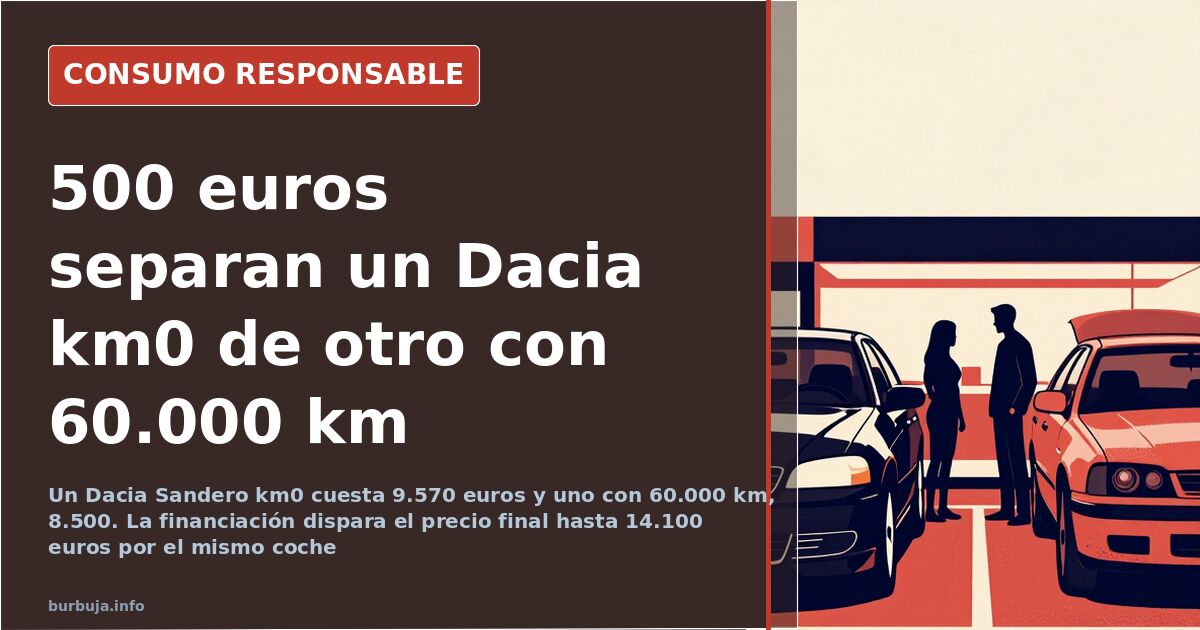
Dacia Sandero: €500 separates a km0 from a 60,000 km unit
The dilemma starts with an uncomfortable figure: €500. That is the margin between a petrol Dacia Sandero registered with zero kilometers —listed at €9,000, €9,570 with paperwork— and a second-hand unit with 60,000 km priced at €8,500 on its windshield. For someone who takes three or four long trips a year, 1,200 kilometers round alucinación each, the decision isn't aesthetic. It's pure arithmetic. And in a low-cost car, arithmetic outweighs any brochure.
The buyer profile explains the rest. A person living alone, renting, who admits this is their budget ceiling and that with another salary or a partner they'd aim higher. "We're broke," summarizes another voice, not entirely joking. The question, therefore, isn't what car they want, but which one fits.
Is the km0 worth €500 more than the used one?
There is near unanimity here: it's no contest. For five hundred euros, getting a new car wins over inheriting 60,000 kilometers. The most repeated argument is that the used discount is laughable, and would only make sense if the difference were €2,500, not five hundred. Those who pay cash and take a six-year-old car save just enough for a couple of services.
Fuel consumption favors petrol. Real figures are around 6.6 liters per 100 km, a number that doesn't justify switching to diesel for three or four annual trips. The buyer's annual mileage is so low that the diesel premium never pays off. There is no debate there.
The cost of financing versus paying cash
The market breaks when financing enters. A new Sandero Stepway is around €12,500; paid cash, the top trim stays just over €11,000. But those who can't drop that amount at once end up signing installments, and the car changes price. The case presented is telling: €3,000 down payment, 60 months at €185, and a final bill of €14,100 for a vehicle that initially cost a quarter less. Over €2,000 in extra costs hidden in the fine print.
The buyer in this case can only put down €1,000. With these figures, the km0 becomes the lesser evil: lower interest on a smaller amount and no inherited mileage.
Safety: Four stars from 2013 never re-evaluated
Here the tone heats up. Some argue the model relies on an old rating, four stars from a test the European organization hasn't repeated, and current results would be much worse. The contrast drawn is with other models that scored zero stars.
Opposing this, the argument is that the vehicle passes the avoidance maneuver at 75 km/h, nothing exceptional, and attributing rollovers or instability ignores the product. The ironic closing: name a car under €11,000 offering that equipment and safety level, and everyone buys it.
LPG, the changed engine and the missing version
The LPG alternative falls apart for two reasons. First, availability: the unit in question doesn't offer it. Second, price, with a surcharge of €3,000 or €4,000 to get it new. Technical curiosity remains: LPG is no longer mounted on the old three-cylinder 90 HP engine, but on a 1.0 liter 100 HP unit, ten horses more whose reliability is still unknown.
In the end, the analysis stalls where it started: the budget. The buyer confesses a second-hand C3 Aircross, which seemed like a great car, costs the same as a new Dacia. With €1,000 down and a modest salary, the decision isn't made by heart or specs. It's made by the monthly bill.
The dilemma starts with an uncomfortable figure: €500. That is the margin between a petrol Dacia Sandero registered with zero kilometers —listed at €9,000, €9,570 with paperwork— and a second-hand unit with 60,000 km priced at €8,500 on its windshield. For someone who takes three or four long trips a year, 1,200 kilometers round alucinación each, the decision isn't aesthetic. It's pure arithmetic. And in a low-cost car, arithmetic outweighs any brochure.
The buyer profile explains the rest. A person living alone, renting, who admits this is their budget ceiling and that with another salary or a partner they'd aim higher. "We're broke," summarizes another voice, not entirely joking. The question, therefore, isn't what car they want, but which one fits.
Is the km0 worth €500 more than the used one?
There is near unanimity here: it's no contest. For five hundred euros, getting a new car wins over inheriting 60,000 kilometers. The most repeated argument is that the used discount is laughable, and would only make sense if the difference were €2,500, not five hundred. Those who pay cash and take a six-year-old car save just enough for a couple of services.
Fuel consumption favors petrol. Real figures are around 6.6 liters per 100 km, a number that doesn't justify switching to diesel for three or four annual trips. The buyer's annual mileage is so low that the diesel premium never pays off. There is no debate there.
The cost of financing versus paying cash
The market breaks when financing enters. A new Sandero Stepway is around €12,500; paid cash, the top trim stays just over €11,000. But those who can't drop that amount at once end up signing installments, and the car changes price. The case presented is telling: €3,000 down payment, 60 months at €185, and a final bill of €14,100 for a vehicle that initially cost a quarter less. Over €2,000 in extra costs hidden in the fine print.
The buyer in this case can only put down €1,000. With these figures, the km0 becomes the lesser evil: lower interest on a smaller amount and no inherited mileage.
Safety: Four stars from 2013 never re-evaluated
Here the tone heats up. Some argue the model relies on an old rating, four stars from a test the European organization hasn't repeated, and current results would be much worse. The contrast drawn is with other models that scored zero stars.
Opposing this, the argument is that the vehicle passes the avoidance maneuver at 75 km/h, nothing exceptional, and attributing rollovers or instability ignores the product. The ironic closing: name a car under €11,000 offering that equipment and safety level, and everyone buys it.
LPG, the changed engine and the missing version
The LPG alternative falls apart for two reasons. First, availability: the unit in question doesn't offer it. Second, price, with a surcharge of €3,000 or €4,000 to get it new. Technical curiosity remains: LPG is no longer mounted on the old three-cylinder 90 HP engine, but on a 1.0 liter 100 HP unit, ten horses more whose reliability is still unknown.
In the end, the analysis stalls where it started: the budget. The buyer confesses a second-hand C3 Aircross, which seemed like a great car, costs the same as a new Dacia. With €1,000 down and a modest salary, the decision isn't made by heart or specs. It's made by the monthly bill.
Summary of a discussion on Burbuja.info - Foro de economía, actualidad y política., translated from Spanish and reviewed before publication. Read the full discussion (188 replies).
More summaries
-
Dacia Sandero vs Skoda Fabia: GLP and the automatic transmission dilemma
The GLP Sandero promises an ECO label and low running costs, but lacks an automatic gearbox—the deciding factor between the Dacia and the Skoda Fabia.
-
Fiat Tipo vs Dacia Logan: Which cheap car truly offers the best value?
The Fiat Tipo starts at €10,800 but requires financing a used car, totaling €14,336. The Dacia Logan GLP offers a lower cash price without mandatory loans.
-
Dacia Spring: Zero NCAP Stars Despite Public Subsidies
The Dacia Spring, Spain's top-selling electric car with 261 units, scored zero stars in Euro NCAP safety tests while public aid makes its purchase cheaper.
-
Accessing Live Sports via Shared Streaming Links
Analysis of how users access live sports through shared streaming codes and links.
-
Debian 12 on Nvidia: The Wall That Sends Users Back to Windows
Installing Debian 12 with Nvidia graphics hits non-free driver issues, broken Bluetooth, and NTFS drives requiring root passwords.
-
Spain's DGT Proposes Cyclists Ride Center Lane, Against Traffic
DGT reforms traffic rules allowing cyclists to ride in the center of lanes and against traffic on 30 km/h streets, with overtaking speed limits.