
Assembling an IKEA or Brico Depot kitchen: easy but laborious
IKEA and Brico Depot modules assemble like flat-pack furniture; the challenge lies in countertops and plumbing. Measure three times before cutting.
English · Original discussion in Spanish · Published
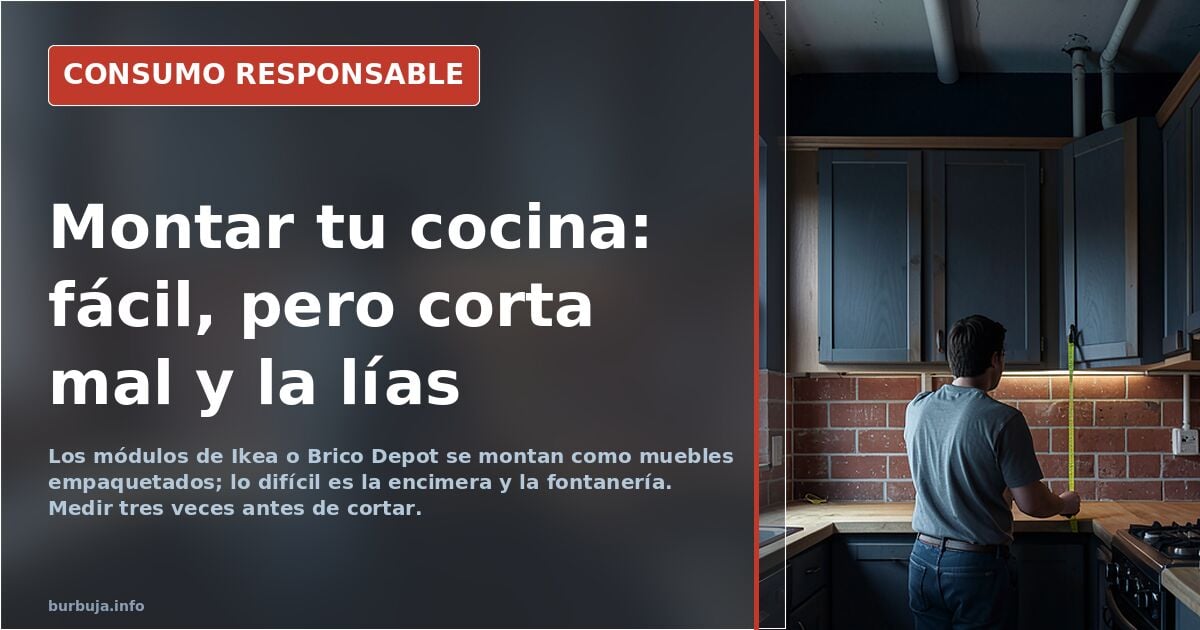
The €3,000 kitchen you can build yourself for half the price
According to the initial post, a typical store-bought kitchen costs around €3,000. With prefabricated modules from major retailers, the same space is resolved for much less, and assembly doesn't require a professional: it requires skill, tools, and above all, measuring three times before cutting. This is the consensus in discussions about whether self-building a kitchen is worthwhile, where disagreement isn't about difficulty but material quality.
The mechanics are those of any flat-pack furniture. Modules are placed in position, screwed to the wall, and joined together. The induction hob fits into the cutout and connects like any other appliance; the oven is similar. What truly complicates things is the countertop—hence many outsource it to a stone guason—and sink plumbing. One weekend is not enough unless the kitchen is tiny: some speak of three or four days with two people.
How much does it cost to assemble an IKEA or Brico Depot kitchen?
Savings aren't just in the furniture. IKEA's assembly service is charged separately and in one case amounts to €600, a figure many find disproportionate for screwing panels together. In contrast, using a van to transport items from the store is common, though without clear guarantees.
On quality, opinions vary. Some argue that IKEA modules are light-years ahead in ease of assembly and fit compared to other DIY chains, with screws that align and holes that exist. Others claim the opposite: that the particleboard in these kitchens is low-density, hinge holes wear out with use, and a warehouse supplier offers moisture-resistant and fire-retardant boards for slightly more. A key data point settles part of the debate: according to a forum user, IKEA hardware is Blum, the same brand used in high-end kitchens.
What tools are needed to assemble the kitchen?
Electric screwdriver, jigsaw, drill, level, and hammer. The list is short and cheap compared to paying for assembly. The real hurdle is prior design: calculating module combinations on paper, measuring the room at bottom, middle, and top levels—walls aren't straight—and deciding where burners, sink, and dishwasher go based on outlets. An online configurator helps generate the complete parts list, including items no one would have thought of.
The costly mistake is obvious: over-cutting a piece cannot be undone. Stone countertops also pose logistical challenges, such as carrying them up stairs when they don't fit in the elevator.
How long does a budget kitchen last compared to a branded one?
Here arises the uncomfortable comparison. A forty-year-old kitchen still stands with some hardware replaced; appliances from then are on their second round. Against this, it is argued that no kitchen is an inheritable bronze mirror: all wear out with heat, impacts, and daily use, requiring renewal after years. The budget kitchen, viewed through this lens, is a way to lower depreciation, not a compromise.
The prediction, with reservations: prefabricated modules will continue gaining ground as long as professional assembly is priced like construction work. What remains unclear is whether the board will last as long as older materials did.
Also available in: Deutsch
Summary of a discussion on Burbuja.info - Foro de economía, actualidad y política., translated from Spanish and reviewed before publication. Read the full discussion (23 replies).
More summaries
-
Ikea or Leroy Merlin kitchen: assembly is what decides the price
Forum debate: Ikea stands out for hardware and warranty, Leroy Merlin for variety, Bricomart for price. The real cost depends on who assembles the units.
-
Bricodepot kitchen: cheap, but you can feel it
A forum user argues that Bricodepot is cheap but low quality. Assembly at Leroy was quoted at 500 euros, plus another 100 for delivery.
-
Drywall at €2.45/m2: the trap of insulating a damp house
Drywall board at €2.45/m2 at Brico Depot and XPS at €3.25/m2: the prices don't solve rising damp or condensation in a stone house without a cavity.
-
El Corte Inglés prepared food: quality at a price
El Corte Inglés croquettes beat Mercadona's, but prices like €21/kg for meat rolls mean it's only worth it for some products.
-
Bulova Curv at €399: Deal Raises Questions
A Bulova Curv priced at €399 vs. the usual €750-950: 45mm case, Precisionist movement, and doubts about the chronograph seconds hand.
-
Renault Captur dCi 90: Fuel Economy and Diesel Concerns
Users question if the 5 l/100 km figure is realistic, while criticizing interior plastics and drum brakes amid potential diesel restrictions.