
Dacia Sandero Stepway: €9,000 and plenty of doubts
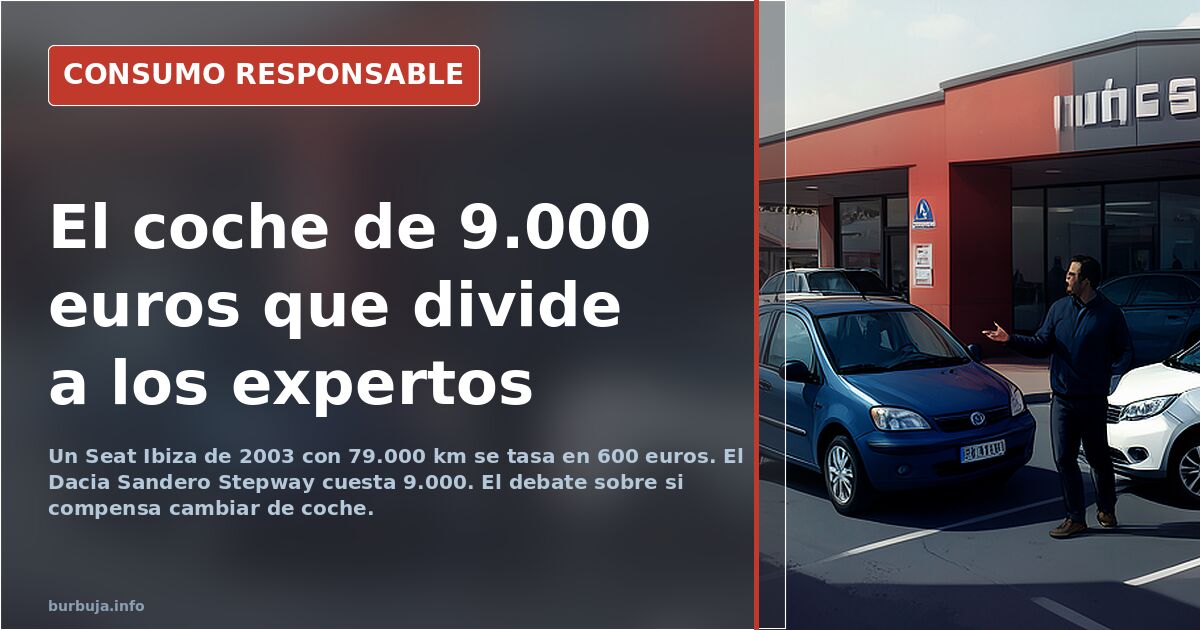
A 2003 Seat Ibiza with 79,000 km is valued at just €600, while a Dacia Sandero Stepway costs €9,000. The debate over whether changing cars is worth it.
English · Original discussion in Spanish · Published
Dacia Sandero Stepway: €9,000 and plenty of doubts
The owner of a 2003 Seat Ibiza with 79,000 kilometres faces a financial decision many drivers will recognise: spend €2,000 repairing the bodywork and paint of a car that, by his own account, isn't worth even €1,000 on the market, or take advantage of the Plan PIVE 3 (a Spanish scrappage incentive scheme) to buy a Dacia Sandero Stepway with air conditioning for €9,000. The question is far from trivial: the PIVE contributes €2,000, but the trade-in car is valued at just €600, and according to the author's experience at a dealership, the new model shoots up to €12,000 once basic extras are added.
The conversation soon turns to product quality. Some argue that Dacias are eighties cars at nineties prices, with poor finishes and rear drum brakes even on the most expensive versions. On the other side, the reliability data from OCU (the Spanish consumer organisation) cited in the thread rank Dacia as the brand that visits the workshop least, and the owner of a 90 hp diesel Sandero defends his purchase: "It's missing nothing." The problem is that the Stepway isn't an SUV: it's a raised hatchback with plastic cladding.
The economic analysis in the thread is ruthless. One forum member calculates that repairing the Ibiza costs €800; buying the Dacia, €9,000. Ten times as much for a car that, in his view, is neither bigger, nor more powerful, nor less thirsty. The only real advantage is the ride height and the rugged look, which in the city means fewer scares with kerbs. But the outlay is only justified if the old car is truly on its last legs, and here the mileage works against it: 79,000 kilometres is a brand-new engine. The thread author's final decision was to wait. The Dacia, with air conditioning and a spare wheel, was heading towards €12,000. "That's deceiving people," he concludes.
The Plan PIVE and the final-price trap
The Plan PIVE 3 is presented as a €2,000 incentive, but the trade-in car has a residual value the market doesn't recognise. The 2003 Ibiza, with 79,000 kilometres, is valued at €600 by dealerships, even though it's advertised for between €2,500 and €3,000 on second-hand portals. The gap between the asking price and the real selling price is huge: the owner tried to sell it for €2,500 and nobody bought it. "I was even offered a PS3 with games in exchange," he jokes.
The real cost of the deal isn't €9,000, but €9,000 plus whatever you fail to get for the old car. If the Ibiza could be sold for €2,500, the net outlay would be €6,500. But it doesn't sell. The PIVE, therefore, isn't an incentive: it's a disguised bailout of the residual value. The conclusion is that the new car costs €9,000 and the old one is given away.
Dacia quality: between reliability and plastic
OCU ranks Dacia as the brand with the fewest breakdowns, alongside Honda, Kia, Toyota and Subaru. The argument is mechanical simplicity: less equipment, fewer things to break. But perceived quality is another matter. A mechanic consulted in the thread describes the Dacia's underbody as "chilling", reminiscent of the old R-7 and four tin cans. The seats are hard, the plastics don't fit properly and the engine noise sounds like a farm vehicle.
The Sandero Stepway adds height and cladding, but no all-wheel drive. It's a living-room "soft-roader": good for paved trails and for parking without antiestéticar of kerbs. For real off-road use, the thread recommends a second-hand Japanese car, like a RAV4. Safety is also debated: the rear drum brakes are enough for 90 hp, but not for demanding use. The conclusion is that the Dacia is fine for the city, but not for anyone seeking performance.
Alternatives: Kia, Skoda and the temptation of used cars
The thread offers a bouquet of alternatives. The 105 hp Kia Ceed was bought for €12,600 after haggling, with a seven-year warranty. The 60 hp Skoda Fabia comes in at €8,000 and, according to one owner, "reaches 160 km/h without breaking a sweat". The Renault Clio III comes to €8,416. These are cars with better finishes and similar prices. The question is whether it's worth paying €1,000 more for a product that doesn't feel like plastic.
The answer depends on usage. For city driving and short trips, the Dacia is rational. For long journeys, the thread agrees it's uncomfortable and noisy. The author's final decision was to wait. The PIVE expires, but the old car keeps going. And with 79,000 kilometres, the engine has plenty of life left in it.
The qualified prediction: if the PIVE disappears, the used-car market will adjust and old cars will be worth what they're actually worth. Meanwhile, the Dacia Sandero Stepway will remain Spain's best-selling car, according to August figures. Not because it's good, but because it's cheap. And in times of crisis, that's what counts.
Also available in: Deutsch
Summary of a discussion on Burbuja.info - Foro de economía, actualidad y política., translated from Spanish and reviewed before publication. Read the full discussion (61 replies).
More summaries
-
Dacia Sandero vs Skoda Fabia: GLP and the automatic transmission dilemma
The GLP Sandero promises an ECO label and low running costs, but lacks an automatic gearbox—the deciding factor between the Dacia and the Skoda Fabia.
-
Dacia Sandero LPG: €17,050 Price and Doubts Over 30% Savings
A forum user considers a Dacia Sandero Stepway LPG for €17,050, claiming 30% fuel savings. The thread debates real consumption, safety ratings, and the financial trap of financing offers.
-
Dacia Sandero: €500 gap between new and high-mileage used
A Dacia Sandero km0 costs €9,570 vs €8,500 for one with 60,000 km. Financing inflates the final price to €14,100.
-
White-label vs. name-brand air conditioners: which should you buy?
Is it worth paying double for a Mitsubishi or Daikin? 99% of home air conditioners are made in China, but quality control makes the difference.
-
The bachelor fridge: harmless joke or a health warning?
The single person's fridge, packed with ultra-processed foods, is a symbol of freedom with a hidden cost to health and finances. An analysis of a food phenomenon in Spain.
-
Primark sales soar 17% in Spain as bargain hunting wins out
Primark grows 17% in Spain with rock-bottom prices: shirts at €7. The debate over extreme bargain hunting pits low-cost fans against critics of exploitation.