
Record bank profits in Spain widen inequality gap
Santander pays €840m dividends as four Spanish banks cut 14,759 jobs amid record earnings.
English · Original discussion in Spanish · Published
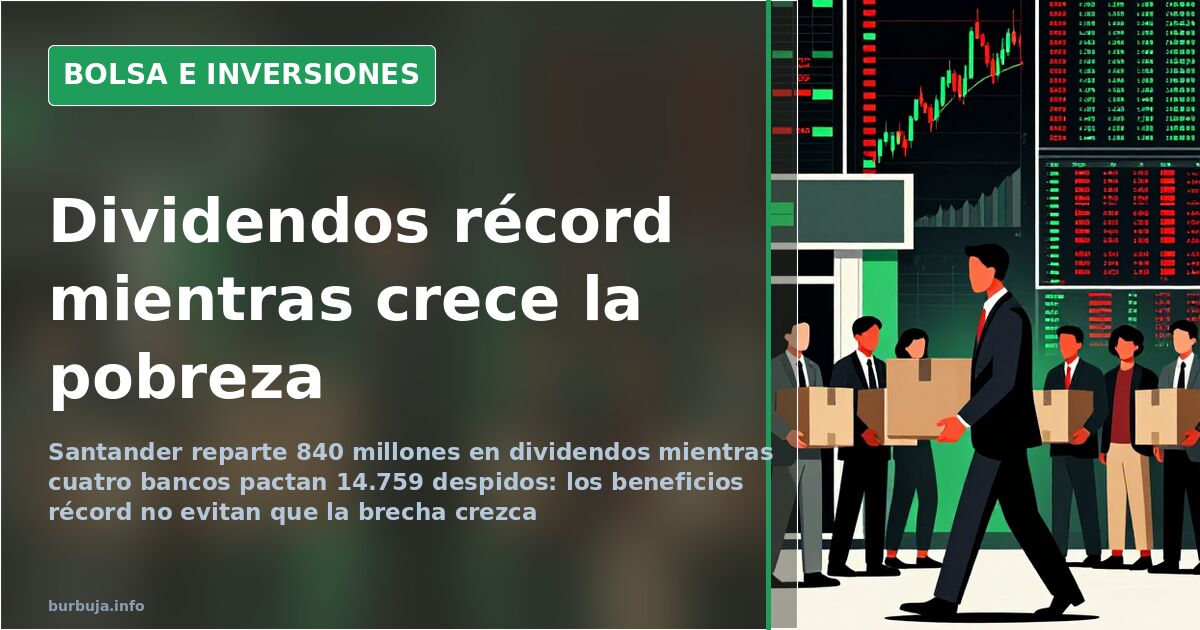
Record profits and rising poverty: the widening gap
While Banco Santander distributed €840 million in cash to shareholders, four major Spanish institutions—Santander, Sabadell, BBVA, and CaixaBank—agreed on 14,759 layoffs. Profits are accumulating: €3.675 billion attributed profit for Santander in H1 2021, €832 million for Endesa, €727 million for Mercadona, €383 million for Naturgy, and €1.911 billion for BBVA. Inditex also posted historic highs in sales, profit, and cash flow, while Aramco doubled its third-quarter profits. Meanwhile, millions of people find a hot shower a luxury. The question is not if the data is true, but why this happens repeatedly.
The crisis business model: fewer staff, higher margins
The logic is old and effective: the worse things go for the majority, the better they go for the bottom line. The pandemic served as an excuse for Spanish banks to implement restructuring long desired: fewer branches, reduced services, and mass layoffs. Staff cuts translate almost immediately into profit, and with high banking concentration, customers have no choice but to accept poorer service.
This is compounded by ownership structures that distribute results among very few. Large companies operate like cards held by a handful of wealthy families who play all numbers: a key shareholder in a telecom firm is often directly or indirectly a shareholder in a bank; that bank holds stakes in tech firms; those tech firms hold stakes in pharmaceuticals or defense industries. When one card loses value, others compensate.
The merit thesis: save, invest, never touch principal
Here appears the other half of the argument, pointing downward. The recipe is repeated until exhaustion and has four steps:
It’s the same mechanic as buying an apartment, renting it out, and living off the income. The cultural reference is "Rich Dad Poor Dad," whose harshest version claims those who remain poor do so because they don’t save, spend unnecessarily, or get into debt. It’s claimed that 80% of lottery winners end up bankrupt within three years: a figure launched without source, functioning as opinion dressed as data.
Against the objection that investing doesn’t pay off, some argue low-fee funds exist and that the real bite comes from tax on savings, with rates between 19% and 26% on capital returns. The full breakdown of the snowball effect, with timelines and annual reinvestment, separates theory from real results.
Born investor or learned?
The most repeated anecdote is domestic: two brothers, same home, same education, same allowance. One saved every penny; the other spent it on the first thing that crossed his path. Years later, the first has nearly everything invested and keeps saving; the second can’t make ends meet and asks for money. From this, it’s concluded that the investor mindset isn’t taught, it’s innate.
The counterargument focuses on starting points. Large fortunes rarely start from zero: they come from rich or comfortable families, with early financial education and risk capacity. An average salary, saved with effort, goes nowhere far no matter how much you invest. And once wealth exists, each euro works harder and better than the first.
Four developers, small GDP, and a ton of wheat
The other axis is productivity. Some claim four developers can build a global hit product in months: producing like small countries. Previously, a factory and workforce were needed; now, just a good team and global scale. Hence, according to this argument, wealth concentrates in fewer hands.
The repeated example is Jeff Bezos, with an estimated fortune of $200 billion. He controls more than Amazon: he’s attributed about fifteen companies, including Blue Origin and "The Washington Post." Eight billionaires—from Bill Gates to Amancio Ortega, Warren Buffett to Mark Zuckerberg—accumulate more money than the poorest half of the planet, and 25 families move close to [$1.1 trillion](#).
Others temper productivity enthusiasm with common sense: if GDP grows while real consumption of goods and services falls, part of growth is accounting fiction. A rich person can’t eat a ton of wheat a day, no matter how much money they have. And the cycle peine in 2008 reads thus: falling wages, rising unemployment, and a crisis that, unlike classic ones, didn’t empty supermarkets.
The diversion: immigration, voting, and IQ
When diagnosis becomes uncomfortable, conversation shifts sideways. Part of interventions moves the problem to migrant population arrival and how neighborhoods where they concentrate vote. In response, demographic data is cited: Spain hasn’t significantly increased population in two decades, and newcomers prosper when given opportunity; the UK case is mentioned, with jobs left vacant after migrant workers’ departure. Other messages, providing no sources, directly discredit voters and speculate on population IQ.
Merit, structure, or both?
Numbers admit no discussion: record profits on one side, growing gap on the other, and banks laying off while paying dividends. What remains unanswered is responsibility distribution. Is inequality the result of thousands of personal decisions, a structure concentrating capital in fewer hands, or an inevitable mix of both? With data before us, the question still lacks a universally satisfying answer.
While Banco Santander distributed €840 million in cash to shareholders, four major Spanish institutions—Santander, Sabadell, BBVA, and CaixaBank—agreed on 14,759 layoffs. Profits are accumulating: €3.675 billion attributed profit for Santander in H1 2021, €832 million for Endesa, €727 million for Mercadona, €383 million for Naturgy, and €1.911 billion for BBVA. Inditex also posted historic highs in sales, profit, and cash flow, while Aramco doubled its third-quarter profits. Meanwhile, millions of people find a hot shower a luxury. The question is not if the data is true, but why this happens repeatedly.
The crisis business model: fewer staff, higher margins
The logic is old and effective: the worse things go for the majority, the better they go for the bottom line. The pandemic served as an excuse for Spanish banks to implement restructuring long desired: fewer branches, reduced services, and mass layoffs. Staff cuts translate almost immediately into profit, and with high banking concentration, customers have no choice but to accept poorer service.
This is compounded by ownership structures that distribute results among very few. Large companies operate like cards held by a handful of wealthy families who play all numbers: a key shareholder in a telecom firm is often directly or indirectly a shareholder in a bank; that bank holds stakes in tech firms; those tech firms hold stakes in pharmaceuticals or defense industries. When one card loses value, others compensate.
The merit thesis: save, invest, never touch principal
Here appears the other half of the argument, pointing downward. The recipe is repeated until exhaustion and has four steps:
- Save money and put it into something that pays dividends.
- Reinvest every dividend as if it were new savings.
- Let time pass until dividends cover part or all expenses.
- Never touch the principal.
It’s the same mechanic as buying an apartment, renting it out, and living off the income. The cultural reference is "Rich Dad Poor Dad," whose harshest version claims those who remain poor do so because they don’t save, spend unnecessarily, or get into debt. It’s claimed that 80% of lottery winners end up bankrupt within three years: a figure launched without source, functioning as opinion dressed as data.
Against the objection that investing doesn’t pay off, some argue low-fee funds exist and that the real bite comes from tax on savings, with rates between 19% and 26% on capital returns. The full breakdown of the snowball effect, with timelines and annual reinvestment, separates theory from real results.
Born investor or learned?
The most repeated anecdote is domestic: two brothers, same home, same education, same allowance. One saved every penny; the other spent it on the first thing that crossed his path. Years later, the first has nearly everything invested and keeps saving; the second can’t make ends meet and asks for money. From this, it’s concluded that the investor mindset isn’t taught, it’s innate.
The counterargument focuses on starting points. Large fortunes rarely start from zero: they come from rich or comfortable families, with early financial education and risk capacity. An average salary, saved with effort, goes nowhere far no matter how much you invest. And once wealth exists, each euro works harder and better than the first.
Four developers, small GDP, and a ton of wheat
The other axis is productivity. Some claim four developers can build a global hit product in months: producing like small countries. Previously, a factory and workforce were needed; now, just a good team and global scale. Hence, according to this argument, wealth concentrates in fewer hands.
The repeated example is Jeff Bezos, with an estimated fortune of $200 billion. He controls more than Amazon: he’s attributed about fifteen companies, including Blue Origin and "The Washington Post." Eight billionaires—from Bill Gates to Amancio Ortega, Warren Buffett to Mark Zuckerberg—accumulate more money than the poorest half of the planet, and 25 families move close to [$1.1 trillion](#).
Others temper productivity enthusiasm with common sense: if GDP grows while real consumption of goods and services falls, part of growth is accounting fiction. A rich person can’t eat a ton of wheat a day, no matter how much money they have. And the cycle peine in 2008 reads thus: falling wages, rising unemployment, and a crisis that, unlike classic ones, didn’t empty supermarkets.
The diversion: immigration, voting, and IQ
When diagnosis becomes uncomfortable, conversation shifts sideways. Part of interventions moves the problem to migrant population arrival and how neighborhoods where they concentrate vote. In response, demographic data is cited: Spain hasn’t significantly increased population in two decades, and newcomers prosper when given opportunity; the UK case is mentioned, with jobs left vacant after migrant workers’ departure. Other messages, providing no sources, directly discredit voters and speculate on population IQ.
Merit, structure, or both?
Numbers admit no discussion: record profits on one side, growing gap on the other, and banks laying off while paying dividends. What remains unanswered is responsibility distribution. Is inequality the result of thousands of personal decisions, a structure concentrating capital in fewer hands, or an inevitable mix of both? With data before us, the question still lacks a universally satisfying answer.
Also available in: Deutsch
Summary of a discussion on Burbuja.info - Foro de economía, actualidad y política., translated from Spanish and reviewed before publication. Read the full discussion (129 replies).
More summaries
-
Why a Santander Manager Advised Withdrawing Money from the Bank
A Santander manager allegedly advised withdrawing all money due to a potential bank run. What happens to 10,000 euros and savings over 100,000?
-
ING and the ATM war: the 2 euros nobody wants to pay
CaixaBank, Santander and BBVA charge 2 euros for withdrawals at third-party ATMs. ING must decide whether to absorb the ATM fee or pass it on to its three million clients.
-
Extra virgin olive oil falls to €6.35 a litre at Mercadona
Extra virgin olive oil is now €6.35/litre at Mercadona, down from €6.75 months ago, while the origin price of picual is €4.143/kg
-
Invertir desde Cero course reviews: useful but basic
Students call the stock market course introductory, not advanced: one month of classes and a year of monthly sessions.
-
Paramés Criticized for Losing Half of Fund Capital
Cobas Internacional faces over three years of losses, with critics claiming a 50% capital drop and divergence from indices.
-
Spain: Youth Survives Poverty, Old Age Does Not
In Spain, young people cope with low funds; middle-aged adults cannot. Early savings, renting at 50, and uncertain pensions are key issues.