
Why a Santander Manager Advised Withdrawing Money from the Bank
A Santander manager allegedly advised withdrawing all money due to a potential bank run. What happens to 10,000 euros and savings over 100,000?
English · Original discussion in Spanish · Published
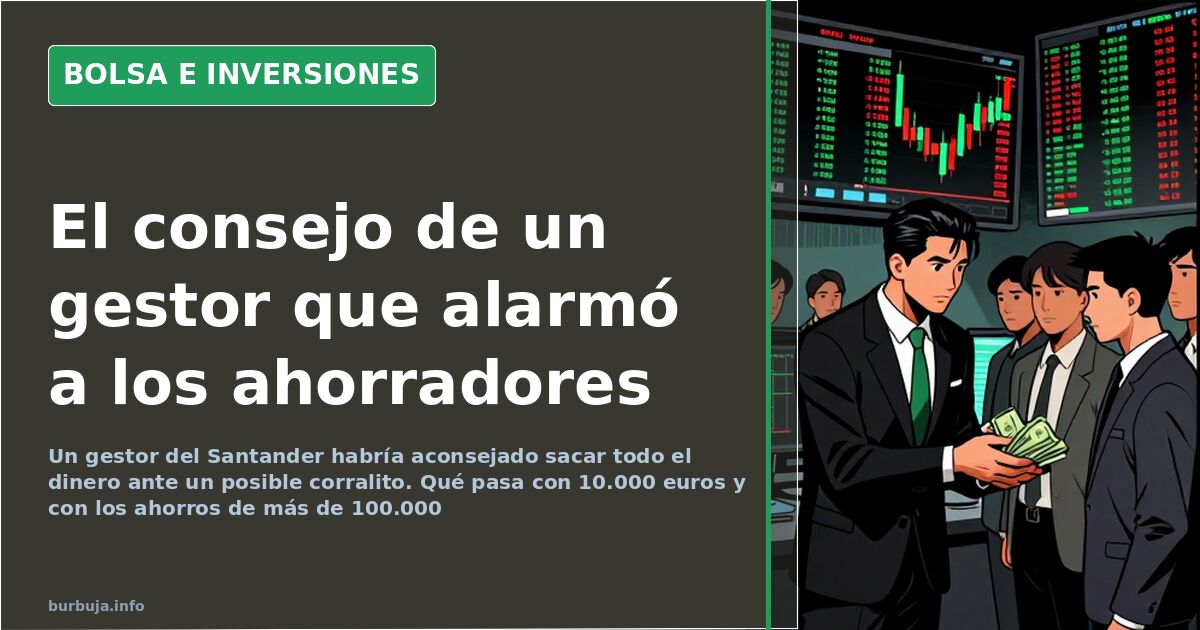
The bank run a Santander manager advised anticipating
Can a bank manager privately advise you to empty your account? The scene is recounted by a saver with 10,000 euros in the bank: a manager at Banco Santander, whom he presents as a friend, allegedly recommended withdrawing all his money "as soon as possible" due to a potential bank run. Alarm spread. And the matter, like almost everything that smells of panic, is much grayer than it seems.
What is a bank run and how does it differ from a haircut
Here's the key that almost no one separates. A bank run is a temporary freeze on transactions and cash withdrawals, decreed from one weekend to another to catch people off guard. A haircut is something else: the state or the bank takes a portion of the balance, directly. The first prevents you from accessing your money; the second reduces it.
The manual summarizes it without embellishments: in Cyprus, the reference no one can shake off, there was talk of haircuts of 50% on accounts over 100,000 euros and 25% on those over 25,000. A saver puts it with crushing logic: that they don't let you withdraw your cash, okay; that they cut it, it hurts a lot more. The cause of both phenomena is the same and sounds ugly when spoken aloud: capitalization of the banking system.
The 100,000 euro threshold and what happens with 10,000
The specific question was twofold and the circulating answer is almost unanimous: 10,000 euro accounts will not be touched; the focus would be on assets above 100,000 euros per person and entity. The nuance matters because it explains why antiestéticar spreads among those who have the least to lose and the most at stake: the small saver is the one who least tolerates a reduction of a hundred euros.
Some take it to the extreme and argue that large fortunes already move their money out long before anything is decreed, and that the blow, if it comes, always falls on the side of those who save penny by penny. The comparison with Cyprus comes up again and again. And with it, the uncomfortable question: does anyone believe that, if this goes south in the spring, they will just let people withdraw their cash?
Does financial panic crime exist?
It appeared early, as a threat. Whoever warned was accused of committing a supposed financial panic crime. The response, dryly, was that such a figure is not typified as such in Spain and that whoever spreads an alert commits no offense by doing so.
The exchange devolved into something much less edifying: exchanges of insults, mutual accusations of lying, and threats of lawsuits. What is relevant, beyond the noise, is that the discussion about the bank run is based on interpretations, not on a resolution or a royal decree confirming anything.
The political background: Article 128 and the shadow of Greece
The fuel for antiestéticar is political rather than economic. Part of the analysis links the antiestéticar to Article 128 of the Constitution, which allows private property to be subordinated to the general interest, and to statements from the Government that are read as a warning. The other half points to Brussels and the ECB: with the debt that Spain carries in euros, breaking away and setting up its own currency is a direct ticket to a Venezuela-type scenario.
There, the Greek route—negotiate, yield, tighten the belt—enters as the only path that does not end in a bank run. The alternative scenario, leaving the euro, is ruled out as unfeasible: there would not be enough paper to print a new currency capable of paying the interest on that debt. And in the background, a certainty that almost everyone shares: whatever happens, taxes will go up, and they will go up a lot.
The manager who is never your friend
The most repeated thesis is not about economics, it's about incentives. An office manager is, basically, a salesperson: their salary is not paid by the saver, it's paid by their boss. That's why the recommendation to withdraw money is viewed with suspicion. Are they looking out for the client's best interest or preparing the ground to sell them something?
The most cynical answer reveals an uncomfortable truth: if tomorrow they convince you otherwise, it won't matter. The recommendation started as "withdraw everything," later qualified with "I didn't tell you to run." That readjustment, in itself, explains why no one should make a financial decision based on what the person at the counter whispers to them.
In the end, the advice that unleashed all this amounts to nothing: no confirmed bank run, no haircut in sight. Just a manager with an argument, a few savers looking at their accounts askance, and a question that remains officially unanswered. Reassuring, right?
Can a bank manager privately advise you to empty your account? The scene is recounted by a saver with 10,000 euros in the bank: a manager at Banco Santander, whom he presents as a friend, allegedly recommended withdrawing all his money "as soon as possible" due to a potential bank run. Alarm spread. And the matter, like almost everything that smells of panic, is much grayer than it seems.
What is a bank run and how does it differ from a haircut
Here's the key that almost no one separates. A bank run is a temporary freeze on transactions and cash withdrawals, decreed from one weekend to another to catch people off guard. A haircut is something else: the state or the bank takes a portion of the balance, directly. The first prevents you from accessing your money; the second reduces it.
The manual summarizes it without embellishments: in Cyprus, the reference no one can shake off, there was talk of haircuts of 50% on accounts over 100,000 euros and 25% on those over 25,000. A saver puts it with crushing logic: that they don't let you withdraw your cash, okay; that they cut it, it hurts a lot more. The cause of both phenomena is the same and sounds ugly when spoken aloud: capitalization of the banking system.
The 100,000 euro threshold and what happens with 10,000
The specific question was twofold and the circulating answer is almost unanimous: 10,000 euro accounts will not be touched; the focus would be on assets above 100,000 euros per person and entity. The nuance matters because it explains why antiestéticar spreads among those who have the least to lose and the most at stake: the small saver is the one who least tolerates a reduction of a hundred euros.
Some take it to the extreme and argue that large fortunes already move their money out long before anything is decreed, and that the blow, if it comes, always falls on the side of those who save penny by penny. The comparison with Cyprus comes up again and again. And with it, the uncomfortable question: does anyone believe that, if this goes south in the spring, they will just let people withdraw their cash?
Does financial panic crime exist?
It appeared early, as a threat. Whoever warned was accused of committing a supposed financial panic crime. The response, dryly, was that such a figure is not typified as such in Spain and that whoever spreads an alert commits no offense by doing so.
The exchange devolved into something much less edifying: exchanges of insults, mutual accusations of lying, and threats of lawsuits. What is relevant, beyond the noise, is that the discussion about the bank run is based on interpretations, not on a resolution or a royal decree confirming anything.
The political background: Article 128 and the shadow of Greece
The fuel for antiestéticar is political rather than economic. Part of the analysis links the antiestéticar to Article 128 of the Constitution, which allows private property to be subordinated to the general interest, and to statements from the Government that are read as a warning. The other half points to Brussels and the ECB: with the debt that Spain carries in euros, breaking away and setting up its own currency is a direct ticket to a Venezuela-type scenario.
There, the Greek route—negotiate, yield, tighten the belt—enters as the only path that does not end in a bank run. The alternative scenario, leaving the euro, is ruled out as unfeasible: there would not be enough paper to print a new currency capable of paying the interest on that debt. And in the background, a certainty that almost everyone shares: whatever happens, taxes will go up, and they will go up a lot.
The manager who is never your friend
The most repeated thesis is not about economics, it's about incentives. An office manager is, basically, a salesperson: their salary is not paid by the saver, it's paid by their boss. That's why the recommendation to withdraw money is viewed with suspicion. Are they looking out for the client's best interest or preparing the ground to sell them something?
The most cynical answer reveals an uncomfortable truth: if tomorrow they convince you otherwise, it won't matter. The recommendation started as "withdraw everything," later qualified with "I didn't tell you to run." That readjustment, in itself, explains why no one should make a financial decision based on what the person at the counter whispers to them.
In the end, the advice that unleashed all this amounts to nothing: no confirmed bank run, no haircut in sight. Just a manager with an argument, a few savers looking at their accounts askance, and a question that remains officially unanswered. Reassuring, right?
Summary of a discussion on Burbuja.info - Foro de economía, actualidad y política., translated from Spanish and reviewed before publication. Read the full discussion (240 replies).
More summaries
-
The AI Bubble: How Circular Payments Keep the S&P 500 Afloat
OpenAI has $550B in commitments but no profit, Oracle issues 6.85% debt, and the billing loop keeps the S&P 500 rising.
-
Gold stuck at 0.382 as bitcoin takes the spotlight
Gold stuck at 0.382 and unable to recover while bitcoin hits 6.000 dollars; thresholds at 1.250 and 1.050 set the scene.
-
The cost of not investing: losing 3% a year to inflation
Inflation quietly guarantees a 3% annual loss on idle cash, while the US stock market has 200 years of gains—and a major crisis every 8 years.
-
Extra virgin olive oil falls to €6.35 a litre at Mercadona
Extra virgin olive oil is now €6.35/litre at Mercadona, down from €6.75 months ago, while the origin price of picual is €4.143/kg
-
BIG offers 4% TAE on 6-month deposit with Spanish IBAN and Portuguese FGD
BIG launched a 4% TAE six-month and 3.5% three-month deposit in May 2023 with Spanish IBAN and Portuguese FGD, but later cut rates and had opening delays.
-
Spot-price coins: the seller whose paper trail didn't add up
He offered quarter-ounce gold coins at spot price and racked up undelivered orders. Buyers cross-checked his details and several got their money back.